Ou Xichao, Li Xiangchen, Pei Shaojun, Zhao Bing, Feng Liping, Teng Chong, Lu Yewei, Zhu Hanfang, Zhou Yang, Xia Hui, Liu Zhengwei, Wang Xiaomeng, Wang Yanling, Anthony Richard, Zhao Yanlin
National Key Laboratory of Intelligent Tracking and Forecasting for Infectious Diseases, National Center for Tuberculosis Control and Prevention, Chinese Center for Disease Control and Prevention, Beijing, China.
Key Laboratory of Precision Medicine in Diagnosis and Monitoring Research of Zhejiang Province, Hangzhou, Zhejiang, China.
Microbiol Spectr. 2025 Aug 5;13(8):e0016925. doi: 10.1128/spectrum.00169-25. Epub 2025 Jul 11.
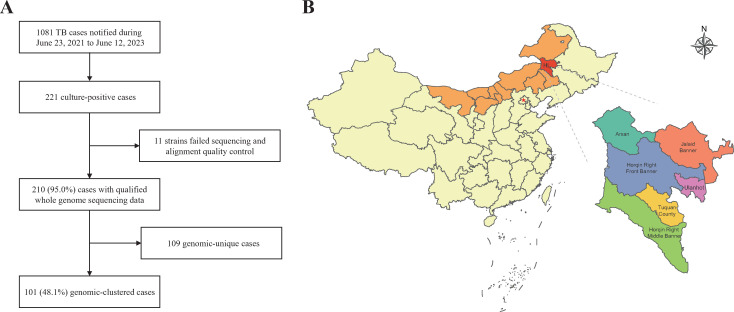
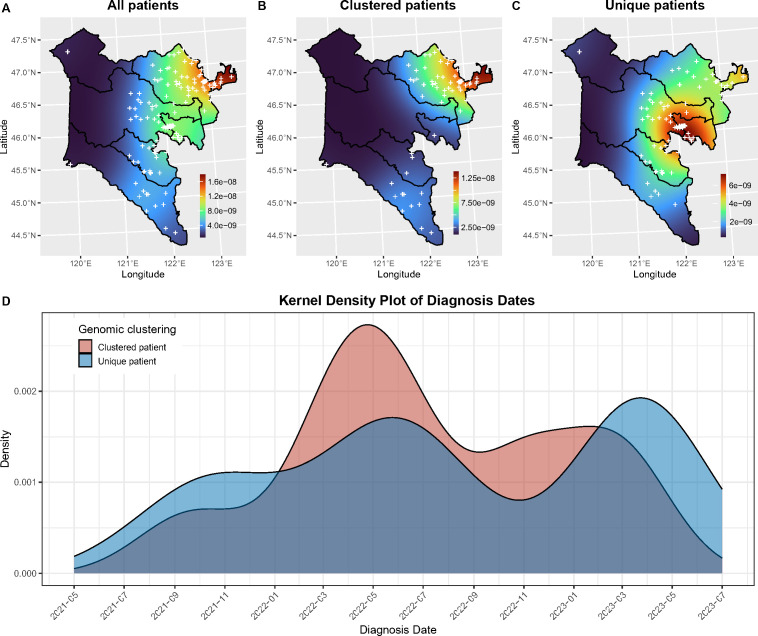
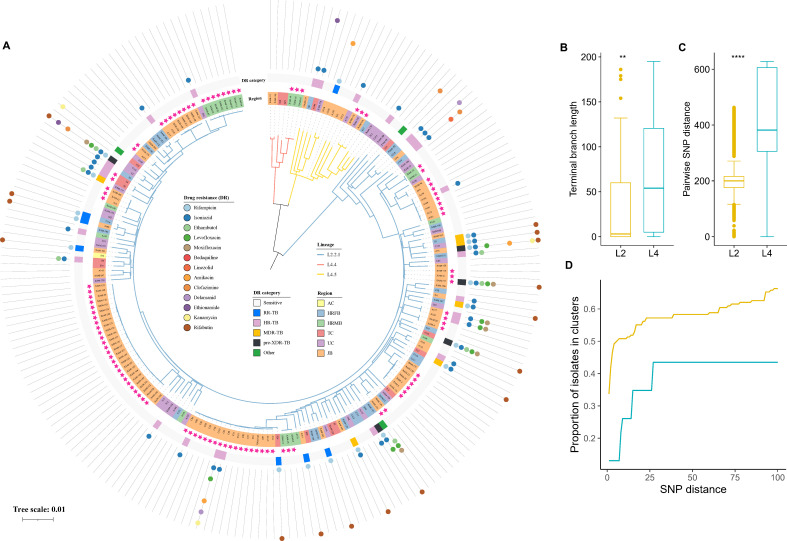
Tuberculosis (TB) remains a significant public health challenge in China, particularly in rural areas like Hinggan League (HL), Inner Mongolia. Understanding the genetic diversity and transmission dynamics of (MTB) strains is crucial for effective TB control. We conducted a prospective study from 2021 to 2023, sequencing 221 MTB isolates from HL. After quality control, 210 cases were analyzed. The genomic clustering rate was calculated to evaluate the level of recent transmission. Risk factors were identified by logistic regression analysis. Geospatial analysis was conducted with kernel density estimation. The majority of strains belonged to sub-lineage 2.2.1 in lineage 2 (L2), also known as the Beijing family (89.0%, 187/210), while the remainder belonged to lineage 4 (L4). L2 strains showed greater genetic similarity and shorter branch lengths compared with L4 strains. The overall drug resistance rate was 21.9%, with six multidrug-resistant TB (MDR-TB) and five pre-extensively drug resistant TB (pre-XDR-TB) cases identified. Almost half of the strains belonged to putative transmission clusters within 10 SNPs. Logistic regression analysis identified living in Jalaid Banner and being infected by L2 strains as significant risk factors for recent transmission. Spatial analysis identified spatial aggregation of TB cases in the eastern region of HL, with a hotspot for recent transmission in Jalaid Banner. The temporal distribution of TB cases in HL exhibited seasonal fluctuations, with diagnosis rates peaking in the first half of each year, and a notable increase in clustered cases in 2022. This study provides insights into the molecular epidemiology and transmission dynamics of TB in HL. Our results underscore the ongoing problem of TB transmission in rural settings, indicating the need for targeted interventions. These findings are vital for informing TB control strategies in HL and similar settings.Tuberculosis (TB) remains a major public health problem in China. This study provides insights into the molecular epidemiology and transmission dynamics of TB in rural areas (Hinggan League [HL], Inner Mongolia) in China. Nearly half of the enrolled TB cases were attributed to recent transmission, a proportion higher than that observed in other rural areas in China (31.4%), highlighting the significance of recent transmission in driving the TB epidemic in this region. Only 19.6% of all drug-resistant TB (DR-TB) cases were found within putative transmission clusters, indicating a lower proportion compared with the previous studies, which indicated that DR-TB is more associated with the evolution of resistance within patients. Spatial analysis showed that the TB epidemic was concentrated in densely populated areas in eastern HL. The findings identified epidemiological differences within HL, highlighting the importance of targeted interventions and surveillance to control the spread of TB in HL.
结核病在中国仍然是一项重大的公共卫生挑战,尤其是在内蒙古兴安盟等农村地区。了解结核分枝杆菌(MTB)菌株的遗传多样性和传播动态对于有效控制结核病至关重要。我们在2021年至2023年进行了一项前瞻性研究,对来自兴安盟的221株MTB分离株进行测序。经过质量控制后,对210例病例进行了分析。计算基因组聚类率以评估近期传播水平。通过逻辑回归分析确定风险因素。采用核密度估计进行地理空间分析。大多数菌株属于2系(L2)中的2.2.1亚系,也称为北京家族(89.0%,187/210),其余属于4系(L4)。与L4菌株相比,L2菌株显示出更高的遗传相似性和更短的分支长度。总体耐药率为21.9%,鉴定出6例耐多药结核病(MDR-TB)和5例广泛耐药结核病前体(pre-XDR-TB)病例。几乎一半的菌株属于10个单核苷酸多态性(SNP)范围内的假定传播簇。逻辑回归分析确定居住在扎赉特旗和感染L2菌株是近期传播的重要风险因素。空间分析确定兴安盟东部地区结核病病例存在空间聚集,扎赉特旗是近期传播的热点地区。兴安盟结核病病例的时间分布呈现季节性波动,诊断率在每年上半年达到峰值,2022年聚集病例显著增加。本研究深入了解了兴安盟结核病的分子流行病学和传播动态。我们的结果强调了农村地区结核病传播这一持续存在的问题,表明需要有针对性的干预措施。这些发现对于为兴安盟及类似地区的结核病控制策略提供信息至关重要。结核病在中国仍然是一个主要的公共卫生问题。本研究深入了解了中国农村地区(内蒙古兴安盟)结核病的分子流行病学和传播动态。近一半的登记结核病病例归因于近期传播,这一比例高于中国其他农村地区(31.4%),突出了近期传播在推动该地区结核病流行中的重要性。在假定的传播簇中仅发现19.6%的耐多药结核病(DR-TB)病例,表明与先前研究相比比例较低,先前研究表明DR-TB与患者体内耐药性的演变更相关。空间分析表明,结核病流行集中在兴安盟东部人口密集地区。这些发现确定了兴安盟内部的流行病学差异,突出了有针对性的干预措施和监测对于控制兴安盟结核病传播的重要性。