Pedrosa Antônio Eulálio, de Azevedo Gustavo Borges Laurindo, Cardoso Jessica Vilarinho, Guimarães João Antonio Matheus, Defino Helton Luiz Aparecido, Perini Jamila Alessandra
Spine Surgery Center, National Institute of Traumatology and Orthopaedics (INTO), Rio de Janeiro, RJ.
Departments of Orthopaedic and Anesthesiology, Ribeirão Preto Medical School, University of São Paulo, de São Paulo-Brazil, Brazil.
J Craniovertebr Junction Spine. 2022 Jul-Sep;13(3):318-324. doi: 10.4103/jcvjs.jcvjs_54_22. Epub 2022 Sep 14.
Association of genetic polymorphisms in paired box 1 () gene can influence the development of adolescent idiopathic scoliosis (AIS). PAX-1 is mainly expressed in the region of the vertebral bodies and intervertebral discs, being important for the proper formation of spinal structures.
The objective of this study was to evaluate the association of polymorphisms in gene with the susceptibility of AIS.
This was an analytical observational case-control study.
Samples of 59 AIS indicated for surgical treatment, and 119 controls, without spinal disease were genotyped for rs6137473 and rs169311 polymorphisms.
The association of the polymorphisms with AIS was evaluated by a multivariable logistic regression model, using odds ratios (OR) and 95% confidence intervals (CI).
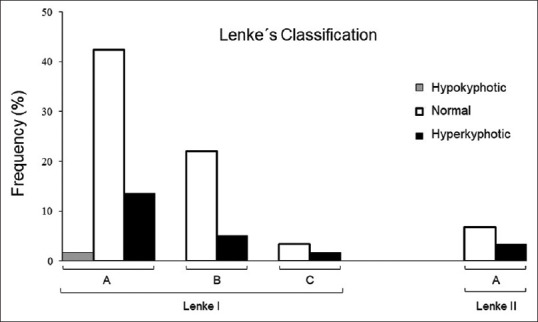
According to Lenke's classification, 89.8% had Type I and 10.2% II curves. The mean value of the Cobb angle of the proximal thoracic curve was 30.8°, 58.7° thoracic, and 30.4° for the lumbar and on the bending films 14.6°, 40.7°, and 11°, respectively. Among the AIS group, there was a predominance of females (8.8:1). The rs169311 and rs6137473 polymorphisms were positively associated with developing the AIS (OR = 1.98; 95% CI = 1.2-3.3 and OR = 3.16; 95% CI = 1.4-7.3, respectively). The rs6137473 polymorphism was associated with the lumbar modifier B and C compared to A (OR = 2.52; 95% CI = 1.1-5.8).
polymorphisms were associated with an increased risk of developing the AIS and with curve severity and can be used as a biomarker to map the risk of developing surgical-grade AIS, guiding the treatment of patients.
配对盒1(PAX-1)基因的遗传多态性关联可能影响青少年特发性脊柱侧凸(AIS)的发展。PAX-1主要在椎体和椎间盘区域表达,对脊柱结构的正常形成很重要。
本研究的目的是评估PAX-1基因多态性与AIS易感性的关联。
这是一项分析性观察性病例对照研究。
对59例接受手术治疗的AIS患者样本和119例无脊柱疾病的对照样本进行PAX-1基因rs6137473和rs169311多态性基因分型。
使用多变量逻辑回归模型,通过比值比(OR)和95%置信区间(CI)评估多态性与AIS的关联。
根据Lenke分类,89.8%为I型曲线,10.2%为II型曲线。近端胸椎曲线的Cobb角平均值为30.8°,胸椎为58.7°,腰椎为30.4°,在弯曲位片上分别为14.6°、40.7°和11°。在AIS组中,女性占主导(8.8:1)。PAX-1基因rs169311和rs6137473多态性与AIS的发生呈正相关(OR分别为1.98;95%CI = 1.2 - 3.3和OR = 3.16;95%CI = 1.4 - 7.3)。与A相比,rs6137473多态性与腰椎修正型B和C相关(OR = 2.52;95%CI = 1.1 - 5.8)。
PAX-1基因多态性与AIS发生风险增加及曲线严重程度相关,可作为一种生物标志物来评估手术级AIS的发生风险,指导患者治疗。