Research Center of Clinical Medicine, Affiliated Hospital of Nantong University, Nantong 226001, P.R. China.
School of Medicine, Nantong University, Nantong 226001, P.R. China.
Int J Biol Sci. 2022 Jan 1;18(3):1022-1038. doi: 10.7150/ijbs.68179. eCollection 2022.
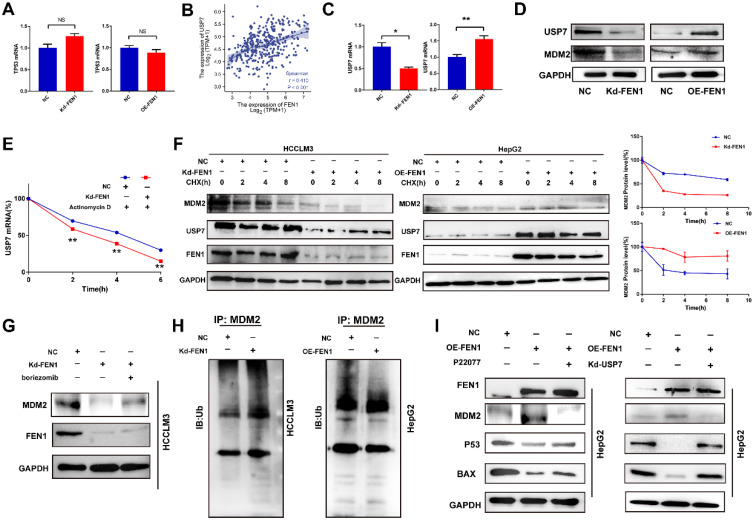
Overexpression of Flap endonuclease 1 (FEN1) has been previously implicated in hepatocellular carcinoma (HCC), while its expression features and mechanisms remain unclear. In the current study, differential expression genes (DEGs) were screened in HCC tissues and normal liver tissues in 4 Gene Expression Omnibus (GEO) datasets. FEN1, one of the hub co-overexpressed genes, was further determined overexpressed in HCC tissues in TCGA, local HCC cohorts, and hepatocarcinogenesis model. In addition, high expression of FEN1 indicated poor prognosis of HCC patients. Loss-of-function and gain-of-function assays demonstrated that FEN1 enhanced the proliferation, cell cycle phage transition, migration/ invasion, therapy resistance, xenograft growth, and epithelial-mesenchymal transition (EMT) process of HCC cells. Mechanically, FEN1 could inactivate P53 signaling by preventing the ubiquitination and degradation of mouse double minute 2 (MDM2) via recruiting ubiquitin-specific protease 7 (USP7). Interfering USP7 with P22077 significantly reversed the malignant phenotypes activated by FEN1. In conclusion, this study suggests FEN1 as a robust prognostic biomarker and potential target for HCC.
Flap endonuclease 1 (FEN1) 的过表达先前被牵连到肝细胞癌 (HCC) 中,而其表达特征和机制尚不清楚。在本研究中,在 4 个基因表达综合 (GEO) 数据集的 HCC 组织和正常肝组织中筛选差异表达基因 (DEGs)。FEN1 是核心共过表达基因之一,在 TCGA、局部 HCC 队列和肝癌发生模型中进一步确定在 HCC 组织中过表达。此外,FEN1 的高表达表明 HCC 患者的预后不良。功能丧失和功能获得实验表明,FEN1 通过招募泛素特异性蛋白酶 7 (USP7) 来阻止鼠双微基因 2 (MDM2) 的泛素化和降解,从而增强 HCC 细胞的增殖、细胞周期相位转变、迁移/侵袭、治疗耐药性、异种移植物生长和上皮-间充质转化 (EMT) 过程。在机制上,FEN1 可以通过招募泛素特异性蛋白酶 7 (USP7) 来防止鼠双微基因 2 (MDM2) 的泛素化和降解,从而使 P53 信号失活。用 P22077 干扰 USP7 显著逆转了由 FEN1 激活的恶性表型。总之,本研究表明 FEN1 可作为 HCC 的强有力的预后生物标志物和潜在的治疗靶点。