Steffens Maryke S, Dunn Adam G, Leask Julie, Wiley Kerrie E
Centre for Health Informatics, Australian Institute of Health Innovation, Macquarie University, Sydney, Australia.
Faculty of Medicine and Health, Discipline of Biomedical Informatics and Digital Health, School of Medical Sciences, The University of Sydney, Sydney, Australia.
Digit Health. 2020 Nov 3;6:2055207620970785. doi: 10.1177/2055207620970785. eCollection 2020 Jan-Dec.
Vaccination misinformation is widespread on social media. Vaccine-promoting organisations are working to curb its influence, but face obstacles. We aimed to analyse their social media strategies and the challenges they encounter.
In this qualitative study, we purposively sampled 21 participants responsible for social media from vaccine-promoting organisations. We used Framework Analysis to explore the data.
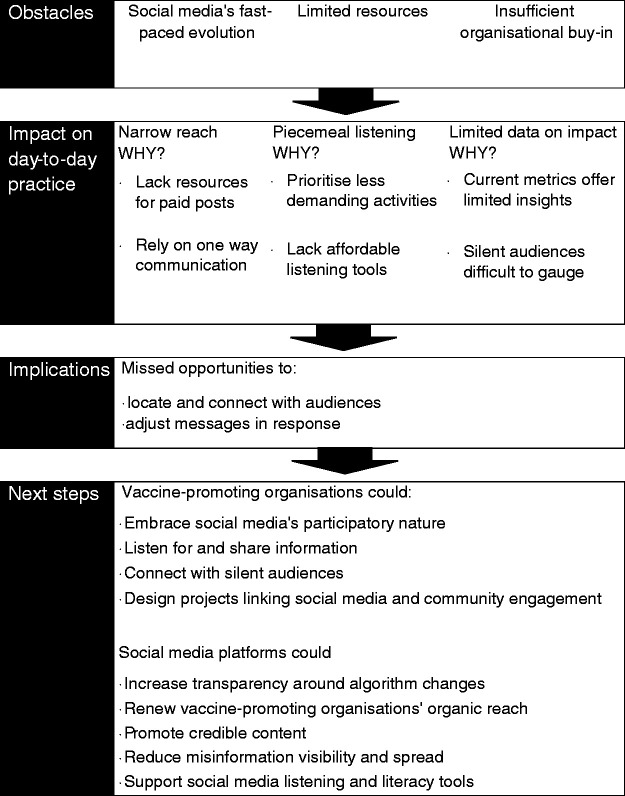
Vaccine-promoting organisations faced obstacles using social media, including fast-paced change, limited resources, and insufficient organisational buy-in. They experienced difficulties reaching audiences, exploiting social media listening, and measuring impact. Consequently, they may miss opportunities to counter misinformation, connect with groups low in vaccine confidence, and determine diverse audience responses. They lack strong evidence linking social media strategies with behaviour change, and have difficulty understanding silent audiences.
Vaccine-promoting organisations have an opportunity to embrace the participatory nature of social media. They could share listening insights with like-minded groups, and conduct research exploring associations between social media strategies and community attitude/behaviour change. Social media platforms could assist by renewing vaccine-promoting organisations' organic reach, supporting the development of tailored listening and credibility tools, and strengthening collaborations to promote credible content.
疫苗相关错误信息在社交媒体上广泛传播。推广疫苗的组织正在努力遏制其影响,但面临诸多障碍。我们旨在分析它们的社交媒体策略以及所遇到的挑战。
在这项定性研究中,我们有目的地从推广疫苗的组织中抽取了21名负责社交媒体工作的参与者。我们使用框架分析法来探究数据。
推广疫苗的组织在使用社交媒体时面临障碍,包括变化节奏快、资源有限以及组织内部支持不足。它们在触达受众、利用社交媒体倾听功能以及衡量影响方面遇到困难。因此,它们可能会错过反驳错误信息、与疫苗信心低的群体建立联系以及确定不同受众反应的机会。它们缺乏将社交媒体策略与行为改变联系起来的有力证据,并且难以了解沉默的受众。
推广疫苗的组织有机会接受社交媒体的参与性本质。它们可以与志同道合的群体分享倾听见解,并开展研究探索社交媒体策略与社区态度/行为改变之间的关联。社交媒体平台可以通过恢复推广疫苗组织的自然传播范围、支持定制化倾听和可信度工具的开发以及加强合作以推广可信内容来提供帮助。