• 文献检索
  • 文档翻译
  • 深度研究
  • 学术资讯
  • Suppr Zotero 插件Zotero 插件
  • 邀请有礼
  • 套餐&价格
  • 历史记录
应用&插件
Suppr Zotero 插件Zotero 插件浏览器插件Mac 客户端Windows 客户端微信小程序
定价
高级版会员购买积分包购买API积分包
服务
文献检索文档翻译深度研究API 文档MCP 服务
关于我们
关于 Suppr公司介绍联系我们用户协议隐私条款
关注我们

Suppr 超能文献

核心技术专利:CN118964589B侵权必究
粤ICP备2023148730 号-1Suppr @ 2026

文献检索

告别复杂PubMed语法,用中文像聊天一样搜索,搜遍4000万医学文献。AI智能推荐,让科研检索更轻松。

立即免费搜索

文件翻译

保留排版,准确专业,支持PDF/Word/PPT等文件格式,支持 12+语言互译。

免费翻译文档

深度研究

AI帮你快速写综述,25分钟生成高质量综述,智能提取关键信息,辅助科研写作。

立即免费体验

美国社交媒体上新冠疫苗推广的促进因素与障碍:一项系统综述

Facilitators and Barriers of COVID-19 Vaccine Promotion on Social Media in the United States: A Systematic Review.

作者信息

Lieneck Cristian, Heinemann Katharine, Patel Janki, Huynh Hung, Leafblad Abigail, Moreno Emmanuel, Wingfield Claire

机构信息

School of Health Administration, Texas State University, San Marcos, TX 78666, USA.

出版信息

Healthcare (Basel). 2022 Feb 8;10(2):321. doi: 10.3390/healthcare10020321.

DOI:10.3390/healthcare10020321
PMID:35206935
原文链接:https://pmc.ncbi.nlm.nih.gov/articles/PMC8871797/
Abstract

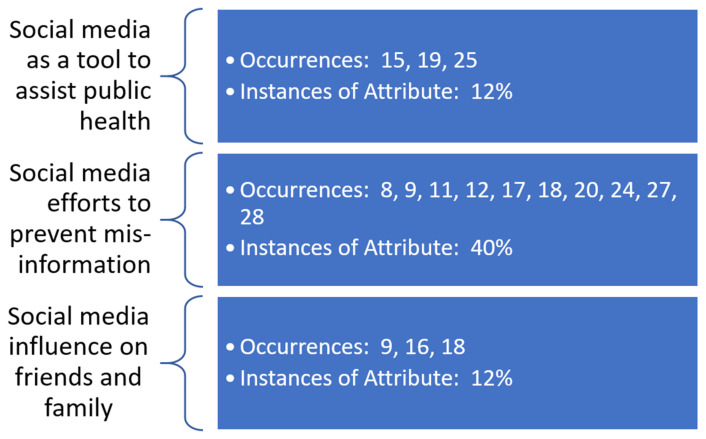
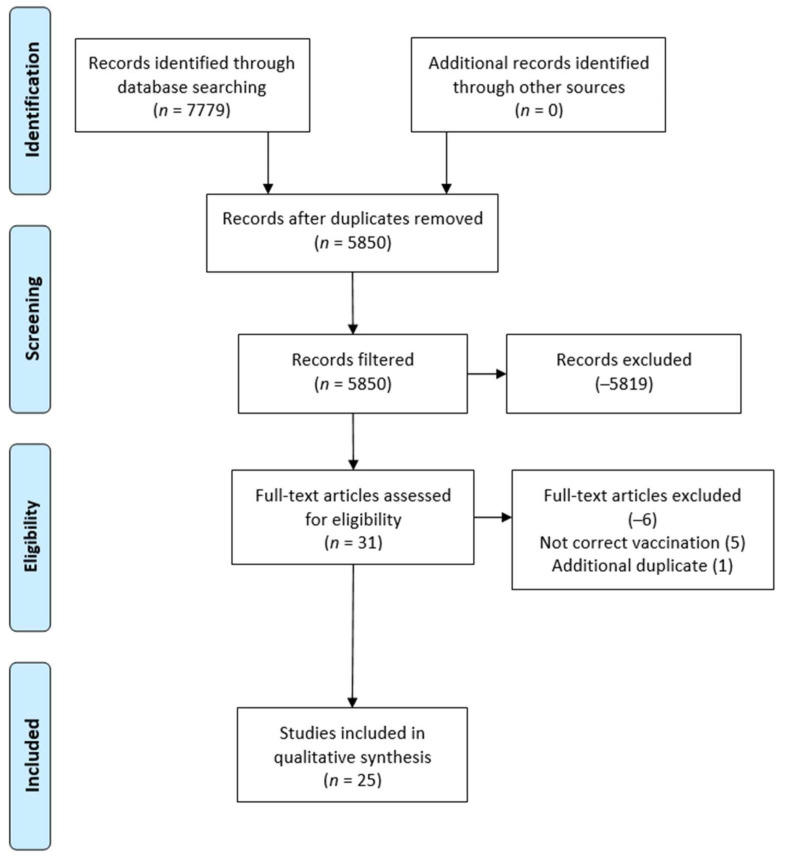
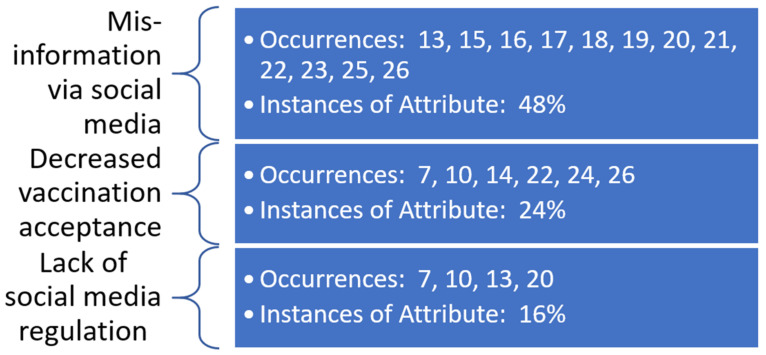
Information regarding the COVID-19 pandemic has spread internationally through a variety of platforms, including social media. While efforts have been made to help reduce the spread of misinformation on social media, many platforms are still largely unregulated. The influence of social media use on vaccination promotion is not fully understood. This systematic review aims to identify facilitators and barriers associated with vaccine promotion through social media use. Reviewers analyzed 25 articles and identified common themes. Facilitators of vaccine promotion included an increase in the efforts of social media companies to reduce misinformation, the use of social media to spread information on public health and vaccine promotion, and the positive influence towards vaccinations of family and friends. Identified barriers to vaccine promotion included the spread of misinformation, decreased vaccine acceptance among users of social media for COVID-19 related information due to polarization, and a lack of regulation on social media platforms. The results of this review provide insight for improving public health campaign promotion on social media and can help inform policy on social media regulation and misinformation prevention.

摘要

有关新冠疫情的信息已通过包括社交媒体在内的各种平台在国际上传播。尽管已努力帮助减少社交媒体上错误信息的传播,但许多平台在很大程度上仍未得到监管。社交媒体使用对疫苗推广的影响尚未完全了解。本系统综述旨在确定与通过社交媒体使用进行疫苗推广相关的促进因素和障碍。综述作者分析了25篇文章并确定了共同主题。疫苗推广的促进因素包括社交媒体公司加大减少错误信息的力度、利用社交媒体传播公共卫生和疫苗推广信息,以及家人和朋友对疫苗接种的积极影响。确定的疫苗推广障碍包括错误信息的传播、由于两极分化导致社交媒体用户对新冠相关信息的疫苗接受度降低,以及社交媒体平台缺乏监管。本综述结果为改善社交媒体上的公共卫生运动推广提供了见解,并有助于为社交媒体监管和错误信息预防政策提供参考。

https://cdn.ncbi.nlm.nih.gov/pmc/blobs/8545/8871797/3a300fc05b97/healthcare-10-00321-g004.jpg
https://cdn.ncbi.nlm.nih.gov/pmc/blobs/8545/8871797/a03677e2720c/healthcare-10-00321-g001.jpg
https://cdn.ncbi.nlm.nih.gov/pmc/blobs/8545/8871797/abc63a5675e7/healthcare-10-00321-g002.jpg
https://cdn.ncbi.nlm.nih.gov/pmc/blobs/8545/8871797/6ce5f3cf7418/healthcare-10-00321-g003.jpg
https://cdn.ncbi.nlm.nih.gov/pmc/blobs/8545/8871797/3a300fc05b97/healthcare-10-00321-g004.jpg
https://cdn.ncbi.nlm.nih.gov/pmc/blobs/8545/8871797/a03677e2720c/healthcare-10-00321-g001.jpg
https://cdn.ncbi.nlm.nih.gov/pmc/blobs/8545/8871797/abc63a5675e7/healthcare-10-00321-g002.jpg
https://cdn.ncbi.nlm.nih.gov/pmc/blobs/8545/8871797/6ce5f3cf7418/healthcare-10-00321-g003.jpg
https://cdn.ncbi.nlm.nih.gov/pmc/blobs/8545/8871797/3a300fc05b97/healthcare-10-00321-g004.jpg

相似文献

1
Facilitators and Barriers of COVID-19 Vaccine Promotion on Social Media in the United States: A Systematic Review.美国社交媒体上新冠疫苗推广的促进因素与障碍:一项系统综述
Healthcare (Basel). 2022 Feb 8;10(2):321. doi: 10.3390/healthcare10020321.
2
COVID-19 Misinformation on Social Media: A Scoping Review.社交媒体上关于新冠病毒病的错误信息:一项范围综述
Cureus. 2022 Apr 29;14(4):e24601. doi: 10.7759/cureus.24601. eCollection 2022 Apr.
3
Complementary, alternative, and integrative medicine-specific COVID-19 misinformation on social media: A scoping review.社交媒体上关于补充医学、替代医学和整合医学的特定新冠病毒错误信息:一项范围综述。
Integr Med Res. 2023 Sep;12(3):100975. doi: 10.1016/j.imr.2023.100975. Epub 2023 Jul 13.
4
Influence of Social Media Platforms on Public Health Protection Against the COVID-19 Pandemic via the Mediating Effects of Public Health Awareness and Behavioral Changes: Integrated Model.社交媒体平台通过公众健康意识和行为变化的中介作用对新冠疫情期间公众健康保护的影响:综合模型
J Med Internet Res. 2020 Aug 19;22(8):e19996. doi: 10.2196/19996.
5
Direct and Indirect Associations of Media Use With COVID-19 Vaccine Hesitancy in South Korea: Cross-sectional Web-Based Survey.直接和间接关联的媒体使用与 COVID-19 疫苗犹豫在韩国:横断面网络调查。
J Med Internet Res. 2022 Jan 6;24(1):e32329. doi: 10.2196/32329.
6
A social media microinfluencer intervention to reduce coronavirus disease 2019 vaccine hesitancy in underserved Tennessee communities: A protocol paper.社交媒体微影响者干预以减少田纳西州服务不足社区对 2019 冠状病毒病疫苗的犹豫:方案论文。
J Am Pharm Assoc (2003). 2022 Jan-Feb;62(1):326-334. doi: 10.1016/j.japh.2021.11.028. Epub 2021 Nov 26.
7
"Vaccines for pregnant women…?! Absurd" - Mapping maternal vaccination discourse and stance on social media over six months.“给孕妇接种疫苗……?!荒谬”——对社交媒体上六个月内关于孕产妇疫苗接种的讨论和立场进行梳理。
Vaccine. 2020 Sep 29;38(42):6627-6637. doi: 10.1016/j.vaccine.2020.07.072. Epub 2020 Aug 9.
8
COVID-19 Misinformation: A Potent Co-Factor in the COVID-19 Pandemic.新冠疫情虚假信息:新冠大流行中的一个强大协同因素。
Cureus. 2022 Oct 7;14(10):e30026. doi: 10.7759/cureus.30026. eCollection 2022 Oct.
9
Prevalence of Health Misinformation on Social Media: Systematic Review.社交媒体健康类错误信息的流行情况:系统评价。
J Med Internet Res. 2021 Jan 20;23(1):e17187. doi: 10.2196/17187.
10
COVID-19 and the 5G Conspiracy Theory: Social Network Analysis of Twitter Data.新冠疫情与5G阴谋论:基于推特数据的社交网络分析
J Med Internet Res. 2020 May 6;22(5):e19458. doi: 10.2196/19458.

引用本文的文献

1
Lessons from the COVID-19 Pandemic: Promoting Vaccination and Public Health Resilience, a Narrative Review.《新冠疫情的经验教训:促进疫苗接种与公共卫生韧性,一篇叙述性综述》
Vaccines (Basel). 2024 Aug 7;12(8):891. doi: 10.3390/vaccines12080891.
2
Creating, publishing, and spreading processes of health-related contents in internet news sites: evaluation of the opinions of actors in health communication.互联网新闻网站中健康相关内容的制作、发布和传播过程:健康传播行为体意见的评估。
Front Public Health. 2024 Jul 30;12:1370343. doi: 10.3389/fpubh.2024.1370343. eCollection 2024.
3
Validating part of the social media infodemic listening conceptual framework using structural equation modelling.

本文引用的文献

1
Examining the effect of information channel on COVID-19 vaccine acceptance.考察信息渠道对 COVID-19 疫苗接受度的影响。
PLoS One. 2021 May 12;16(5):e0251095. doi: 10.1371/journal.pone.0251095. eCollection 2021.
2
Patterns of Media Use, Strength of Belief in COVID-19 Conspiracy Theories, and the Prevention of COVID-19 From March to July 2020 in the United States: Survey Study.2020 年 3 月至 7 月期间美国的媒体使用模式、对新冠病毒阴谋论的信念强度与新冠病毒的预防:调查研究。
J Med Internet Res. 2021 Apr 27;23(4):e25215. doi: 10.2196/25215.
3
COVID-19 vaccine intentions in the United States, a social-ecological framework.
使用结构方程模型验证社交媒体信息疫情监测概念框架的一部分。
EClinicalMedicine. 2024 Mar 14;70:102544. doi: 10.1016/j.eclinm.2024.102544. eCollection 2024 Apr.
4
Fight Against the Mandatory COVID-19 Immunity Passport on Twitter: Natural Language Processing Study.在 Twitter 上反对强制性 COVID-19 免疫护照:自然语言处理研究。
J Med Internet Res. 2023 Nov 23;25:e49435. doi: 10.2196/49435.
5
Barriers to and facilitators of populational adherence to prevention and control measures of COVID-19 and other respiratory infectious diseases: a qualitative evidence synthesis.人口对 COVID-19 和其他呼吸道传染病的预防和控制措施的坚持的障碍和促进因素:定性证据综合。
Eur Respir Rev. 2023 Jun 21;32(168). doi: 10.1183/16000617.0238-2022. Print 2023 Jun 30.
6
A new approach to digital health? Virtual COVID-19 care: A scoping review.数字健康的新方法?虚拟新冠护理:一项范围综述。
Digit Health. 2023 Feb 12;9:20552076231152171. doi: 10.1177/20552076231152171. eCollection 2023 Jan-Dec.
7
The Prevalence, Features, Influencing Factors, and Solutions for COVID-19 Vaccine Misinformation: Systematic Review.新冠病毒疫苗错误信息的流行情况、特征、影响因素和解决方案:系统评价。
JMIR Public Health Surveill. 2023 Jan 11;9:e40201. doi: 10.2196/40201.
8
Hijab or Niqab Interacts with Facemasks Usage at Healthcare Settings in Kabul, Afghanistan: A Multi-Center Observational Study.阿富汗喀布尔医疗机构中 Hijab 或 Niqab 与口罩使用的相互影响:一项多中心观察性研究
Healthcare (Basel). 2022 Oct 5;10(10):1946. doi: 10.3390/healthcare10101946.
9
Infodemics and health misinformation: a systematic review of reviews.信息疫情与健康错误信息:系统综述。
Bull World Health Organ. 2022 Sep 1;100(9):544-561. doi: 10.2471/BLT.21.287654. Epub 2022 Jun 30.
美国的 COVID-19 疫苗接种意向:一个社会生态框架。
Vaccine. 2021 Apr 15;39(16):2288-2294. doi: 10.1016/j.vaccine.2021.02.058. Epub 2021 Mar 10.
4
Artificial Intelligence-Enabled Analysis of Public Attitudes on Facebook and Twitter Toward COVID-19 Vaccines in the United Kingdom and the United States: Observational Study.人工智能分析英美两国民众在脸书和推特上对 COVID-19 疫苗的态度:观察性研究。
J Med Internet Res. 2021 Apr 5;23(4):e26627. doi: 10.2196/26627.
5
The anti-vaccination infodemic on social media: A behavioral analysis.社交媒体上的反疫苗信息疫情:行为分析。
PLoS One. 2021 Mar 3;16(3):e0247642. doi: 10.1371/journal.pone.0247642. eCollection 2021.
6
Escaping Catch-22 - Overcoming Covid Vaccine Hesitancy.逃离第二十二条军规——克服新冠疫苗犹豫心理
N Engl J Med. 2021 Apr 8;384(14):1367-1371. doi: 10.1056/NEJMms2101220. Epub 2021 Feb 12.
7
Tracking COVID-19 Discourse on Twitter in North America: Infodemiology Study Using Topic Modeling and Aspect-Based Sentiment Analysis.追踪北美地区推特上的 COVID-19 相关言论:使用主题建模和基于方面的情感分析的信息流行病学研究。
J Med Internet Res. 2021 Feb 10;23(2):e25431. doi: 10.2196/25431.
8
Predictors of intention to vaccinate against COVID-19: Results of a nationwide survey.预测 COVID-19 疫苗接种意愿的因素:一项全国性调查的结果。
Vaccine. 2021 Feb 12;39(7):1080-1086. doi: 10.1016/j.vaccine.2021.01.010. Epub 2021 Jan 9.
9
How the world's collective attention is being paid to a pandemic: COVID-19 related n-gram time series for 24 languages on Twitter.世界如何集体关注大流行病:Twitter 上 24 种语言与 COVID-19 相关的 n 元组时间序列。
PLoS One. 2021 Jan 6;16(1):e0244476. doi: 10.1371/journal.pone.0244476. eCollection 2021.
10
COVID-19 Vaccination Hesitancy in the United States: A Rapid National Assessment.美国对 COVID-19 疫苗接种的犹豫:一项快速的全国评估。
J Community Health. 2021 Apr;46(2):270-277. doi: 10.1007/s10900-020-00958-x. Epub 2021 Jan 3.