Artemev Artem, Naik Sheetal, Pougno Anastasia, Honnavar Prasanna, Shanbhag Nandan M
Medicine, Xavier University School of Medicine, Oranjestad, ABW.
Physiology, American University of Antigua, St. Johns, ATG.
Cureus. 2022 Feb 12;14(2):e22156. doi: 10.7759/cureus.22156. eCollection 2022 Feb.
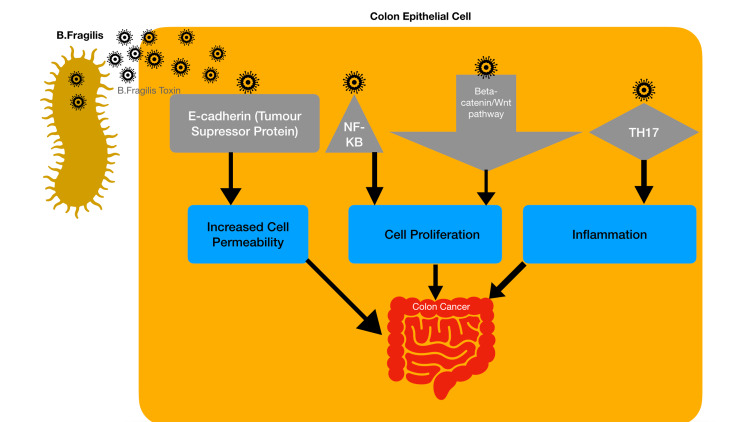
Many studies have been conducted to identify the causative organisms in colorectal cancer (CRC) and compare the microbiota of healthy individuals and those with CRC. The pathways by which the microbiota promotes CRC development are not yet fully understood. The hypothesized mechanisms include damage to the DNA, production of carcinogenic metabolites, and promotion of chronic inflammation. In a state of dysbiosis, the gut loses protective bacteria and is enriched with pathogenic and cancer-promoting bacteria, which promotes functions associated with cancer such as angiogenesis, loss of apoptosis, and cell proliferation. We have established a strong link between microbiota dysbiosis and certain species of bacteria and even viruses involved in tumorigenesis. In this review, we look at some of the major identified species and how they are related to CRC. Future research should include and even focus on mycobiome and virome on CRC development. Due to the diversity of the gut microbiome, there is a high possibility that the gain and loss of bacteria and their metabolic functions lead to CRC.
已经开展了许多研究来确定结直肠癌(CRC)中的致病微生物,并比较健康个体与CRC患者的微生物群。微生物群促进CRC发展的途径尚未完全了解。推测的机制包括DNA损伤、致癌代谢产物的产生以及慢性炎症的促进。在生态失调的状态下,肠道失去保护性细菌,富含致病性和促癌细菌,这促进了与癌症相关的功能,如血管生成、细胞凋亡丧失和细胞增殖。我们已经在微生物群生态失调与某些参与肿瘤发生的细菌甚至病毒之间建立了紧密的联系。在这篇综述中,我们探讨了一些已确定的主要物种以及它们与CRC的关系。未来的研究应该纳入甚至聚焦于真菌群落和病毒群落对CRC发展的影响。由于肠道微生物群的多样性,细菌及其代谢功能的增减很有可能导致CRC。