Goodman William, Bagnall Anne-Marie, Ashley Laura, Azizoddin Desiree, Muehlensiepen Felix, Blum David, Bennett Michael I, Allsop Matthew
Leeds Institute of Health Sciences, University of Leeds, Leeds, United Kingdom.
School of Health, Leeds Beckett University, Leeds, United Kingdom.
JMIR Cancer. 2022 Feb 17;8(1):e33355. doi: 10.2196/33355.
Telehealth approaches are increasingly being used to support patients with advanced diseases, including cancer. Evidence suggests that telehealth is acceptable to most patients; however, the extent of and factors influencing patient engagement remain unclear.
The aim of this review is to characterize the extent of engagement with telehealth interventions in patients with advanced, incurable cancer reported in the international literature.
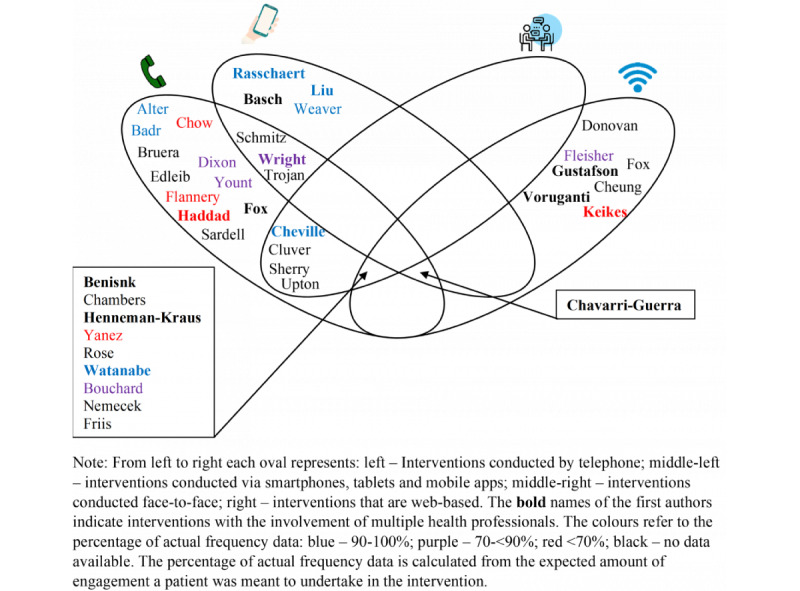
This systematic review was registered with PROSPERO (International Prospective Register of Systematic Reviews) and is reported in line with PRISMA (Preferred Reporting Items for Systematic Reviews and Meta-Analyses) 2020 guidelines. A comprehensive search of databases was undertaken for telehealth interventions (communication between a patient with advanced cancer and their health professional via telehealth technologies), including MEDLINE, Embase, CINAHL, PsycINFO, Cochrane Library, Sociological Abstracts, and Web of Science, from the inception of each electronic database up until December 31, 2020. A narrative synthesis was conducted to outline the design, population, and context of the studies. A conceptual framework of digital engagement comprising quantitative behavioral measures (frequency, amount, duration, and depth of use) framed the analysis of engagement with telehealth approaches. Frequency data were transformed to a percentage (actual patient engagement as a proportion of intended engagement), and the interventions were characterized by intensity (high, medium, and low intended engagement) and mode of delivery for standardized comparisons across studies.
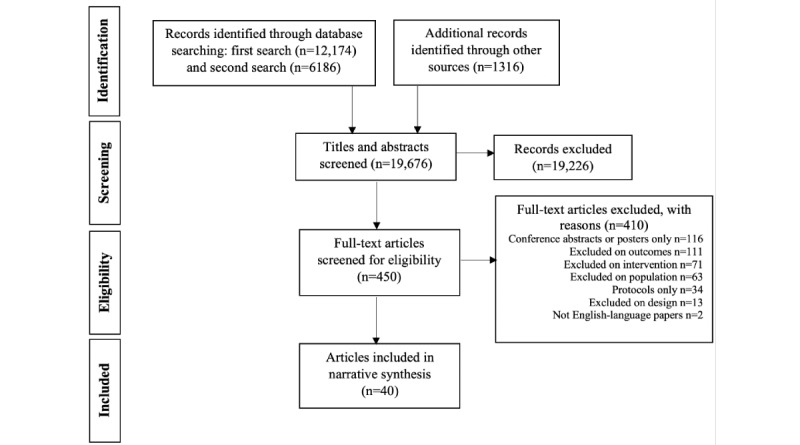
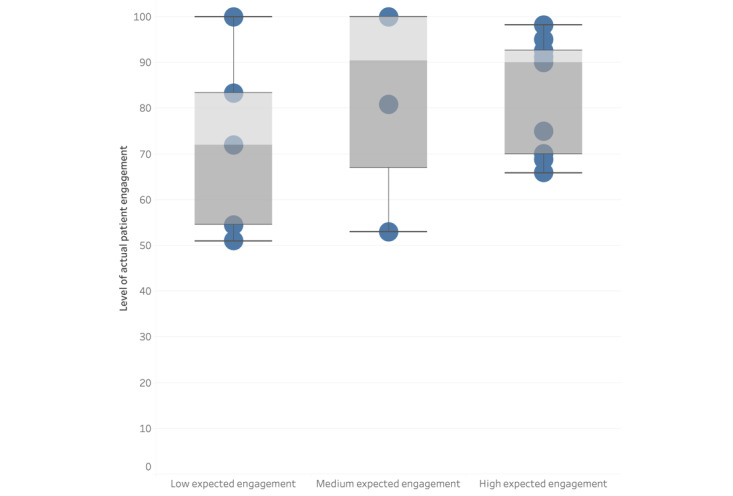
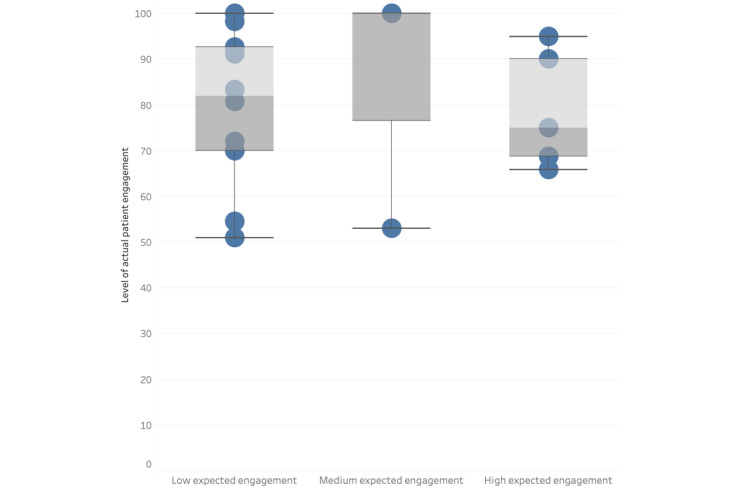
Of the 19,676 identified papers, 40 (0.2%) papers covering 39 different studies were eligible for inclusion, dominated by US studies (22/39, 56%), with most being research studies (26/39, 67%). The most commonly reported measure of engagement was frequency (36/39, 92%), with substantial heterogeneity in the way in which it was measured. A standardized percentage of actual patient engagement was derived from 17 studies (17/39, 44%; n=1255), ranging from 51% to 100% with a weighted average of 75.4% (SD 15.8%). A directly proportional relationship was found between intervention intensity and actual patient engagement. Higher engagement occurred when a tablet, computer, or smartphone app was the mode of delivery.
Understanding engagement for people with advanced cancer can guide the development of telehealth approaches from their design to monitoring as part of routine care. With increasing telehealth use, the development of meaningful and context- and condition-appropriate measures of telehealth engagement is needed to address the current heterogeneity in reporting while improving the understanding of optimal implementation of telehealth for oncology and palliative care.
PROSPERO (International Prospective Register of Systematic Reviews) CRD42018117232; https://www.crd.york.ac.uk/prospero/display_record.php?ID=CRD42018117232.
远程医疗方法越来越多地用于支持包括癌症在内的晚期疾病患者。有证据表明,远程医疗为大多数患者所接受;然而,患者参与的程度及影响因素仍不明确。
本综述的目的是描述国际文献中报道的晚期不可治愈癌症患者对远程医疗干预的参与程度。
本系统综述已在国际前瞻性系统综述注册库(PROSPERO)登记,并按照系统综述和Meta分析的首选报告项目(PRISMA)2020指南进行报告。对数据库进行了全面检索,以查找远程医疗干预措施(晚期癌症患者与其医护人员通过远程医疗技术进行的沟通),检索范围包括MEDLINE、Embase、护理学与健康领域数据库(CINAHL)、心理学文摘数据库(PsycINFO)、考科蓝图书馆、社会学文摘数据库以及科学引文索引数据库,检索时间从各电子数据库建立之初至2020年12月31日。进行了叙述性综合分析,以概述研究的设计、人群和背景。一个包含定量行为指标(使用频率、数量、持续时间和深度)的数字参与概念框架构成了对远程医疗方法参与情况分析的基础。频率数据转换为百分比(实际患者参与度占预期参与度的比例),并根据强度(高、中、低预期参与度)和交付方式对干预措施进行特征描述,以便在各研究间进行标准化比较。
在19676篇已识别的论文中,40篇(0.2%)涵盖39项不同研究的论文符合纳入标准,其中美国研究占主导(22/39,56%),大多数为研究性研究(26/39,67%)。最常报告的参与度衡量指标是频率(36/39,92%),其测量方式存在很大异质性。从17项研究(17/39,44%;n = 1255)中得出了实际患者参与度的标准化百分比,范围为51%至100%,加权平均值为75.4%(标准差15.8%)。发现干预强度与实际患者参与度之间存在正比关系。当平板电脑、计算机或智能手机应用程序作为交付方式时,参与度更高。
了解晚期癌症患者的参与情况可为远程医疗方法从设计到作为常规护理一部分进行监测的发展提供指导。随着远程医疗使用的增加,需要制定有意义且符合背景和病情的远程医疗参与度衡量指标,以解决当前报告中的异质性问题,同时增进对肿瘤学和姑息治疗中远程医疗最佳实施的理解。
国际前瞻性系统综述注册库(PROSPERO)CRD42018117232;https://www.crd.york.ac.uk/prospero/display_record.php?ID=CRD42018117232 。