Sir William Dunn School of Pathology, University of Oxford, Oxford OX1 3RE, U.K.
Biochem J. 2022 Feb 17;479(4):463-477. doi: 10.1042/BCJ20210280.
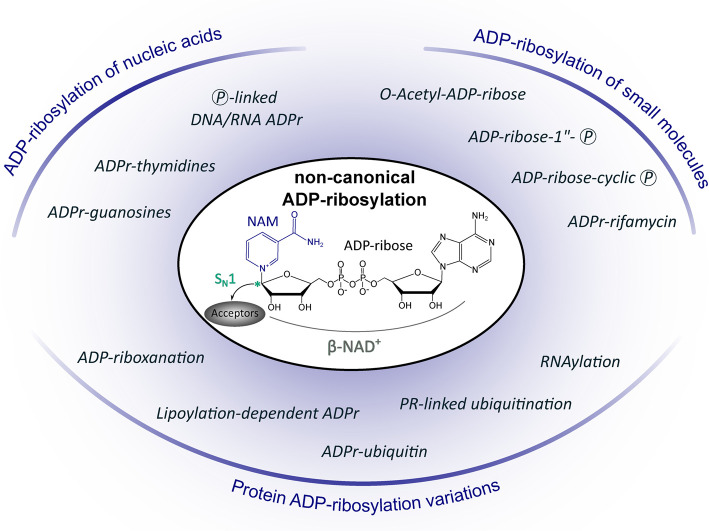
ADP-ribosylation has primarily been known as post-translational modification of proteins. As signalling strategy conserved in all domains of life, it modulates substrate activity, localisation, stability or interactions, thereby regulating a variety of cellular processes and microbial pathogenicity. Yet over the last years, there is increasing evidence of non-canonical forms of ADP-ribosylation that are catalysed by certain members of the ADP-ribosyltransferase family and go beyond traditional protein ADP-ribosylation signalling. New macromolecular targets such as nucleic acids and new ADP-ribose derivatives have been established, notably extending the repertoire of ADP-ribosylation signalling. Based on the physiological relevance known so far, non-canonical ADP-ribosylation deserves its recognition next to the traditional protein ADP-ribosylation modification and which we therefore review in the following.
ADP-核糖基化主要被认为是蛋白质的翻译后修饰。作为一种在所有生命领域中保守的信号策略,它调节底物的活性、定位、稳定性或相互作用,从而调节各种细胞过程和微生物的致病性。然而,在过去的几年中,越来越多的证据表明,某些 ADP-核糖基转移酶家族成员催化的非典型 ADP-核糖基化形式超出了传统的蛋白质 ADP-核糖基化信号。已经确定了新的大分子靶标,如核酸和新的 ADP-核糖基衍生物,特别是扩展了 ADP-核糖基化信号的范围。基于目前已知的生理相关性,非典型 ADP-核糖基化值得与传统的蛋白质 ADP-核糖基化修饰并列,因此我们在以下内容中进行了综述。