Yu Qian, Qiao Guo-Hong, Wang Min, Yu Li, Sun Yaoxiang, Shi Hui, Ma Tie-Liang
Department of Hepatology, Songjiang Hospital Affiliated to Nanjing Medical University, Shanghai, China.
Department of Clinical Laboratory, The Affiliated Yixing Hospital of Jiangsu University, Yixing, China.
Front Cell Dev Biol. 2022 Feb 1;10:812262. doi: 10.3389/fcell.2022.812262. eCollection 2022.
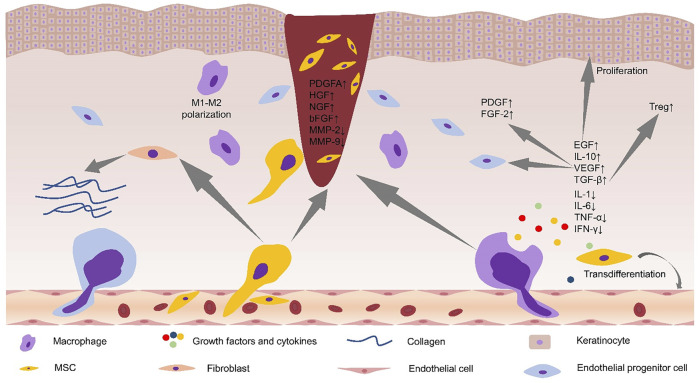
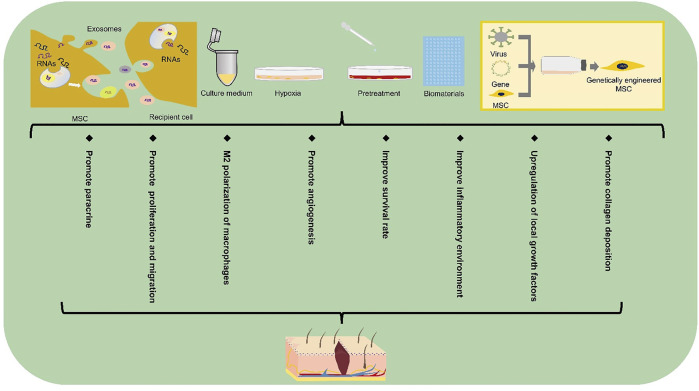
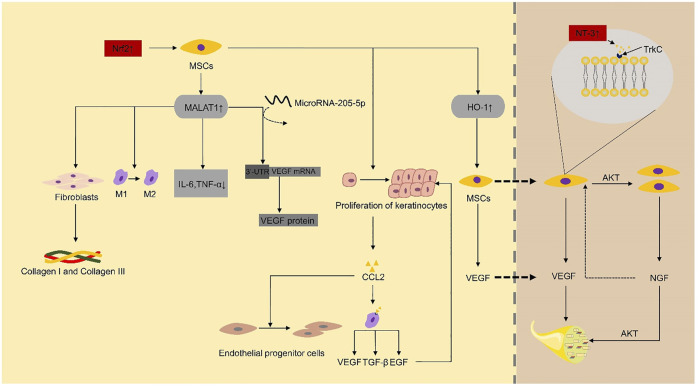
Diabetic foot ulcer has become a worldwide clinical medical challenge as traditional treatments are not effective enough to reduce the amputation rate. Therefore, it is of great social significance to deeply study the pathogenesis and biological characteristics of the diabetic foot, explore new treatment strategies and promote their application. Stem cell-based therapy holds tremendous promise in the field of regenerative medicine, and its mechanisms include promoting angiogenesis, ameliorating neuroischemia and inflammation, and promoting collagen deposition. Studying the specific molecular mechanisms of stem cell therapy for diabetic foot has an important role and practical clinical significance in maximizing the repair properties of stem cells. In addition, effective application modalities are also crucial in order to improve the survival and viability of stem cells at the wound site. In this paper, we reviewed the specific molecular mechanisms of stem cell therapy for diabetic foot and the extended applications of stem cells in recent years, with the aim of contributing to the development of stem cell-based therapy in the repair of diabetic foot ulcers.
糖尿病足溃疡已成为一项全球性的临床医学挑战,因为传统治疗方法在降低截肢率方面效果不够显著。因此,深入研究糖尿病足的发病机制和生物学特性,探索新的治疗策略并推动其应用具有重大的社会意义。基于干细胞的疗法在再生医学领域极具前景,其作用机制包括促进血管生成、改善神经缺血和炎症以及促进胶原蛋白沉积。研究干细胞治疗糖尿病足的具体分子机制对于最大限度发挥干细胞的修复特性具有重要作用和实际临床意义。此外,有效的应用方式对于提高干细胞在伤口部位的存活率和活力也至关重要。在本文中,我们综述了近年来干细胞治疗糖尿病足的具体分子机制以及干细胞的拓展应用,旨在为基于干细胞的疗法在糖尿病足溃疡修复中的发展提供助力。