McPhee Michael J, Salsman Jayme, Foster Jason, Thompson Jordan, Mathavarajah Sabateeshan, Dellaire Graham, Ridgway Neale D
Department of Biochemistry & Molecular Biology, Dalhousie University, Halifax, NS, Canada.
Department of Pathology, Dalhousie University, Halifax, NS, Canada.
Front Cell Dev Biol. 2022 Feb 1;10:837406. doi: 10.3389/fcell.2022.837406. eCollection 2022.
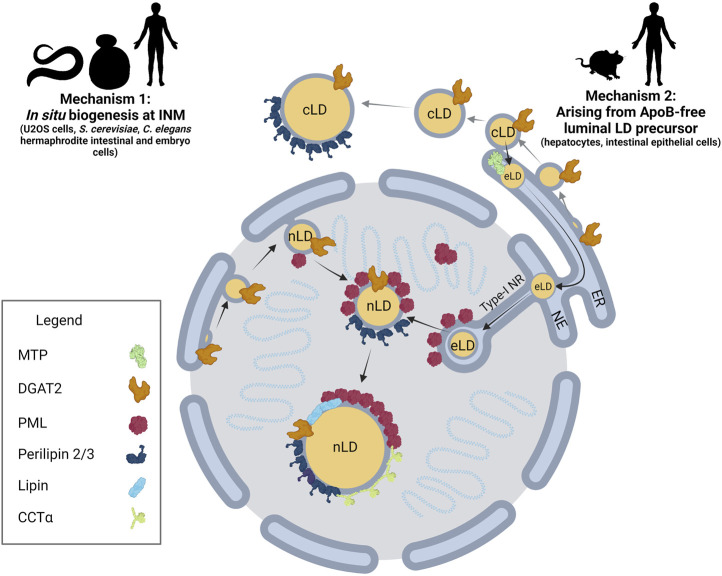
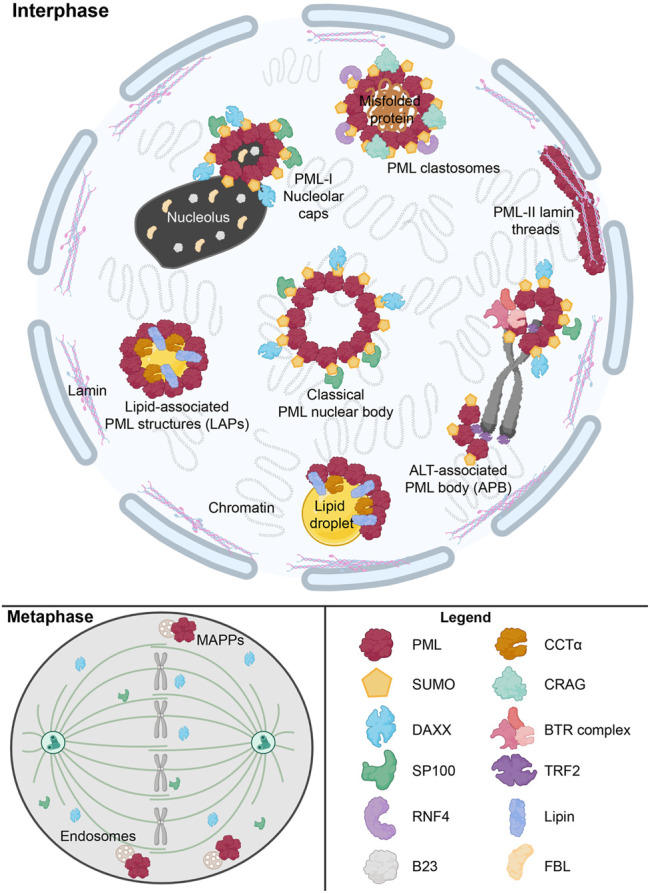
The nucleus harbours numerous protein subdomains and condensates that regulate chromatin organization, gene expression and genomic stress. A novel nuclear subdomain that is formed following exposure of cells to excess fatty acids is the nuclear lipid droplet (nLD), which is composed of a neutral lipid core surrounded by a phospholipid monolayer and associated regulatory and lipid biosynthetic enzymes. While structurally resembling cytoplasmic LDs, nLDs are formed by distinct but poorly understood mechanisms that involve the emergence of lipid droplets from the lumen of the nucleoplasmic reticulum and lipid synthesis. Luminal lipid droplets that emerge into the nucleoplasm do so at regions of the inner nuclear membrane that become enriched in promyelocytic leukemia (PML) protein. The resulting nLDs that retain PML on their surface are termed lipid-associated PML structures (LAPS), and are distinct from canonical PML nuclear bodies (NB) as they lack key proteins and modifications associated with these NBs. PML is a key regulator of nuclear signaling events and PML NBs are sites of gene regulation and post-translational modification of transcription factors. Therefore, the subfraction of nLDs that form LAPS could regulate lipid stress responses through their recruitment and retention of the PML protein. Both nLDs and LAPS have lipid biosynthetic enzymes on their surface suggesting they are active sites for nuclear phospholipid and triacylglycerol synthesis as well as global lipid regulation. In this review we have summarized the current understanding of nLD and LAPS biogenesis in different cell types, their structure and composition relative to other PML-associated cellular structures, and their role in coordinating a nuclear response to cellular overload of fatty acids.
细胞核中存在众多蛋白质亚结构域和凝聚物,它们调节染色质组织、基因表达和基因组应激。一种在细胞暴露于过量脂肪酸后形成的新型核亚结构域是核脂滴(nLD),它由中性脂质核心和围绕其的磷脂单层以及相关的调节和脂质生物合成酶组成。虽然nLD在结构上类似于细胞质脂滴,但其形成机制独特且尚不清楚,涉及从核质网腔中出现脂滴和脂质合成。进入核质的腔内脂滴在富含早幼粒细胞白血病(PML)蛋白的内核膜区域形成。在其表面保留PML的所得nLD被称为脂质相关PML结构(LAPS),它们与典型的PML核体(NB)不同,因为它们缺乏与这些核体相关的关键蛋白质和修饰。PML是核信号事件的关键调节因子,PML核体是基因调节和转录因子翻译后修饰的位点。因此,形成LAPS的nLD亚组分可能通过募集和保留PML蛋白来调节脂质应激反应。nLD和LAPS在其表面都有脂质生物合成酶,这表明它们是核磷脂和三酰甘油合成以及整体脂质调节的活性位点。在这篇综述中,我们总结了目前对不同细胞类型中nLD和LAPS生物发生、它们相对于其他与PML相关的细胞结构的结构和组成,以及它们在协调细胞核对脂肪酸细胞过载反应中的作用的理解。