Musso Mariacristina, Hübner David, Schwarzkopf Sarah, Bernodusson Maria, LeVan Pierre, Weiller Cornelius, Tangermann Michael
Department of Neurology and Neurophysiology, Medical Center-University of Freiburg, Faculty of Medicine, University of Freiburg, Germany.
Cluster of Excellence, BrainLinks-BrainTools, University of Freiburg, Germany.
Brain Commun. 2022 Feb 8;4(1):fcac008. doi: 10.1093/braincomms/fcac008. eCollection 2022.
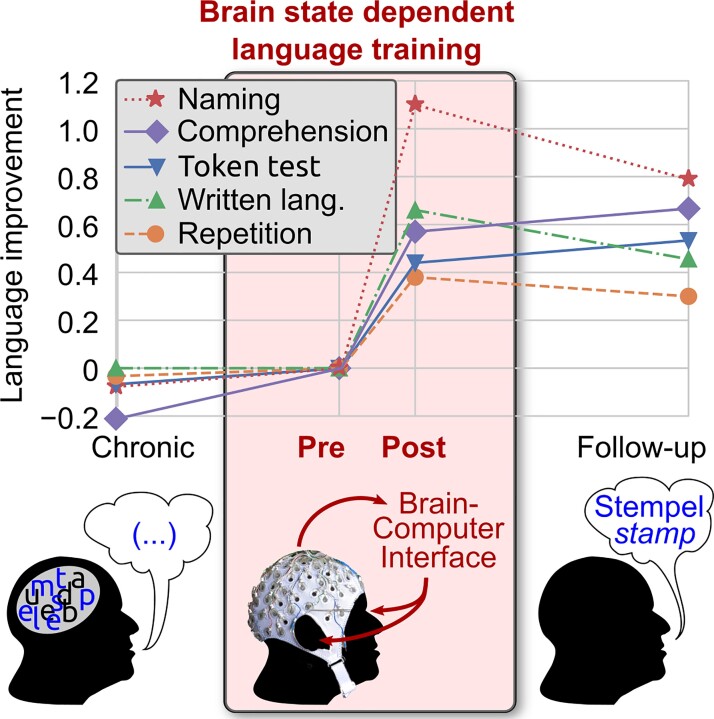
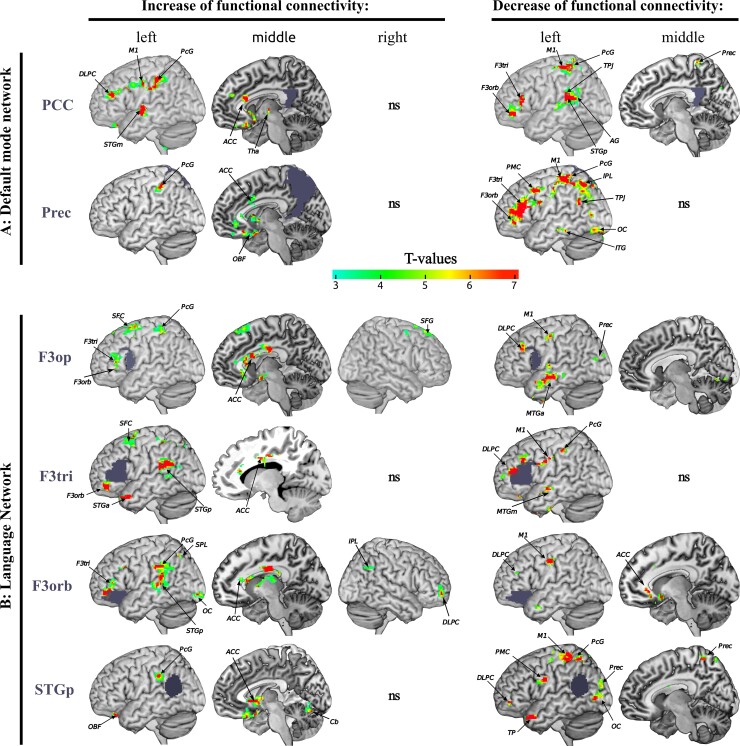
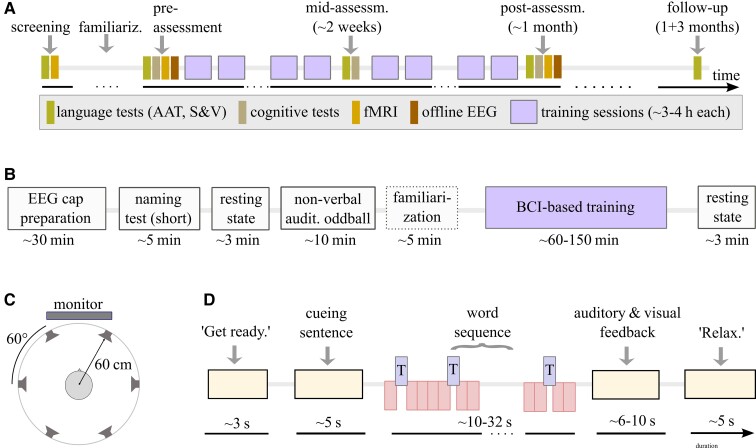
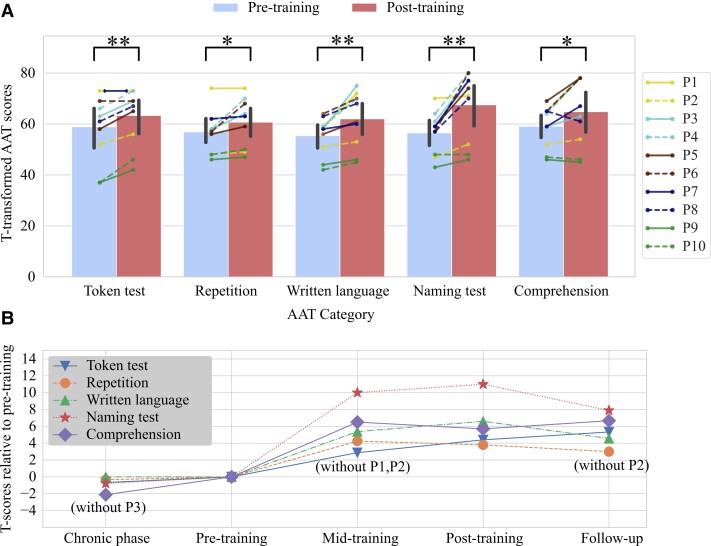
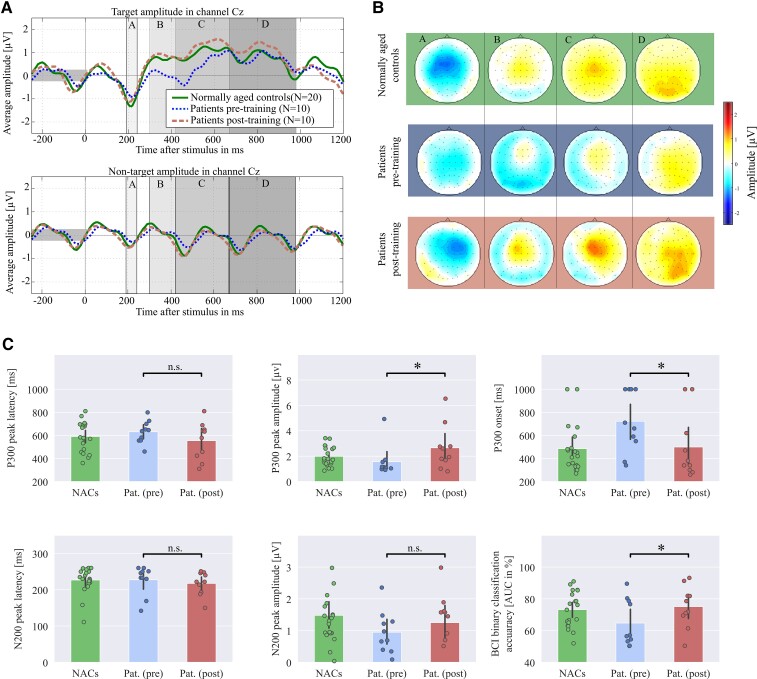
Aphasia, the impairment to understand or produce language, is a frequent disorder after stroke with devastating effects. Conventional speech and language therapy include each formal intervention for improving language and communication abilities. In the chronic stage after stroke, it is effective compared with no treatment, but its effect size is small. We present a new language training approach for the rehabilitation of patients with aphasia based on a brain-computer interface system. The approach exploits its capacity to provide feedback time-locked to a brain state. Thus, it implements the idea that reinforcing an appropriate language processing strategy may induce beneficial brain plasticity. In our approach, patients perform a simple auditory target word detection task whilst their EEG was recorded. The constant decoding of these signals by machine learning models generates an individual and immediate brain-state-dependent feedback. It indicates to patients how well they accomplish the task during a training session, even if they are unable to speak. Results obtained from a proof-of-concept study with 10 stroke patients with mild to severe chronic aphasia (age range: 38-76 years) are remarkable. First, we found that the high-intensity training (30 h, 4 days per week) was feasible, despite a high-word presentation speed and unfavourable stroke-induced EEG signal characteristics. Second, the training induced a sustained recovery of aphasia, which generalized to multiple language aspects beyond the trained task. Specifically, all tested language assessments (Aachen Aphasia Test, Snodgrass & Vanderwart, Communicative Activity Log) showed significant medium to large improvements between pre- and post-training, with a standardized mean difference of 0.63 obtained for the Aachen Aphasia Test, and five patients categorized as non-aphasic at post-training assessment. Third, our data show that these language improvements were accompanied neither by significant changes in attention skills nor non-linguistic skills. Investigating possible modes of action of this brain-computer interface-based language training, neuroimaging data (EEG and resting-state functional MRI) indicates a training-induced faster word processing, a strengthened language network and a rebalancing between the language- and default mode networks.
失语症是指理解或生成语言的能力受损,是中风后常见的一种具有严重影响的病症。传统的言语和语言治疗包括各种旨在提高语言和沟通能力的正式干预措施。在中风后的慢性阶段,与不进行治疗相比,它是有效的,但其效应量较小。我们提出了一种基于脑机接口系统的针对失语症患者康复的新语言训练方法。该方法利用其提供与脑状态锁时相关反馈的能力。因此,它践行了强化适当的语言处理策略可能会诱导有益的脑可塑性这一理念。在我们的方法中,患者在进行简单的听觉目标词检测任务时记录其脑电图。通过机器学习模型对这些信号进行持续解码会生成与个体脑状态相关的即时反馈。这向患者表明他们在训练过程中完成任务的情况,即使他们无法说话。对10名患有轻至重度慢性失语症的中风患者(年龄范围:38 - 76岁)进行的概念验证研究结果显著。首先,我们发现高强度训练(每周4天,共30小时)是可行的,尽管单词呈现速度快且中风引起的脑电图信号特征不利。其次,训练导致失语症持续恢复,这种恢复扩展到了训练任务之外的多个语言方面。具体而言,所有测试的语言评估(亚琛失语症测试、斯诺德格拉斯和范德沃特测试、交流活动日志)在训练前和训练后均显示出显著的中度至大幅度改善,亚琛失语症测试的标准化平均差异为0.63,并且在训练后评估中有5名患者被归类为无失语症。第三,我们的数据表明,这些语言改善并未伴随着注意力技能或非语言技能的显著变化。在研究这种基于脑机接口的语言训练可能的作用方式时,神经影像学数据(脑电图和静息态功能磁共振成像)表明训练导致单词处理速度加快、语言网络增强以及语言网络与默认模式网络之间的重新平衡。