Laboratoire IAPS (N°201723207F), Université de Toulon, Toulon, France.
LAMHESS, Université Côte d'Azur, Nice, France.
Eur J Appl Physiol. 2022 Apr;122(4):1071-1084. doi: 10.1007/s00421-022-04898-3. Epub 2022 Feb 18.
Due to its eccentric nature, downhill running (DR) training has been suggested to promote strength gains through neuromuscular adaptations. However, it is unknown whether short-term chronic DR can elicit such adaptations.
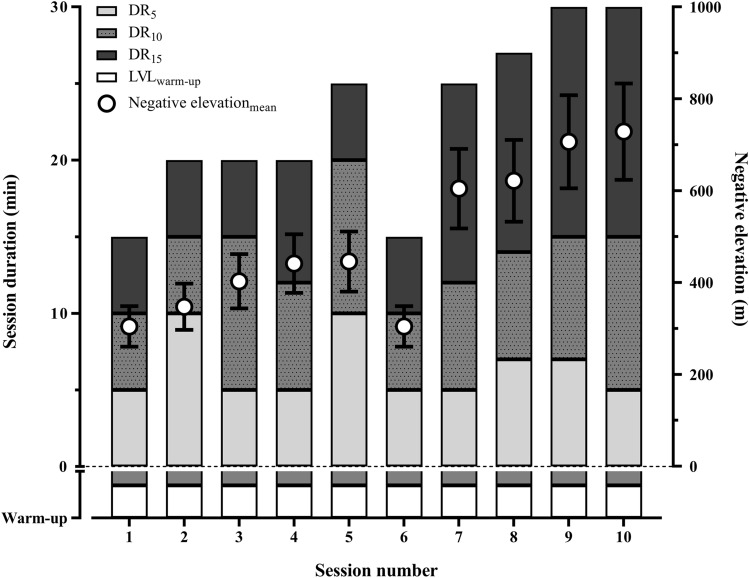
Twelve untrained, young, healthy adults (5 women, 7 men) took part in 4 weeks' DR, comprising 10 sessions, with running speed equivalent to 60-65% maximal oxygen uptake ([Formula: see text]O, assessed at weeks 0 and 4). Isometric and isokinetic knee-extensor maximal voluntary torque (MVT), vastus lateralis (VL) muscle morphology/architecture (anatomical cross-sectional area, ACSA; physiological CSA, PCSA; volume; fascicle length, L; pennation angle, PA) and neuromuscular activation (VL EMG) were assessed at weeks 0, 2 and 4.
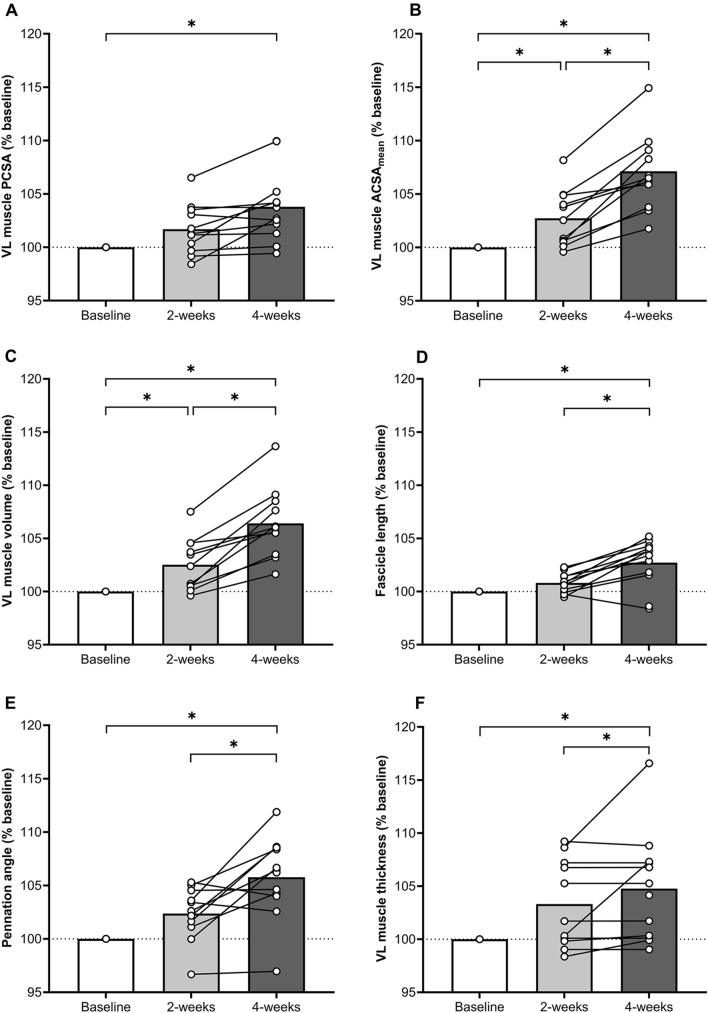
MVT increased by 9.7-15.2% after 4 weeks (p < 0.01). VL EMG during isometric MVT increased by 35.6 ± 46.1% after 4 weeks (p < 0.05) and correlated with changes in isometric MVT after 2 weeks (r = 0.86, p = 0.001). VL ACSA (+2.9 ± 2.7% and +7.1 ± 3.5%) and volume (+2.5 ± 2.5% and +6.6 ± 3.2%) increased after 2 and 4 weeks, respectively (p < 0.05). PCSA (+3.8 ± 3.3%), PA (+5.8 ± 3.8%) and L (+2.7 ± 2.2%) increased after 4 weeks (p < 0.01). Changes in VL volume (r = 0.67, p = 0.03) and PCSA (r = 0.71, p = 0.01) correlated with changes in concentric MVT from 2 to 4 weeks. [Formula: see text]O (49.4 ± 6.2 vs. 49.7 ± 6.3 mL·kg·min) did not change after 4 weeks (p = 0.73).
Just 4 weeks' moderate-intensity DR promoted neuromuscular adaptations in young, healthy adults, typically observed after high-intensity eccentric resistance training. Neural adaptations appeared to contribute to most of the strength gains at 2 and 4 weeks, while muscle hypertrophy seemed to contribute to MVT changes from 2 to 4 weeks only.
由于其偏侧性,下坡跑(DR)训练被认为可以通过神经肌肉适应来促进力量的增加。然而,目前尚不清楚短期慢性 DR 是否能引起这种适应。
12 名未经训练的年轻健康成年人(5 名女性,7 名男性)参加了 4 周的 DR 训练,包括 10 次训练,跑步速度相当于 60-65%最大摄氧量([Formula: see text]O,在第 0 周和第 4 周评估)。在第 0、2 和 4 周评估了等长和等速膝关节伸肌最大自主扭矩(MVT)、股外侧肌(VL)肌肉形态/结构(解剖横截面积,ACSA;生理 CSA,PCSA;体积;肌纤维长度,L;羽毛角,PA)和神经肌肉激活(VL EMG)。
4 周后 MVT 增加了 9.7-15.2%(p<0.01)。VL EMG 在等长 MVT 中增加了 35.6±46.1%,4 周后(p<0.05),并与 2 周后的等长 MVT 变化相关(r=0.86,p=0.001)。VL ACSA(+2.9±2.7%和+7.1±3.5%)和体积(+2.5±2.5%和+6.6±3.2%)分别在第 2 周和第 4 周后增加(p<0.05)。PCSA(+3.8±3.3%)、PA(+5.8±3.8%)和 L(+2.7±2.2%)在第 4 周后增加(p<0.01)。VL 体积(r=0.67,p=0.03)和 PCSA(r=0.71,p=0.01)的变化与第 2 周到第 4 周的等速 MVT 变化相关。[Formula: see text]O(49.4±6.2 与 49.7±6.3 mL·kg·min)在 4 周后没有变化(p=0.73)。
仅仅 4 周的中等强度 DR 就促进了年轻健康成年人的神经肌肉适应,通常在高强度离心抗阻训练后观察到。神经适应似乎对第 2 周和第 4 周的大部分力量增加都有贡献,而肌肉肥大似乎仅对第 2 周到第 4 周的 MVT 变化有贡献。