Faculty of Sport Sciences, Waseda University, Tokorozawa, Saitama, JAPAN.
Japan Society for the Promotion of Science, Chiyoda, Tokyo, JAPAN.
Med Sci Sports Exerc. 2018 Aug;50(8):1629-1640. doi: 10.1249/MSS.0000000000001611.
It is unclear whether the superiority of eccentric over concentric training on neuromuscular improvements is due to higher torque (mechanical loading) achievable during eccentric contractions or due to resulting greater total work.
This study aimed to examine neuromuscular adaptations after maximal eccentric versus concentric training matched for total work.
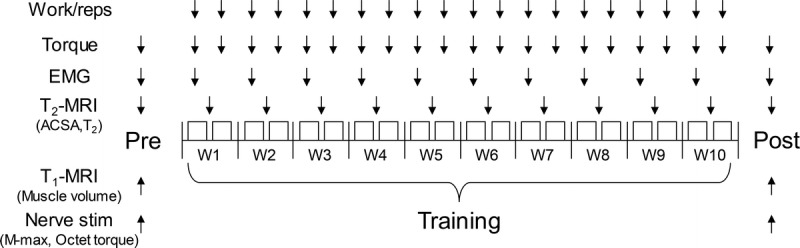
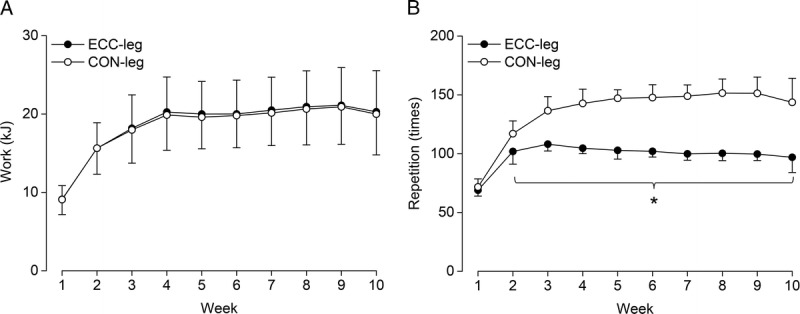
Twelve males conducted single-joint isokinetic (180°·s) maximal eccentric contractions of the knee extensors in one leg (ECC-leg) and concentric in the other (CON-leg), 6 sets per session (3-5 sets in the initial 1-3 sessions), 2 sessions per week for 10 wk. The preceding leg performed 10 repetitions per set. The following leg conducted the equivalent volume of work. In addition to peak torque during training, agonist EMG and MRI-based anatomical cross-sectional area (ACSA) and transverse relaxation time (T2) at midthigh as reflective of neural drive, hypertrophy, and edema, respectively, were assessed weekly throughout the training period and pre- and posttraining. Whole muscle volume was also measured pre- and posttraining.
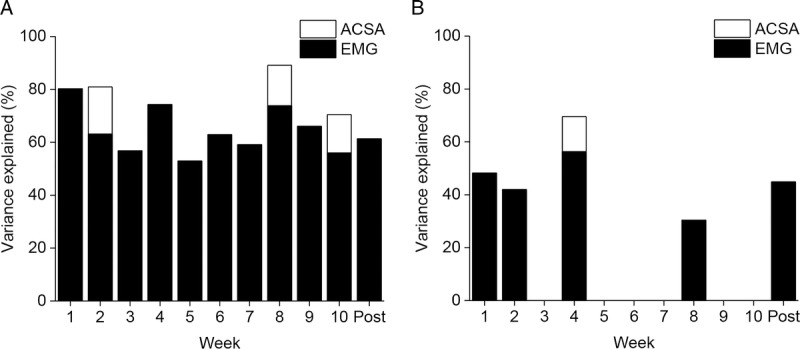
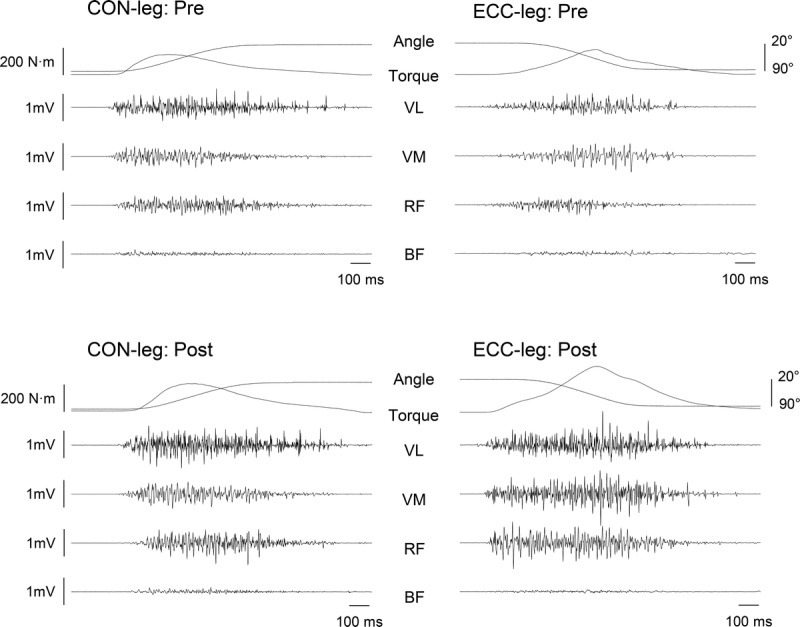
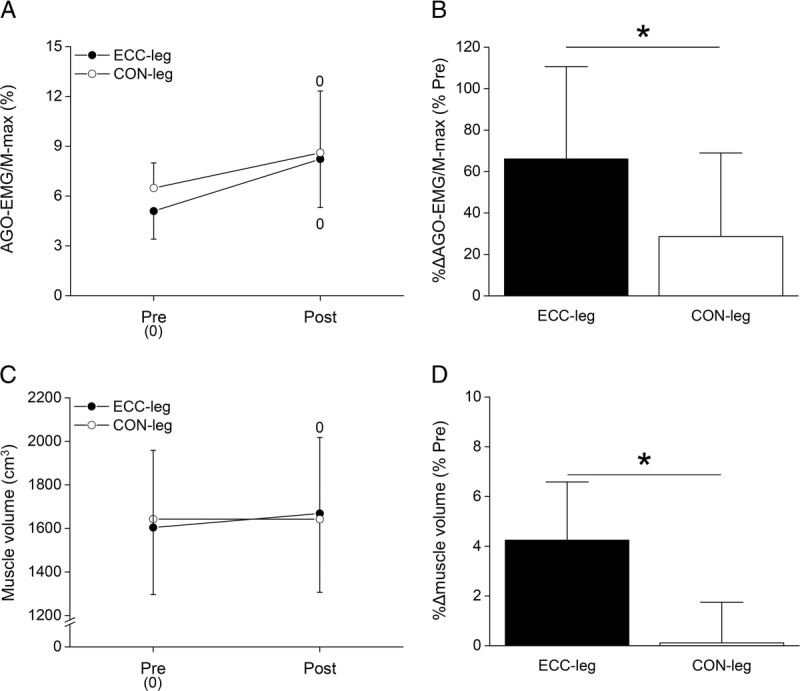
Torque and EMG (in trained contraction conditions) significantly increased in both legs after week 1 (W1) and week 4 (W4), respectively, with a greater degree for ECC-leg (torque +76%, EMG +73%: posttraining) than CON-leg (+28%, +20%). ACSA significantly increased after W4 in ECC-leg only (+4%: posttraining), without T2 changes throughout. Muscle volume also increased in ECC-leg only (+4%). Multiple regression analysis revealed that changes (%Δ) in EMG solely explained 53%-80% and 30%-56% of the total variance in %Δtorque through training in ECC-leg and CON-leg, respectively, with small contributions (+13%-18%) of %ΔACSA for both legs.
Eccentric training induces greater neuromuscular changes than concentric training even when matched for total work, whereas most of the strength gains during 10-wk training are attributable to the increased neural drive.
本研究旨在比较经总功匹配的最大离心和向心训练后神经肌肉适应性的变化。
12 名男性在单关节等速(180°·s)膝关节伸展器中进行单侧最大离心收缩(ECC-leg)和向心收缩(CON-leg),每节 6 组(前 1-3 节 3-5 组),每周 2 次,每次 10 周。前一节的每组重复 10 次。随后的腿进行等效的工作量。除了训练过程中的峰值扭矩外,还每周评估整个训练期间和训练前后的激动剂肌电图(EMG)以及大腿中部基于 MRI 的解剖横截面积(ACSA)和横向弛豫时间(T2),分别反映神经驱动、肥大和水肿。训练前后还测量了整块肌肉的体积。
在第 1 周(W1)和第 4 周(W4),双腿的扭矩和 EMG(在训练收缩条件下)均显著增加,ECC-leg 增加程度更大(扭矩增加 76%,EMG 增加 73%:训练后),而 CON-leg 增加 28%,增加 20%。仅在 ECC-leg,ACSA 在 W4 后显著增加(增加 4%:训练后),而 T2 无变化。ECC-leg 仅肌肉体积增加(增加 4%)。多元回归分析显示,在 ECC-leg 和 CON-leg 中,EMG 的变化(%Δ)分别解释了训练中扭矩总方差的 53%-80%和 30%-56%,而两条腿的 ACSA 的变化(%Δ)仅占 13%-18%。
即使总功匹配,离心训练也会引起比向心训练更大的神经肌肉变化,而在 10 周训练期间的大部分力量增加归因于神经驱动的增加。