Cammisuli Davide Maria, Cignoni Fabio, Ceravolo Roberto, Bonuccelli Ubaldo, Castelnuovo Gianluca
Department of Psychology, Catholic University of the Sacred Heart, Milan, Italy.
Neurological Clinic, Department of Clinical and Experimental Medicine, University of Pisa, Pisa, Italy.
Front Neurol. 2022 Feb 2;12:798191. doi: 10.3389/fneur.2021.798191. eCollection 2021.
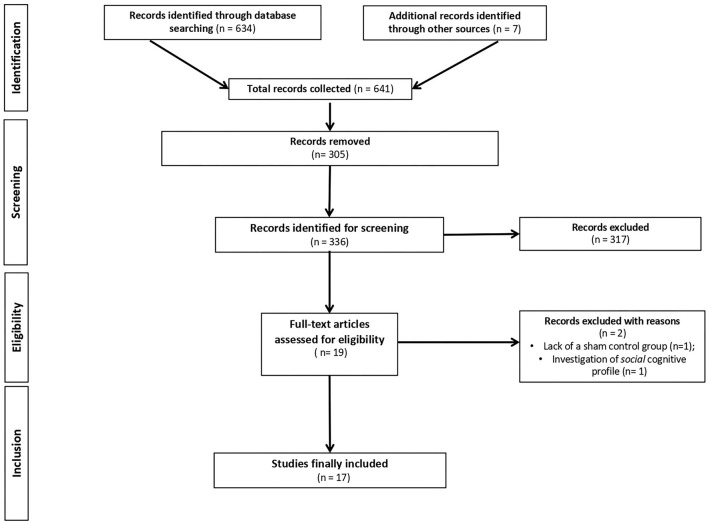
Alzheimer's disease (AD) and Parkinson's disease (PD) are neurodegenerative disorders characterized by cognitive impairment and functional decline increasing with disease progression. Within non-pharmacological interventions, transcranial direct current stimulation (tDCS) might represent a cost-effective rehabilitation strategy to implement cognitive abilities with positive implications for functional autonomy and quality-of-life of patients. Our systematic review aimed at evaluating the effects of tDCS upon cognition in people suffering from AD and PD. We searched for randomized controlled trials (RCTs) into PubMed, Web of Science, and Cochrane Library. Three review authors extracted data of interest, with neuropsychological tests or experimental cognitive tasks scores as outcome measures. A total of 17 RCTs (10 trials for AD and 7 trials for PD) were included. Compared with sham stimulation, tDCS may improve global cognition and recognition memory in patients with AD and also some executive functions (i.e., divided attention, verbal fluency, and reduction of sensitivity to interference) in patients with PD. Criticism remains about benefits for the other investigated cognitive domains. Despite preliminary emerging evidences, larger RCTs with common neuropsychological measures and long-term follow-ups establishing longevity of the observed effects are necessary for future research in applied psychology field, alongside improved clinical guidelines on the neurodegenerative disorders pertaining electrodes montage, sessions number, duration and intensity of the stimulation, and cognitive battery to be used.
阿尔茨海默病(AD)和帕金森病(PD)是神经退行性疾病,其特征是认知障碍和功能衰退随疾病进展而加重。在非药物干预措施中,经颅直流电刺激(tDCS)可能是一种具有成本效益的康复策略,可用于提高认知能力,对患者的功能自主性和生活质量产生积极影响。我们的系统评价旨在评估tDCS对AD和PD患者认知功能的影响。我们在PubMed、科学网和考科蓝图书馆中检索了随机对照试验(RCT)。三位综述作者提取了感兴趣的数据,以神经心理学测试或实验性认知任务分数作为结局指标。共纳入17项RCT(AD患者10项试验,PD患者7项试验)。与假刺激相比,tDCS可能改善AD患者的整体认知和识别记忆,也可能改善PD患者的一些执行功能(即分散注意力、语言流畅性和降低对干扰的敏感性)。对于其他研究的认知领域的益处仍存在争议。尽管有初步的新证据,但在应用心理学领域的未来研究中,仍需要更大规模的RCT,采用通用的神经心理学测量方法并进行长期随访,以确定观察到的效果的持续性,同时需要改进关于神经退行性疾病的临床指南,涉及电极安置、疗程数量、刺激的持续时间和强度以及所使用的认知测试组合。