• 文献检索
  • 文档翻译
  • 深度研究
  • 学术资讯
  • Suppr Zotero 插件Zotero 插件
  • 邀请有礼
  • 套餐&价格
  • 历史记录
应用&插件
Suppr Zotero 插件Zotero 插件浏览器插件Mac 客户端Windows 客户端微信小程序
定价
高级版会员购买积分包购买API积分包
服务
文献检索文档翻译深度研究API 文档MCP 服务
关于我们
关于 Suppr公司介绍联系我们用户协议隐私条款
关注我们

Suppr 超能文献

核心技术专利:CN118964589B侵权必究
粤ICP备2023148730 号-1Suppr @ 2026

文献检索

告别复杂PubMed语法,用中文像聊天一样搜索,搜遍4000万医学文献。AI智能推荐,让科研检索更轻松。

立即免费搜索

文件翻译

保留排版,准确专业,支持PDF/Word/PPT等文件格式,支持 12+语言互译。

免费翻译文档

深度研究

AI帮你快速写综述,25分钟生成高质量综述,智能提取关键信息,辅助科研写作。

立即免费体验

从日常咖啡因摄入中恢复所需的时间。

Time to Recover From Daily Caffeine Intake.

作者信息

Lin Yu-Shiuan, Weibel Janine, Landolt Hans-Peter, Santini Francesco, Garbazza Corrado, Kistler Joshua, Rehm Sophia, Rentsch Katharina, Borgwardt Stefan, Cajochen Christian, Reichert Carolin F

机构信息

Centre for Chronobiology, University Psychiatric Clinics Basel, Basel, Switzerland.

Transfaculty Research Platform Molecular and Cognitive Neurosciences, University of Basel, Basel, Switzerland.

出版信息

Front Nutr. 2022 Feb 2;8:787225. doi: 10.3389/fnut.2021.787225. eCollection 2021.

DOI:10.3389/fnut.2021.787225
PMID:35187019
原文链接:https://pmc.ncbi.nlm.nih.gov/articles/PMC8849224/
Abstract

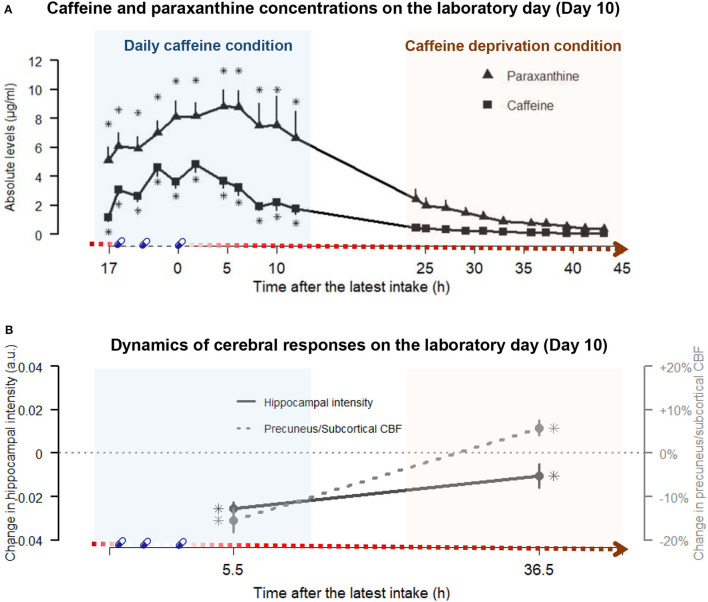
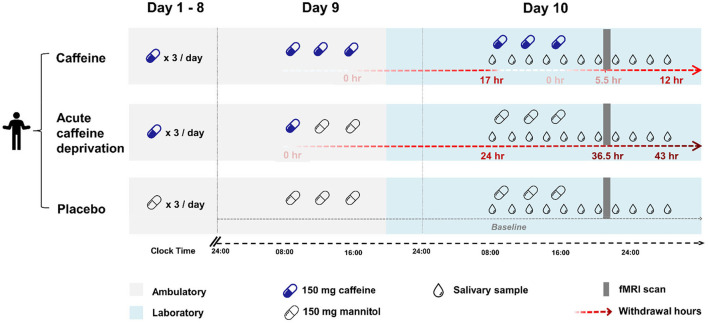
Caffeine elicits widespread effects in the central nervous system and is the most frequently consumed psychostimulant worldwide. First evidence indicates that, during daily intake, the elimination of caffeine may slow down, and the primary metabolite, paraxanthine, may accumulate. The neural impact of such adaptions is virtually unexplored. In this report, we leveraged the data of a laboratory study with = 20 participants and three within-subject conditions: caffeine (150 mg caffeine × 3/day × 10 days), placebo (150 mg mannitol × 3/day × 10 days), and acute caffeine deprivation (caffeine × 9 days, afterward placebo × 1 day). On day 10, we determined the course of salivary caffeine and paraxanthine using liquid chromatography-mass spectrometry coupled with tandem mass spectrometry. We assessed gray matter (GM) intensity and cerebral blood flow (CBF) after acute caffeine deprivation as compared to changes in the caffeine condition from our previous report. The results indicated that levels of paraxanthine and caffeine remained high and were carried overnight during daily intake, and that the levels of paraxanthine remained elevated after 24 h of caffeine deprivation compared to placebo. After 36 h of caffeine deprivation, the previously reported caffeine-induced GM reduction was partially mitigated, while CBF was elevated compared to placebo. Our findings unveil that conventional daily caffeine intake does not provide sufficient time to clear up psychoactive compounds and restore cerebral responses, even after 36 h of abstinence. They also suggest investigating the consequences of a paraxanthine accumulation during daily caffeine intake.

摘要

咖啡因在中枢神经系统中会引发广泛影响,是全球消费最为频繁的精神兴奋剂。初步证据表明,在日常摄入过程中,咖啡因的消除可能会减缓,其主要代谢产物副黄嘌呤可能会积累。而这种适应性变化对神经的影响几乎尚未得到探索。在本报告中,我们利用了一项实验室研究的数据,该研究有20名参与者,设置了三种受试者内条件:咖啡因组(150毫克咖啡因×每日3次×10天)、安慰剂组(150毫克甘露醇×每日3次×10天)以及急性咖啡因戒断组(咖啡因摄入9天,之后服用1天安慰剂)。在第10天,我们使用液相色谱 - 质谱联用串联质谱法测定唾液中咖啡因和副黄嘌呤的含量。与我们之前报告中咖啡因条件下的变化相比,我们评估了急性咖啡因戒断后的灰质(GM)强度和脑血流量(CBF)。结果表明,在日常摄入期间,副黄嘌呤和咖啡因的水平一直很高且会持续到夜间,并且与安慰剂相比,在咖啡因戒断24小时后副黄嘌呤水平仍然升高。在咖啡因戒断36小时后,之前报告的咖啡因引起的灰质减少部分得到缓解,而与安慰剂相比脑血流量升高。我们的研究结果表明,即使在戒断36小时后,常规的每日咖啡因摄入量也没有提供足够的时间来清除精神活性化合物并恢复大脑反应。它们还建议研究日常咖啡因摄入期间副黄嘌呤积累的后果。
https://cdn.ncbi.nlm.nih.gov/pmc/blobs/1d2c/8849224/73f14038b849/fnut-08-787225-g0003.jpg
https://cdn.ncbi.nlm.nih.gov/pmc/blobs/1d2c/8849224/9b2a6c75c309/fnut-08-787225-g0001.jpg
https://cdn.ncbi.nlm.nih.gov/pmc/blobs/1d2c/8849224/d6d3135aa0fd/fnut-08-787225-g0002.jpg
https://cdn.ncbi.nlm.nih.gov/pmc/blobs/1d2c/8849224/73f14038b849/fnut-08-787225-g0003.jpg
https://cdn.ncbi.nlm.nih.gov/pmc/blobs/1d2c/8849224/9b2a6c75c309/fnut-08-787225-g0001.jpg
https://cdn.ncbi.nlm.nih.gov/pmc/blobs/1d2c/8849224/d6d3135aa0fd/fnut-08-787225-g0002.jpg
https://cdn.ncbi.nlm.nih.gov/pmc/blobs/1d2c/8849224/73f14038b849/fnut-08-787225-g0003.jpg

相似文献

1
Time to Recover From Daily Caffeine Intake.从日常咖啡因摄入中恢复所需的时间。
Front Nutr. 2022 Feb 2;8:787225. doi: 10.3389/fnut.2021.787225. eCollection 2021.
2
Daily Caffeine Intake Induces Concentration-Dependent Medial Temporal Plasticity in Humans: A Multimodal Double-Blind Randomized Controlled Trial.每日咖啡因摄入诱导人类注意力依赖的内侧颞叶可塑性:一项多模态双盲随机对照试验。
Cereb Cortex. 2021 May 10;31(6):3096-3106. doi: 10.1093/cercor/bhab005.
3
Serum caffeine and paraxanthine as markers for reported caffeine intake in pregnancy.血清咖啡因和副黄嘌呤作为孕期报告咖啡因摄入量的标志物。
Ann Epidemiol. 1998 Feb;8(2):107-11. doi: 10.1016/s1047-2797(97)00125-7.
4
Brain activity during a working memory task after daily caffeine intake and caffeine withdrawal: a randomized double-blind placebo-controlled trial.每日摄入咖啡因和戒断咖啡因后进行工作记忆任务时的大脑活动:一项随机、双盲、安慰剂对照试验。
Sci Rep. 2023 Jan 18;13(1):1002. doi: 10.1038/s41598-022-26808-5.
5
Comparison of Caffeine and d-amphetamine in Cocaine-Dependent Subjects: Differential Outcomes on Subjective and Cardiovascular Effects, Reward Learning, and Salivary Paraxanthine.咖啡因与右旋苯丙胺对可卡因依赖者影响的比较:对主观及心血管效应、奖赏学习和唾液副黄嘌呤的不同作用
J Addict Res Ther. 2014;5(2):176. doi: 10.4172/2155-6105.1000176.
6
Sympathomimetic effects of paraxanthine and caffeine in humans.对羟基苯甲黄嘌呤和咖啡因对人体的拟交感神经作用。
Clin Pharmacol Ther. 1995 Dec;58(6):684-91. doi: 10.1016/0009-9236(95)90025-X.
7
Paraxanthine safety and comparison to caffeine.副黄嘌呤的安全性及与咖啡因的比较。
Front Toxicol. 2023 Feb 2;5:1117729. doi: 10.3389/ftox.2023.1117729. eCollection 2023.
8
An optimized and validated SPE-LC-MS/MS method for the determination of caffeine and paraxanthine in hair.一种用于测定毛发中咖啡因和副黄嘌呤的优化且经过验证的固相萃取-液相色谱-串联质谱法。
Talanta. 2015 Nov 1;144:62-70. doi: 10.1016/j.talanta.2015.05.084. Epub 2015 Jun 2.
9
Pharmacokinetics of caffeine in plasma and saliva, and the influence of caffeine abstinence on CYP1A2 metrics.血浆和唾液中咖啡因的药代动力学,以及咖啡因戒断对 CYP1A2 标志物的影响。
J Pharm Pharmacol. 2011 Sep;63(9):1161-8. doi: 10.1111/j.2042-7158.2011.01326.x. Epub 2011 Jul 6.
10
The impact of daily caffeine intake on nighttime sleep in young adult men.每日咖啡因摄入量对年轻成年男性夜间睡眠的影响。
Sci Rep. 2021 Feb 25;11(1):4668. doi: 10.1038/s41598-021-84088-x.

引用本文的文献

1
The dependence of CO cerebrovascular reactivity (CVR) on caffeine.一氧化碳脑血管反应性(CVR)对咖啡因的依赖性。
Imaging Neurosci (Camb). 2025 Aug 8;3. doi: 10.1162/IMAG.a.103. eCollection 2025.
2
Unveiling the influence of caffeine on topiramate: metabolomic marker analysis using liquid chromatography-mass spectrometry.揭示咖啡因对托吡酯的影响:使用液相色谱-质谱联用技术的代谢组学标志物分析
Front Mol Biosci. 2025 Jun 17;12:1549993. doi: 10.3389/fmolb.2025.1549993. eCollection 2025.
3
1-Methylxanthine enhances memory and neurotransmitter levels.

本文引用的文献

1
The impact of daily caffeine intake on nighttime sleep in young adult men.每日咖啡因摄入量对年轻成年男性夜间睡眠的影响。
Sci Rep. 2021 Feb 25;11(1):4668. doi: 10.1038/s41598-021-84088-x.
2
Daily Caffeine Intake Induces Concentration-Dependent Medial Temporal Plasticity in Humans: A Multimodal Double-Blind Randomized Controlled Trial.每日咖啡因摄入诱导人类注意力依赖的内侧颞叶可塑性:一项多模态双盲随机对照试验。
Cereb Cortex. 2021 May 10;31(6):3096-3106. doi: 10.1093/cercor/bhab005.
3
Caffeine has a dual influence on NMDA receptor-mediated glutamatergic transmission at the hippocampus.
1-甲基黄嘌呤可增强记忆力并提高神经递质水平。
PLoS One. 2025 Jan 16;20(1):e0313486. doi: 10.1371/journal.pone.0313486. eCollection 2025.
4
Caffeine and Arrhythmias: A Critical Analysis of Cardiovascular Responses and Arrhythmia Susceptibility.咖啡因与心律失常:心血管反应及心律失常易感性的批判性分析
J Saudi Heart Assoc. 2024 Nov 16;36(4):335-348. doi: 10.37616/2212-5043.1402. eCollection 2024.
5
Dose response effects of theacrine on cognitive performance and subsequent sleep.瓜拉纳对认知表现和随后睡眠的剂量反应影响。
Sci Rep. 2024 Nov 19;14(1):28614. doi: 10.1038/s41598-024-79046-2.
6
Effects of caffeine intake on pupillary parameters in humans: a systematic review and meta-analysis.咖啡因摄入对人体瞳孔参数的影响:系统评价和荟萃分析。
Behav Brain Funct. 2024 Aug 5;20(1):19. doi: 10.1186/s12993-024-00245-y.
7
Coffee Bean and Its Chemical Constituent Caffeine and Chlorogenic Acid as Promising Chemoprevention Agents: Updated Biological Studies against Cancer Cells.咖啡豆及其化学成分咖啡因和绿原酸作为有前途的化学预防剂:针对癌细胞的最新生物学研究。
Molecules. 2024 Jul 12;29(14):3302. doi: 10.3390/molecules29143302.
8
Repeated caffeine intake suppresses cerebral grey matter responses to chronic sleep restriction in an A adenosine receptor-dependent manner: a double-blind randomized controlled study with PET-MRI.重复摄入咖啡因以依赖于 A 腺苷受体的方式抑制慢性睡眠限制对大脑灰质反应:一项使用 PET-MRI 的双盲随机对照研究。
Sci Rep. 2024 Jun 3;14(1):12724. doi: 10.1038/s41598-024-61421-8.
9
Caffeine Release from Magneto-Responsive Hydrogels Controlled by External Magnetic Field and Calcium Ions and Its Effect on the Viability of Neuronal Cells.外部磁场和钙离子控制的磁响应水凝胶中咖啡因的释放及其对神经元细胞活力的影响
Polymers (Basel). 2023 Mar 31;15(7):1757. doi: 10.3390/polym15071757.
10
Brain activity during a working memory task after daily caffeine intake and caffeine withdrawal: a randomized double-blind placebo-controlled trial.每日摄入咖啡因和戒断咖啡因后进行工作记忆任务时的大脑活动:一项随机、双盲、安慰剂对照试验。
Sci Rep. 2023 Jan 18;13(1):1002. doi: 10.1038/s41598-022-26808-5.
咖啡因对海马体 NMDA 受体介导的谷氨酸能传递有双重影响。
Purinergic Signal. 2020 Dec;16(4):503-518. doi: 10.1007/s11302-020-09724-z. Epub 2020 Oct 6.
4
Caffeinated Coffee and Tea Consumption, Genetic Variation and Cognitive Function in the UK Biobank.含咖啡因咖啡和茶的摄入、基因变异与英国生物库中的认知功能。
J Nutr. 2020 Aug 1;150(8):2164-2174. doi: 10.1093/jn/nxaa147.
5
Caffeine Consumption in Switzerland: Results from the First National Nutrition Survey MenuCH.瑞士的咖啡因摄入量:首次国家营养调查菜单 CH 的结果。
Nutrients. 2019 Dec 20;12(1):28. doi: 10.3390/nu12010028.
6
Caffeine-dependent changes of sleep-wake regulation: Evidence for adaptation after repeated intake.咖啡因对睡眠-觉醒调节的依赖性变化:重复摄入后适应性的证据。
Prog Neuropsychopharmacol Biol Psychiatry. 2020 Apr 20;99:109851. doi: 10.1016/j.pnpbp.2019.109851. Epub 2019 Dec 19.
7
Cerebral blood flow changes after a day of wake, sleep, and sleep deprivation.清醒、睡眠和睡眠剥夺一天后大脑血流的变化。
Neuroimage. 2019 Feb 1;186:497-509. doi: 10.1016/j.neuroimage.2018.11.032. Epub 2018 Nov 22.
8
Daily Patterns of Caffeine Intake and the Association of Intake with Multiple Sociodemographic and Lifestyle Factors in US Adults Based on the NHANES 2007-2012 Surveys.基于 2007-2012 年 NHANES 调查,美国成年人咖啡因摄入的日常模式及其与多种社会人口学和生活方式因素的关联。
J Acad Nutr Diet. 2019 Jan;119(1):106-114. doi: 10.1016/j.jand.2018.08.152. Epub 2018 Nov 13.
9
Habitual coffee consumption and cognitive function: a Mendelian randomization meta-analysis in up to 415,530 participants.习惯性喝咖啡与认知功能:多达 415530 名参与者的孟德尔随机化荟萃分析。
Sci Rep. 2018 May 14;8(1):7526. doi: 10.1038/s41598-018-25919-2.
10
Interindividual Differences in Caffeine Metabolism and Factors Driving Caffeine Consumption.个体间咖啡因代谢的差异和影响咖啡因摄入的因素。
Pharmacol Rev. 2018 Apr;70(2):384-411. doi: 10.1124/pr.117.014407. Epub 2018 Mar 7.