Department of Radiation Oncology, University of California Davis School of Veterinary Medicine, Davis, California, USA.
Department of Radiation Oncology, University of California Davis, Medical Center, Sacramento, California, USA.
J Appl Clin Med Phys. 2022 Apr;23(4):e13551. doi: 10.1002/acm2.13551. Epub 2022 Feb 21.
The purpose of this work is to evaluate the Hyperscint-RP100 scintillation dosimetry research platform (Hyperscint-RP100, Medscint Inc., Quebec, QC, Canada) designed for clinical quality assurance (QA) for use in in vivo dosimetry measurements.
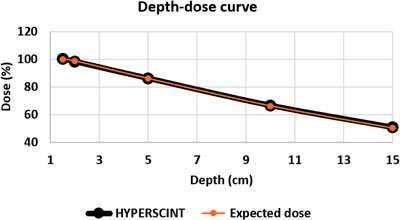
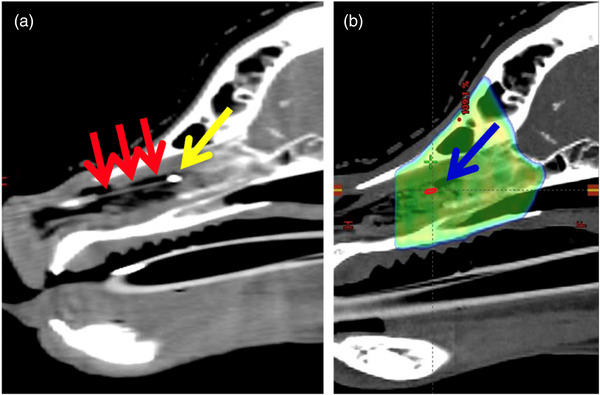
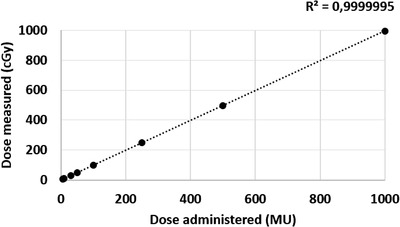
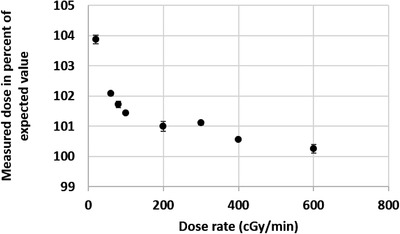
The pre-clinical evaluation of the scintillator was performed using a Varian TrueBeam linear accelerator. Dependency on field size, depth, dose, dose rate, and temperature were evaluated in a water tank and compared to calibration data from commissioning and annual QA. Angularity was evaluated with a 3D printed phantom. The clinical evaluation was first performed in two cadaver dogs, and then in three companion animal dogs receiving radiation therapy for nasal tumors. A treatment planning CT scan was performed for cadavers and clinical patients. Prior to treatment, the probe was inserted into the radiation field. Radiation was then delivered and measured with the scintillator. For cadavers, the treatment was repeated after making an intentional shift in patient position to simulate a treatment error.
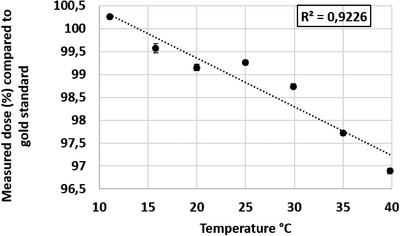
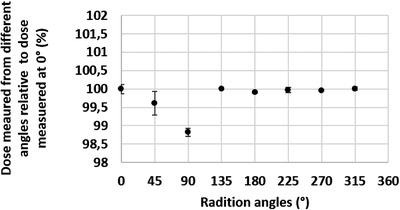
In the preclinical measurements the dose differed from annual measurements as follows: field size -0.77 to 0.43%, depth dose -0.36 to 1.14%, dose -0.54 to 2.93%, dose rate 0.3 to 3.6%, and angularity -1.18 to 0.01%. Temperature dependency required a correction factor of 0.11%/°C. In the two cadavers, the dose differed by -1.17 to 0.91%. The device correctly detected the treatment error when the heads were intentionally laterally shifted. In three canine clinical patients treated in multiple fractions, the detected dose ranged from 98.33 to 103.15%.
Results of this new device are promising although more work is necessary to fully validate it for clinical dosimetry.
本研究旨在评估 Hyperscint-RP100 闪烁体剂量测定研究平台(Hyperscint-RP100,Medscint Inc.,魁北克省,加拿大),该平台专为临床质量保证(QA)而设计,用于体内剂量测量。
在瓦里安 TrueBeam 线性加速器上对闪烁体进行了临床前评估。在水箱中评估了与射野大小、深度、剂量、剂量率和温度的依赖性,并与验收和年度 QA 的校准数据进行了比较。使用 3D 打印的模体评估了各向异性。首先在两只尸体犬中进行了临床评估,然后在三只接受鼻肿瘤放射治疗的伴侣动物犬中进行了临床评估。为尸体和临床患者进行了治疗计划 CT 扫描。在治疗前,将探头插入辐射场中。然后用闪烁体进行放射治疗并进行测量。对于尸体,在故意改变患者体位以模拟治疗误差后,重复治疗。
在临床前测量中,剂量与年度测量的差异如下:射野大小-0.77%至 0.43%,深度剂量-0.36%至 1.14%,剂量-0.54%至 2.93%,剂量率 0.3%至 3.6%,各向异性-1.18%至 0.01%。温度依赖性需要 0.11%/°C 的校正因子。在两只尸体中,剂量的差异为-1.17%至 0.91%。当头部被故意侧向移动时,该设备正确地检测到治疗误差。在三只接受多次分割治疗的犬临床患者中,检测到的剂量范围为 98.33%至 103.15%。
尽管需要进一步的工作来充分验证该设备在临床剂量学中的应用,但该新设备的结果是有希望的。