National Center for Complementary and Integrative Health, National Institutes of Health, Bethesda, Maryland.
National Center for Complementary and Integrative Health, National Institutes of Health, Bethesda, Maryland; Clinical Neuroscience Section, Karolinska Institutet, Solna, Sweden.
J Pain. 2022 Sep;23(9):1543-1555. doi: 10.1016/j.jpain.2022.01.011. Epub 2022 Feb 19.
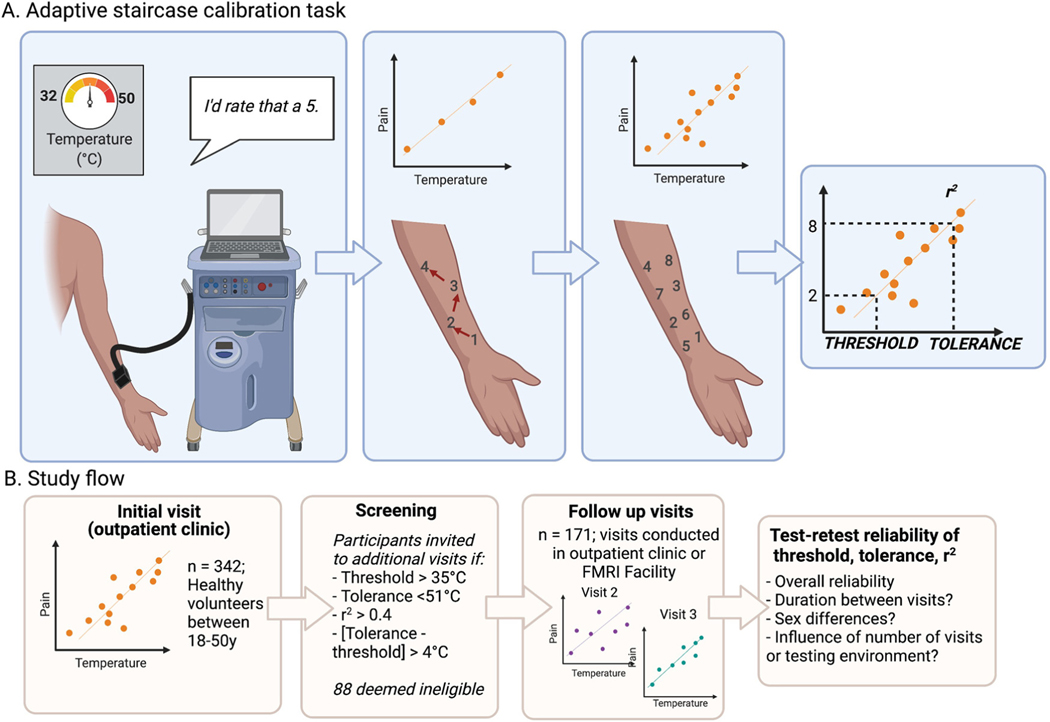
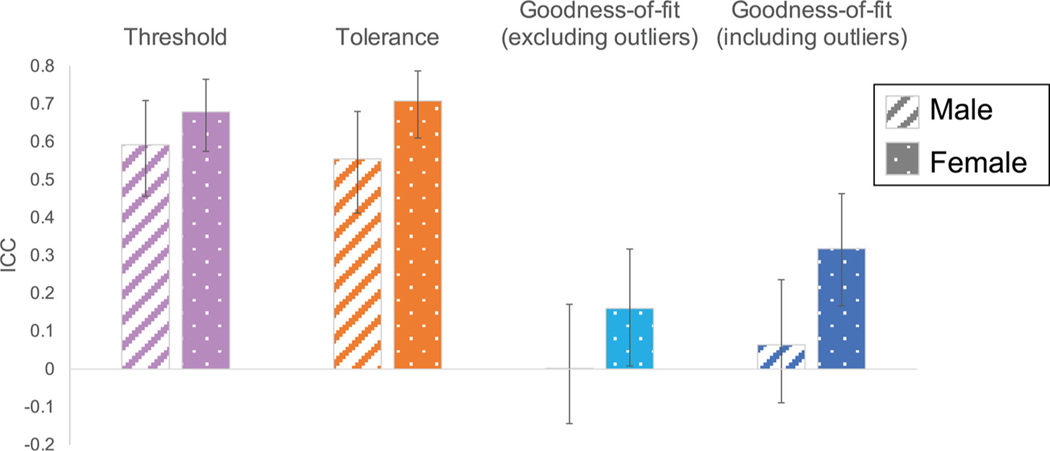
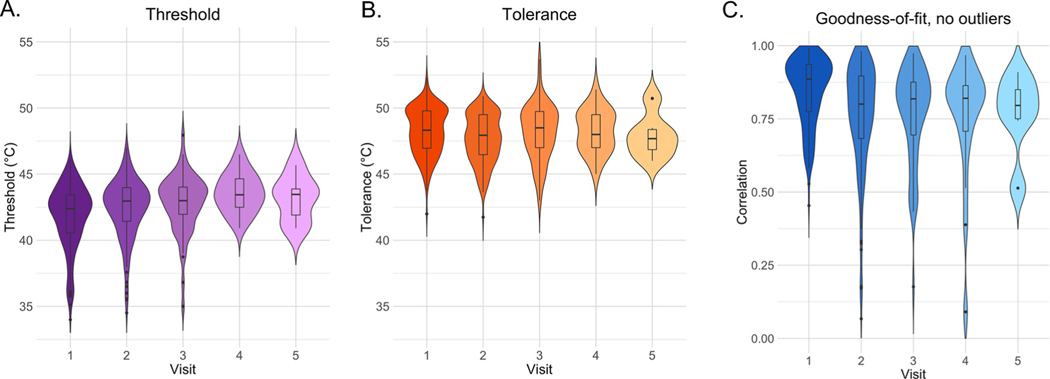
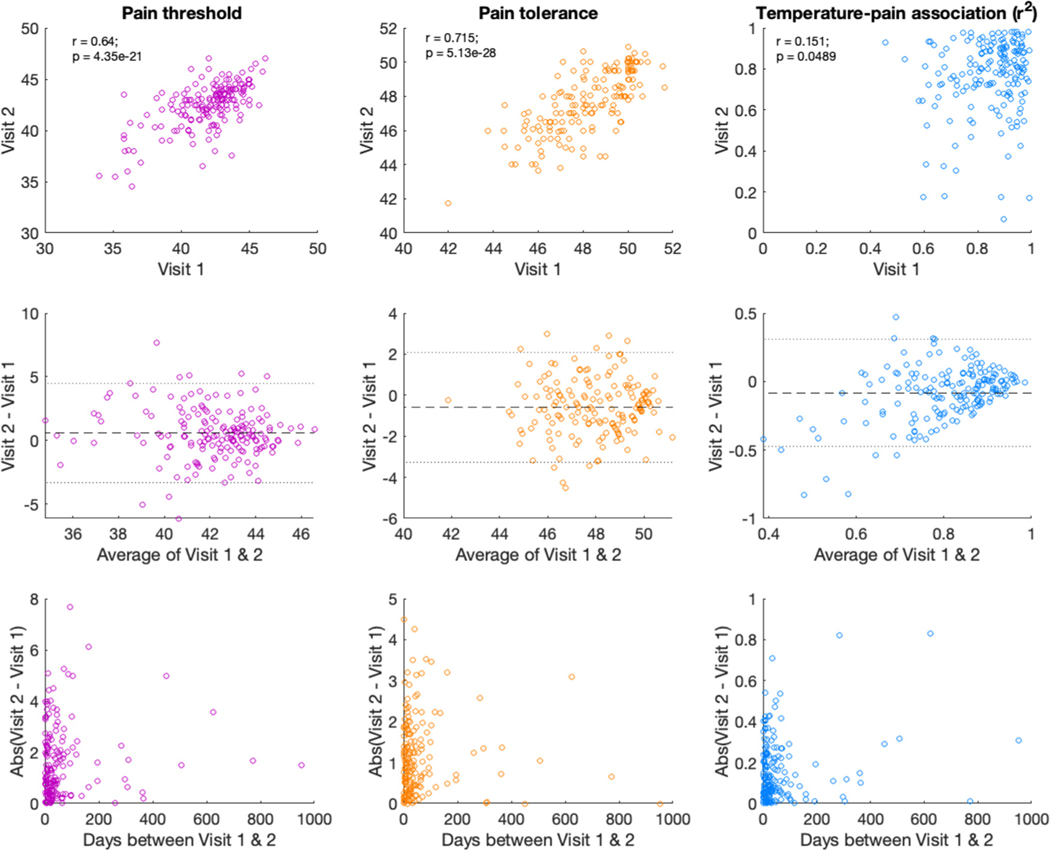
Quantitative sensory testing (QST) allows researchers to evaluate associations between noxious stimuli and acute pain in clinical populations and healthy participants. Despite its widespread use, our understanding of QST's reliability is limited, as reliability studies have used small samples and restricted time windows. We examined the reliability of pain ratings in response to noxious thermal stimulation in 171 healthy volunteers (n = 99 female, n = 72 male) who completed QST on multiple visits ranging from 1 day to 952 days between visits. On each visit, participants underwent an adaptive pain calibration in which they experienced 24 heat trials and rated pain intensity after stimulus offset on a 0 to 10 Visual Analog Scale. We used linear regression to determine pain threshold, pain tolerance, and the correlation between temperature and pain for each session and examined the reliability of these measures. Threshold and tolerance were moderately reliable (Intra-class correlation = .66 and .67, respectively; P < .001), whereas temperature-pain correlations had low reliability (Intra-class correlation = .23). In addition, pain tolerance was significantly more reliable in female participants than male participants, and we observed similar trends for other pain sensitive measures. Our findings indicate that threshold and tolerance are largely consistent across visits, whereas sensitivity to changes in temperature vary over time and may be influenced by contextual factors. PERSPECTIVE: This article assesses the reliability of an adaptive thermal pain calibration procedure. We find that pain threshold and tolerance are moderately reliable whereas the correlation between pain rating and stimulus temperature has low reliability. Female participants were more reliable than male participants on all pain sensitivity measures.
定量感觉测试 (QST) 可使研究人员在临床人群和健康参与者中评估有害刺激与急性疼痛之间的关系。尽管 QST 应用广泛,但由于可靠性研究采用的样本较小且时间窗口受限,我们对其可靠性的了解仍很有限。我们在 171 名健康志愿者(n=99 名女性,n=72 名男性)中检查了有害热刺激反应的疼痛评分的可靠性,这些志愿者在 1 天至 952 天的访问间隔内多次接受 QST。在每次访问中,参与者都会接受自适应疼痛校准,在此过程中,他们会经历 24 次热试验,并在刺激结束后在 0 到 10 的视觉模拟量表上对疼痛强度进行评分。我们使用线性回归来确定每个会话的疼痛阈值、疼痛耐受度和温度与疼痛之间的相关性,并检查这些测量值的可靠性。阈值和耐受度具有中等可靠性(组内相关系数分别为.66 和.67;P <.001),而温度-疼痛相关性的可靠性较低(组内相关系数为.23)。此外,女性参与者的疼痛耐受度明显比男性参与者更可靠,我们在其他疼痛敏感测量值中也观察到了类似的趋势。我们的研究结果表明,阈值和耐受度在很大程度上是一致的,而对温度变化的敏感性会随时间而变化,并且可能受到环境因素的影响。观点:本文评估了自适应热疼痛校准程序的可靠性。我们发现,疼痛阈值和耐受度具有中等可靠性,而疼痛评分与刺激温度之间的相关性的可靠性较低。在所有疼痛敏感性测量值上,女性参与者比男性参与者更可靠。