Theoretical and Computational Biophysics Group, NIH Center for Macromolecular Modeling and Bioinformatics, Beckman Institute for Advanced Science and Technology, Department of Biochemistry, and Center for Biophysics and Quantitative Biology, University of Illinois at Urbana-Champaign, Urbana, Illinois 61801, United States.
School of Medical Sciences, Faculty of Medicine and Health, University of Sydney, Camperdown, New South Wales 2006, Australia.
ACS Chem Neurosci. 2022 Mar 16;13(6):776-785. doi: 10.1021/acschemneuro.1c00769. Epub 2022 Feb 22.
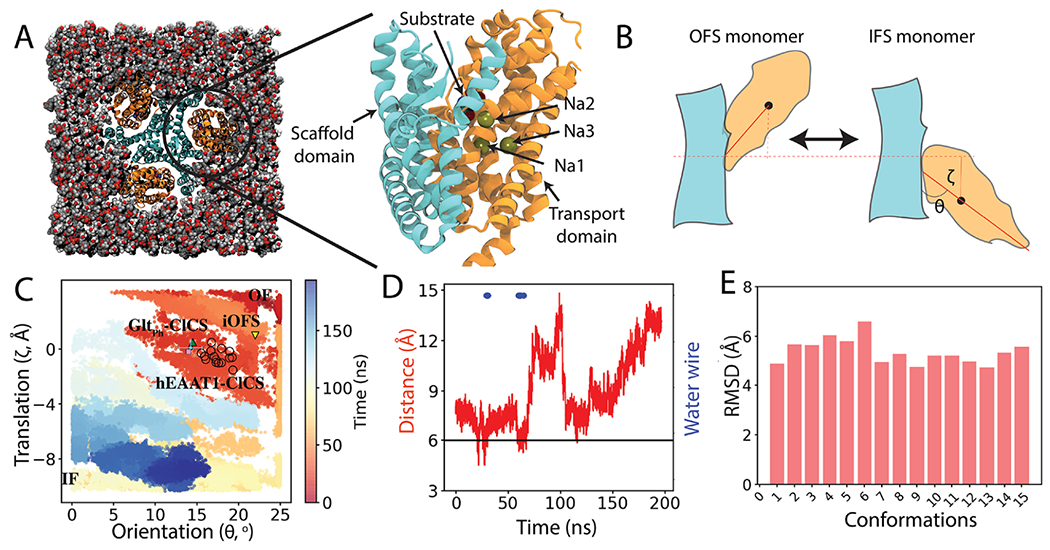
Excitatory amino acid transporters (EAATs) are glutamate transporters that belong to the solute carrier 1A (SLC1A) family. They couple glutamate transport to the cotransport of three sodium (Na) ions and one proton (H) and the counter-transport of one potassium (K) ion. In addition to this coupled transport, binding of cotransported species to EAATs activates a thermodynamically uncoupled chloride (Cl) conductance. Structures of SLC1A family members have revealed that these transporters use a twisting elevator mechanism of transport, where a mobile transport domain carries substrate and coupled ions across the membrane, while a static scaffold domain anchors the transporter in the membrane. We recently demonstrated that the uncoupled Cl conductance is activated by the formation of an aqueous pore at the domain interface during the transport cycle in archaeal Glt. However, a pathway for the uncoupled Cl conductance has not been reported for the EAATs, and it is unclear if such a pathway is conserved. Here, we employ all-atom molecular dynamics (MD) simulations combined with enhanced sampling, free-energy calculations, and experimental mutagenesis to approximate large-scale conformational changes during the transport process and identified a Cl-conducting conformation in human EAAT1 (hEAAT1). Sampling the large-scale structural transitions in hEAAT1 allowed us to capture an intermediate conformation formed during the transport cycle with a continuous aqueous pore at the domain interface. The free-energy calculations performed for the conduction of Cl and Na ions through the captured conformation highlight the presence of two hydrophobic gates that control low-barrier movement of Cl through the aqueous pathway. Overall, our findings provide insights into the mechanism by which a human neurotransmitter transporter supports functional duality of active transport and passive Cl permeation and confirm the commonality of this mechanism in different members of the SLC1A family.
兴奋性氨基酸转运体(EAATs)是谷氨酸转运体,属于溶质载体 1A(SLC1A)家族。它们将谷氨酸转运与共转运三个钠离子(Na)和一个质子(H)以及反向转运一个钾离子(K)结合在一起。除了这种偶联转运外,共转运物质与 EAAT 的结合会激活热力学上不偶联的氯离子(Cl)电导。SLC1A 家族成员的结构表明,这些转运体使用扭曲的电梯转运机制,其中可移动的转运结构域携带底物和共转运离子穿过膜,而静态支架结构域将转运体锚定在膜中。我们最近证明,在古细菌 Glt 的转运循环中,在结构域界面形成水相孔会激活不偶联的 Cl 电导。然而,尚未报道 EAAT 中存在不偶联 Cl 电导的途径,也不清楚该途径是否保守。在这里,我们使用全原子分子动力学(MD)模拟结合增强采样、自由能计算和实验诱变来近似转运过程中的大规模构象变化,并在人 EAAT1(hEAAT1)中鉴定出一种 Cl 传导构象。对 hEAAT1 中大规模结构转变的采样使我们能够捕获在转运循环中形成的中间构象,该构象在结构域界面处具有连续的水相孔。对通过捕获构象传导 Cl 和 Na 离子进行的自由能计算突出了两个疏水性门的存在,这些门控制 Cl 通过水相途径的低势垒运动。总体而言,我们的研究结果提供了对人神经递质转运体支持主动转运和被动 Cl 渗透功能双重性的机制的深入了解,并证实了这种机制在 SLC1A 家族不同成员中的共性。