Department of Anatomy, Faculty of Medicine and Allied Sciences, Rajarata University of Sri Lanka, Saliyapura, North Central, Sri Lanka
Department of Community Medicine, Faculty of Medicine and Allied Sciences, Rajarata University of Sri Lanka, Saliyapura, North Central, Sri Lanka.
BMJ Open Gastroenterol. 2022 Feb;9(1). doi: 10.1136/bmjgast-2021-000831.
Non-alcoholic fatty liver disease (NAFLD) is increasing globally with a mounting body of evidence on various adverse effects on pregnancy. Yet, prospective studies, especially from low-income and middle-income countries, are lacking in examining the impact of NAFLD in pregnancy. In this study, we explored the effect of NAFLD on the development of gestational diabetes mellitus (GDM) and early pregnancy miscarriages.
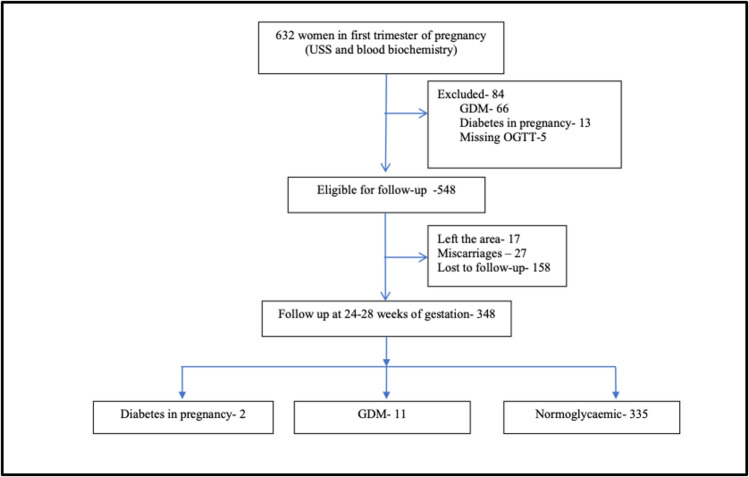
A population-based prospective cohort study was conducted among first-trimester pregnant women who registered in the national pregnancy care programme during July-September 2019 in Anuradhapura district, Sri Lanka. Baseline clinical-biochemical parameters and ultrasound scan (USS) of the liver were done to assess fatty liver. Those who were normoglycaemic based on WHO criteria were followed up, and a repeat oral glucose tolerance test was performed between 24 and 28 weeks of gestation.
Of the 632 pregnant women studied, 90 (14%) and 234 (37%) were diagnosed as having fatty liver grade (FLG) II and I, respectively. The cumulative incidence of GDM in FLG 0, I, and II were 11, 44, and 162 per 1000 pregnancies, respectively. After adjusting for age and other known risk factors, women with FLG II had a relative risk (RR) of 12.5 (95% CI 2.2 to 66.4) for developing GDM compared with FLG 0. In addition, women with FLG I (RR 2.1, 95% CI 1.01 to 4.64) and FLG II (RR 4.5, 95% CI 2.1 to 9.9) were significant risk factors for early pregnancy miscarriages, and FLG II remained as the only independent predictor of miscarriages after adjusting for age, parity, body mass index, blood sugar, blood pressure, and haemoglobin level (adjusted OR 4.2 (95% CI 1.9 to 9.1)).
In this rural south Asian community, NAFLD is shown to be a major risk factor for GDM and early pregnancy miscarriages. Therefore, routine identification of NAFLD through a simple USS may help in the early identification of high-risk mothers.
非酒精性脂肪性肝病(NAFLD)在全球范围内呈上升趋势,越来越多的证据表明其对妊娠有多种不良影响。然而,缺乏来自低收入和中等收入国家的前瞻性研究来检查 NAFLD 对妊娠的影响。在这项研究中,我们探讨了 NAFLD 对妊娠期糖尿病(GDM)和早期妊娠流产的影响。
这是一项在斯里兰卡阿努拉德普勒区于 2019 年 7 月至 9 月期间在全国妊娠保健计划中登记的初产妇中进行的基于人群的前瞻性队列研究。进行基线临床生物化学参数和肝脏超声检查(USS)以评估脂肪肝。根据世界卫生组织标准,那些血糖正常的孕妇将被随访,并在妊娠 24-28 周时进行重复口服葡萄糖耐量试验。
在 632 名孕妇中,90 名(14%)和 234 名(37%)分别被诊断为脂肪肝分级(FLG)II 和 I。FLG 0、I 和 II 的 GDM 累积发病率分别为每 1000 例妊娠 11、44 和 162 例。在调整年龄和其他已知危险因素后,与 FLG 0 相比,FLG II 妇女发生 GDM 的相对风险(RR)为 12.5(95%CI 2.2-66.4)。此外,FLG I(RR 2.1,95%CI 1.01-4.64)和 FLG II(RR 4.5,95%CI 2.1-9.9)的妇女是早期妊娠流产的显著危险因素,并且在调整年龄、产次、体重指数、血糖、血压和血红蛋白水平后,FLG II 仍然是流产的唯一独立预测因素(调整后 OR 4.2(95%CI 1.9-9.1))。
在这个南亚农村社区,NAFLD 是 GDM 和早期妊娠流产的主要危险因素。因此,通过简单的 USS 常规识别 NAFLD 可能有助于早期识别高危产妇。