Department of Environmental Sciences, The University of Toledo, Toledo, OH 43606;
Lake Erie Center, The University of Toledo, Oregon, OH 43616.
Proc Natl Acad Sci U S A. 2022 Mar 1;119(9). doi: 10.1073/pnas.2115033119.
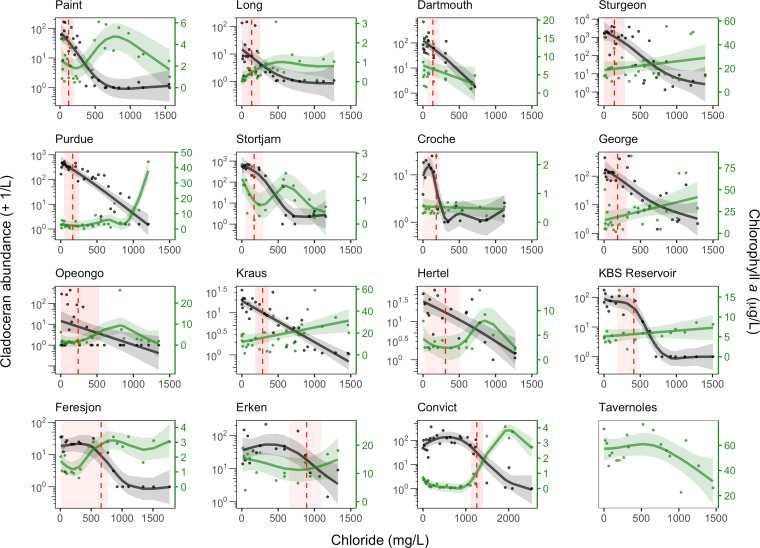
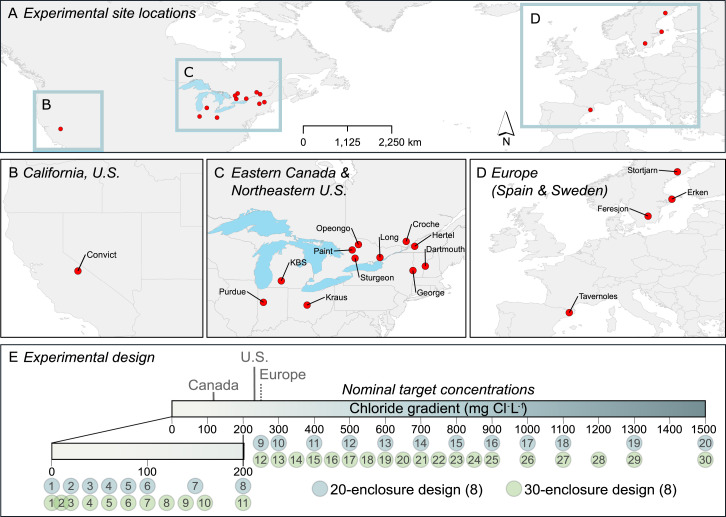
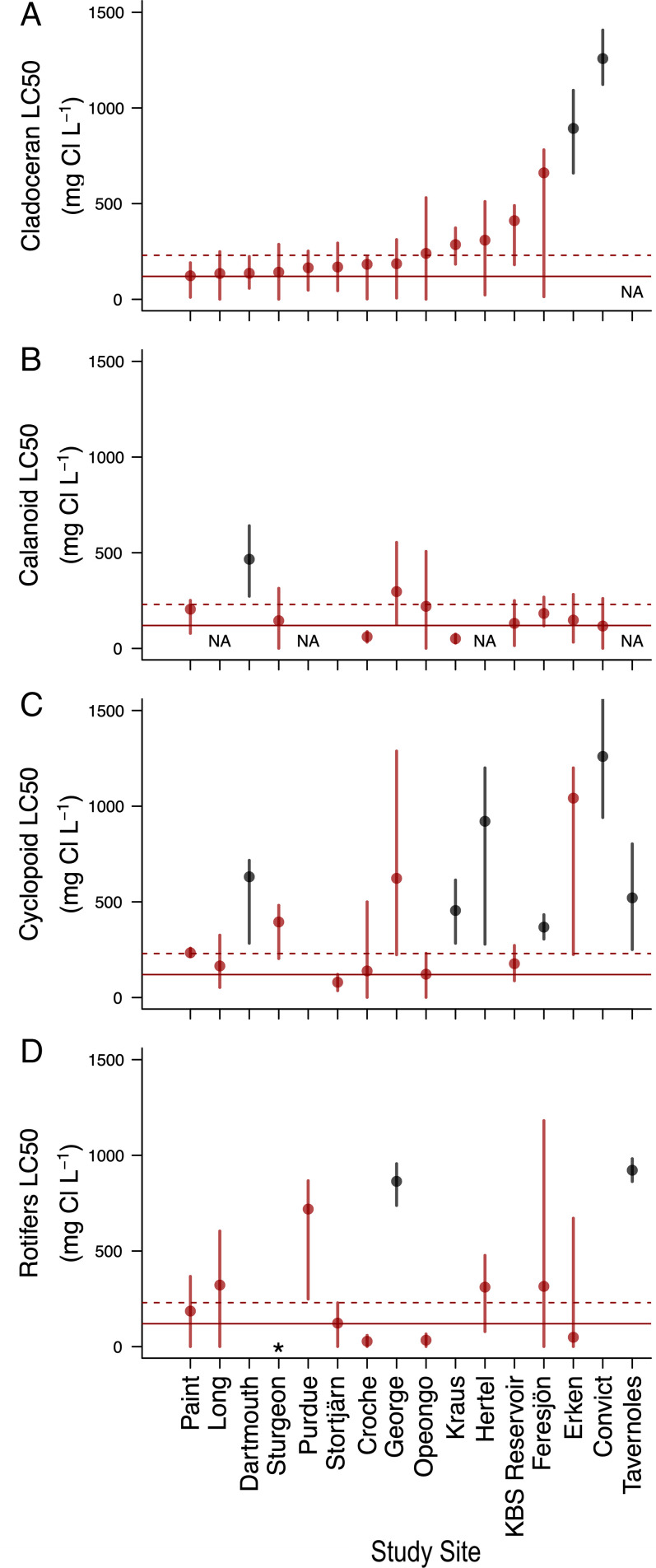
Human-induced salinization caused by the use of road deicing salts, agricultural practices, mining operations, and climate change is a major threat to the biodiversity and functioning of freshwater ecosystems. Yet, it is unclear if freshwater ecosystems are protected from salinization by current water quality guidelines. Leveraging an experimental network of land-based and in-lake mesocosms across North America and Europe, we tested how salinization-indicated as elevated chloride (Cl) concentration-will affect lake food webs and if two of the lowest Cl thresholds found globally are sufficient to protect these food webs. Our results indicated that salinization will cause substantial zooplankton mortality at the lowest Cl thresholds established in Canada (120 mg Cl/L) and the United States (230 mg Cl/L) and throughout Europe where Cl thresholds are generally higher. For instance, at 73% of our study sites, Cl concentrations that caused a ≥50% reduction in cladoceran abundance were at or below Cl thresholds in Canada, in the United States, and throughout Europe. Similar trends occurred for copepod and rotifer zooplankton. The loss of zooplankton triggered a cascading effect causing an increase in phytoplankton biomass at 47% of study sites. Such changes in lake food webs could alter nutrient cycling and water clarity and trigger declines in fish production. Current Cl thresholds across North America and Europe clearly do not adequately protect lake food webs. Water quality guidelines should be developed where they do not exist, and there is an urgent need to reassess existing guidelines to protect lake ecosystems from human-induced salinization.
人类活动导致的盐分增加,如使用道路除冰盐、农业活动、采矿作业和气候变化,对淡水生态系统的生物多样性和功能构成了重大威胁。然而,目前的水质指南是否能保护淡水生态系统免受盐分增加的影响还不清楚。利用跨越北美和欧洲的陆地和湖泊中尺度实验网络,我们测试了盐分增加(以升高的氯化物(Cl)浓度表示)将如何影响湖泊食物网,以及全球发现的两个最低 Cl 阈值是否足以保护这些食物网。我们的结果表明,盐分增加将在加拿大(120 毫克 Cl/L)和美国(230 毫克 Cl/L)以及欧洲建立的最低 Cl 阈值下导致大量浮游动物死亡,而欧洲的 Cl 阈值通常更高。例如,在我们研究的 73%的地点,导致枝角类动物数量减少 50%以上的 Cl 浓度与加拿大、美国和欧洲的 Cl 阈值相同或低于该阈值。桡足类和轮虫浮游动物也出现了类似的趋势。浮游动物的减少引发了级联效应,导致 47%的研究地点的浮游植物生物量增加。湖泊食物网的这些变化可能会改变养分循环和水的清澈度,并导致鱼类产量下降。目前,北美的 Cl 阈值和欧洲显然不能充分保护湖泊食物网。在没有这些标准的地方应该制定水质标准,并且迫切需要重新评估现有的准则,以保护湖泊生态系统免受人类引起的盐分增加的影响。