From the South African Medical Research Council Vaccine and Infectious Diseases Analytics Research Unit (S.A.M., G.K., N.D., C.K.M., A.J.N., P.C.M.) and African Leadership in Vaccinology Expertise (S.A.M., G.K.), University of the Witwatersrand, the National Institute for Communicable Diseases, National Health Laboratory Service (W.J., L.B., R.W.), and ResearchLinkMe (N.N.-M.), Johannesburg, the Centre for Environmental and Occupational Health Research, School of Public Health and Family Medicine, University of Cape Town, Cape Town (J.E.M.), and Right to Care, Centurion (L.B.) - all in South Africa.
N Engl J Med. 2022 Apr 7;386(14):1314-1326. doi: 10.1056/NEJMoa2119658. Epub 2022 Feb 23.
The B.1.1.529 (omicron) variant of severe acute respiratory syndrome coronavirus 2 (SARS-CoV-2) was first identified on November 25, 2021, in Gauteng province, South Africa. Data regarding the seroprevalence of SARS-CoV-2 IgG in Gauteng before the fourth wave of coronavirus disease 2019 (Covid-19), in which the omicron variant was dominant, are needed.
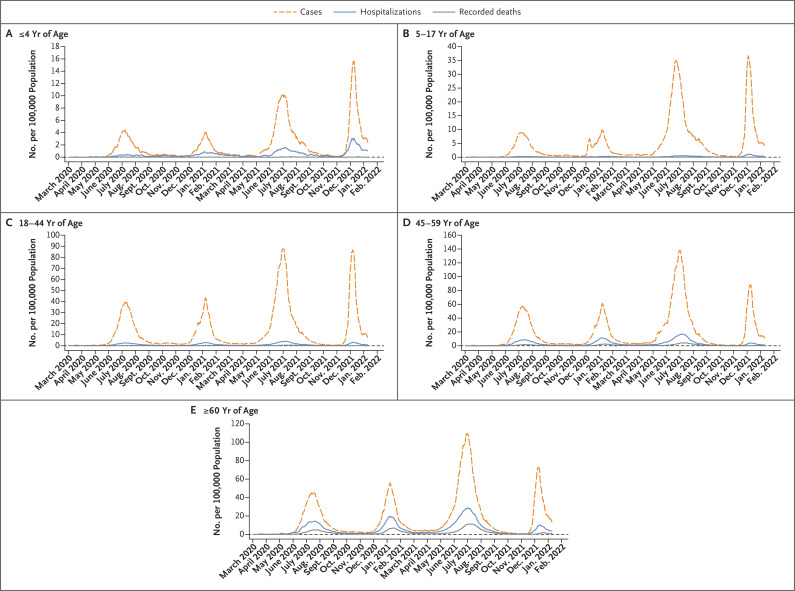
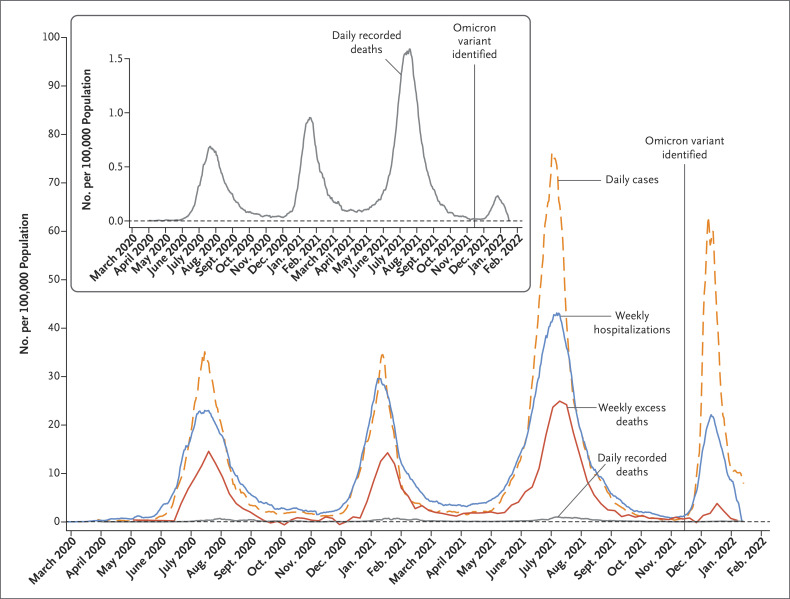
We conducted a seroepidemiologic survey from October 22 to December 9, 2021, in Gauteng to determine the seroprevalence of SARS-CoV-2 IgG. Households included in a previous seroepidemiologic survey (conducted from November 2020 to January 2021) were contacted; to account for changes in the survey population, there was a 10% increase in the households contacted, with the use of the same sampling framework. Dried-blood-spot samples were tested for IgG against SARS-CoV-2 spike protein and nucleocapsid protein with the use of quantitative assays. We also evaluated Covid-19 epidemiologic trends in Gauteng, including cases, hospitalizations, recorded deaths, and excess deaths from the start of the pandemic through January 12, 2022.
Samples were obtained from 7010 participants, of whom 1319 (18.8%) had received a Covid-19 vaccine. The seroprevalence of SARS-CoV-2 IgG ranged from 56.2% (95% confidence interval [CI], 52.6 to 59.7) among children younger than 12 years of age to 79.7% (95% CI, 77.6 to 81.5) among adults older than 50 years of age. Vaccinated participants were more likely to be seropositive for SARS-CoV-2 than unvaccinated participants (93.1% vs. 68.4%). Epidemiologic data showed that the incidence of SARS-CoV-2 infection increased and subsequently declined more rapidly during the fourth wave than it had during the three previous waves. The incidence of infection was decoupled from the incidences of hospitalization, recorded death, and excess death during the fourth wave, as compared with the proportions seen during previous waves.
Widespread underlying SARS-CoV-2 seropositivity was observed in Gauteng before the omicron-dominant wave of Covid-19. Epidemiologic data showed a decoupling of hospitalizations and deaths from infections while omicron was circulating. (Funded by the Bill and Melinda Gates Foundation.).
2021 年 11 月 25 日,南非豪登省首次发现了严重急性呼吸综合征冠状病毒 2(SARS-CoV-2)的 B.1.1.529(奥密克戎)变体。在 2019 年冠状病毒病(COVID-19)第四波疫情(奥密克戎变体为主导)之前,豪登省需要 SARS-CoV-2 IgG 的血清阳性率数据。
我们于 2021 年 10 月 22 日至 12 月 9 日在豪登省进行了一项血清流行病学调查,以确定 SARS-CoV-2 IgG 的血清阳性率。联系了之前的血清流行病学调查(2020 年 11 月至 2021 年 1 月进行)中包括的家庭;为了说明调查人群的变化,联系了增加 10%的家庭,使用相同的抽样框架。使用定量检测法检测针对 SARS-CoV-2 刺突蛋白和核衣壳蛋白的 IgG 抗体。我们还评估了豪登省 COVID-19 的流行病学趋势,包括从大流行开始到 2022 年 1 月 12 日的病例、住院、记录的死亡和超额死亡。
从 7010 名参与者中获得了样本,其中 1319 名(18.8%)接种了 COVID-19 疫苗。SARS-CoV-2 IgG 的血清阳性率在 12 岁以下儿童中为 56.2%(95%置信区间[CI],52.6 至 59.7),在 50 岁以上成年人中为 79.7%(95%CI,77.6 至 81.5)。接种疫苗的参与者比未接种疫苗的参与者更有可能对 SARS-CoV-2 呈血清阳性(93.1%比 68.4%)。流行病学数据显示,与之前的三波疫情相比,在第四波疫情期间,SARS-CoV-2 感染的发病率增加,随后迅速下降。在第四波疫情期间,感染的发病率与住院、记录的死亡和超额死亡的发病率脱钩,而在之前的波次中则是相关的。
在 COVID-19 奥密克戎主导波之前,豪登省已广泛存在 SARS-CoV-2 血清阳性。流行病学数据显示,奥密克戎传播期间,住院和死亡与感染脱钩。(由比尔及梅琳达·盖茨基金会资助)。