CHU de Caen Normandie, Department of Microbiology, Caen, France.
CHU de Caen Normandie, Department of Haematology, Caen, France.
Microbiol Spectr. 2022 Feb 23;10(1):e0183021. doi: 10.1128/spectrum.01830-21.
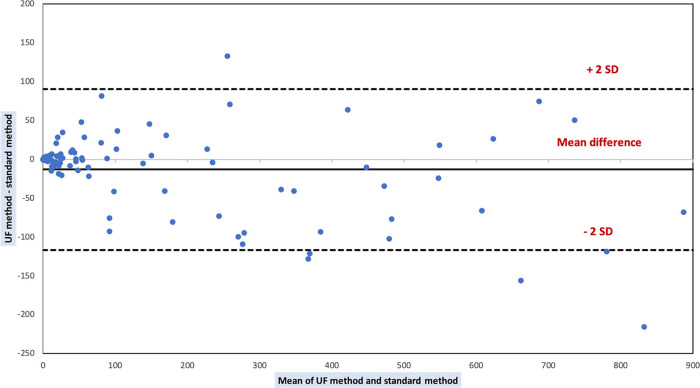
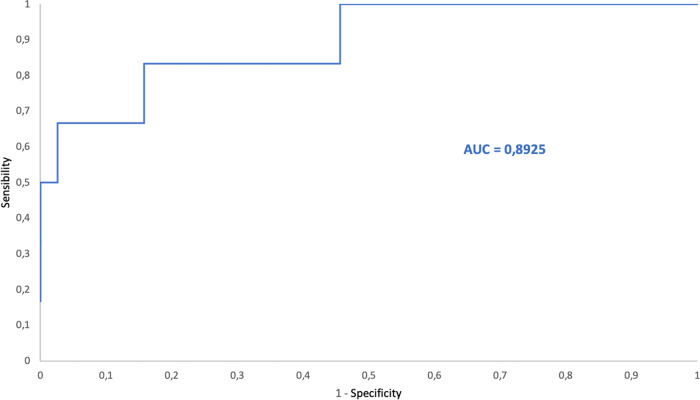
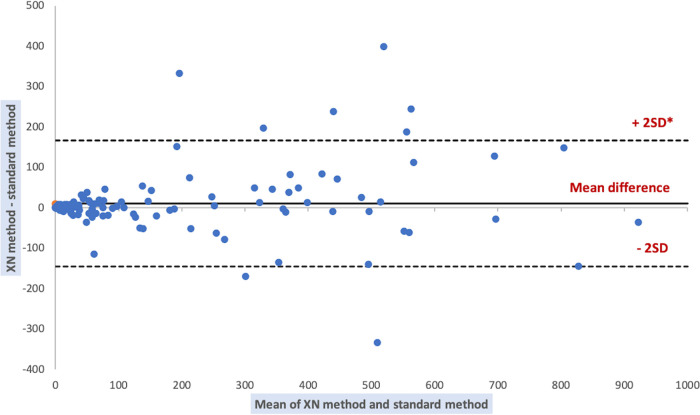
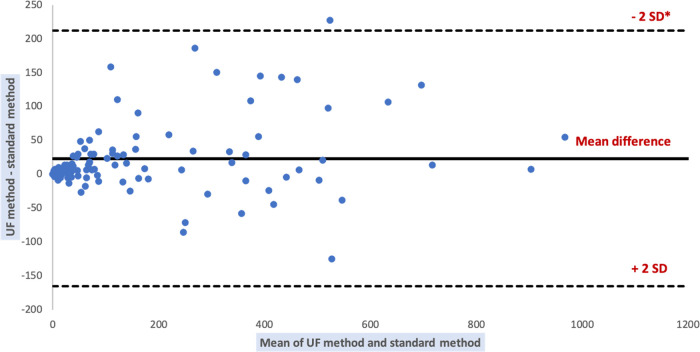
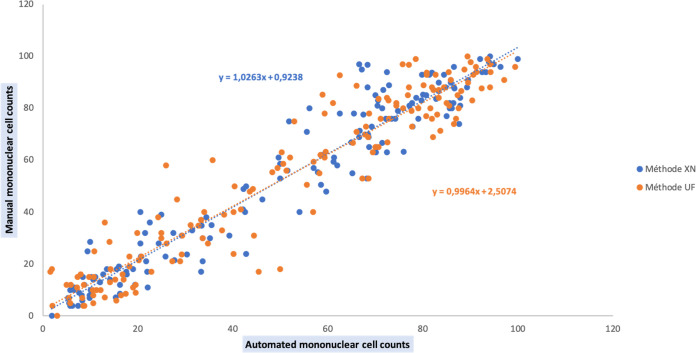
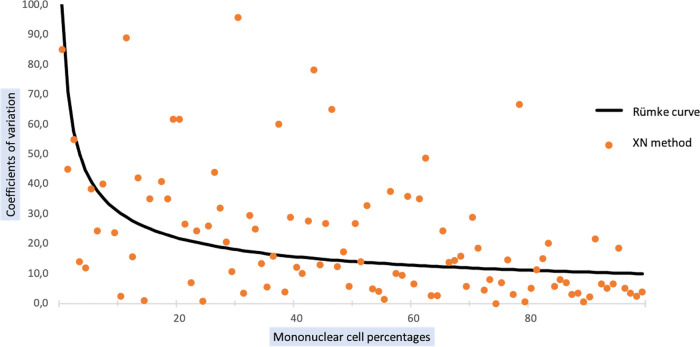
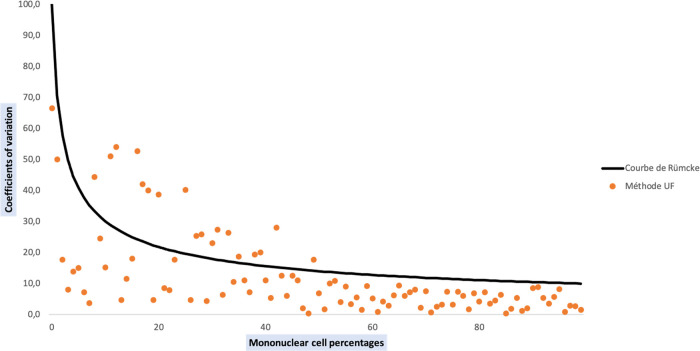
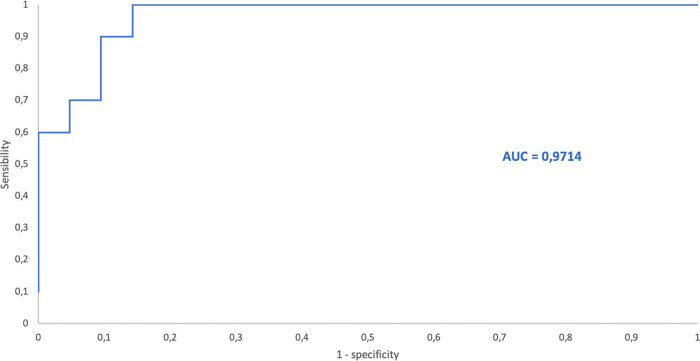
The analysis of biological fluids is crucial for the diagnosis and monitoring of diseases causing effusions and helps in the diagnosis of infectious diseases. The gold standard method for cell count in biological fluids is the manual method using counting chambers. The microbiological routine procedures consist of Direct Gram staining and culture on solid or liquid media. We evaluate the analytical performance of SYSMEX UF4000 (Sysmex, Kobe, Japan) and Sysmex XN10 (Sysmex, Kobe, Japan) in comparison with cytological and microbiological routine procedures. A total of 526 biological fluid samples were included in this study (42 ascitic, 31 pleural, 31 peritoneal, 125 cerebrospinal, 281 synovial, and 16 peritoneal dialysis fluids). All samples were analyzed by flow cytometry and subsequently processed following cytological and/or microbiological routine procedures. With regard to cell counts, UF4000 (Sysmex, Kobe, Japan) showed a performance that was at least equivalent to those of the reference methods and superior to those of XN10 (Sysmex, Kobe, Japan). Moreover, the bacterial count obtained with UF4000 (Sysmex, Kobe, Japan) was significantly higher among culture or Direct Gram stain positive samples. We established three optimal cutoff points to predict Direct Gram stain positive samples for peritoneal (465.0 bacteria/μL), synovial (1200.0 bacteria/μL), and cerebrospinal fluids (17.2 bacteria/μL) with maximum sensitivity and negative predictive values. Cell count and detection of bacteria by flow cytometry could be used upstream cytological and microbiological routine procedures to improve and accelerate the diagnosis of infection of biological fluid samples. The analysis of biological fluids is crucial for the diagnosis and monitoring of diseases causing effusions and helps in the diagnosis of infectious diseases. The possibility of carrying out cytological and microbiological analyses of biological fluid samples on the same automated machine would simplify the sample circuit (addressing the sample in a single laboratory, 24/7). It would also minimize the quantity of sample required. The performance of cytological and microbiological analysis by the flow cytometer UF 4000 (Sysmex, Kobe, Japan) has never been evaluated yet. This study has shown that bacterial count by flow cytometry using UF4000 (Sysmex, Kobe, Japan) could be used upstream of microbiological routine procedures to improve and to accelerate the diagnosis of infection of biological fluid samples.
生物体液分析对于渗出液相关疾病的诊断和监测至关重要,并有助于感染性疾病的诊断。生物体液细胞计数的金标准方法是使用计数室的手动方法。微生物常规程序包括直接革兰氏染色和固体或液体培养基培养。我们评估了 SYSMEX UF4000(Sysmex,神户,日本)和 Sysmex XN10(Sysmex,神户,日本)与细胞学和微生物常规程序相比的分析性能。本研究共纳入 526 例生物体液样本(42 例腹水、31 例胸水、31 例腹水、125 例脑脊液、281 例滑液和 16 例腹膜透析液)。所有样本均采用流式细胞术进行分析,随后按照细胞学和/或微生物常规程序进行处理。就细胞计数而言,UF4000(Sysmex,神户,日本)的性能至少与参考方法相当,优于 XN10(Sysmex,神户,日本)。此外,UF4000(Sysmex,神户,日本)获得的细菌计数在培养或直接革兰氏染色阳性样本中显著更高。我们建立了三个最佳截断值来预测腹膜(465.0 个细菌/μL)、滑液(1200.0 个细菌/μL)和脑脊液(17.2 个细菌/μL)的直接革兰氏染色阳性样本,具有最高的灵敏度和阴性预测值。通过流式细胞术进行细胞计数和细菌检测可用于细胞学分型和微生物常规程序之前,以改善和加速生物体液样本感染的诊断。生物体液分析对于渗出液相关疾病的诊断和监测至关重要,并有助于感染性疾病的诊断。在同一台自动化机器上进行生物体液样本的细胞学和微生物学分析的可能性将简化样本流程(在一个实验室中处理样本,24/7)。它还将最大限度地减少所需的样本量。UF4000(Sysmex,神户,日本)流式细胞仪的细胞和微生物分析性能尚未得到评估。本研究表明,UF4000(Sysmex,神户,日本)的流式细胞术细菌计数可用于微生物常规程序之前,以改善和加速生物体液样本感染的诊断。