Guo Yuyang, Zhao Baihua, Zhou Shan, Wen Lieming, Liu Jieyu, Fu Yaqian, Xu Fang, Liu Minghui
Department of Ultrasound Diagnosis, The Second Xiangya Hospital, Central South University, Changsha, China.
Health Management Center, The Second Xiangya Hospital, Central South University, Changsha, China.
Ultrasonography. 2022 Jul;41(3):511-518. doi: 10.14366/usg.21237. Epub 2022 Jan 31.
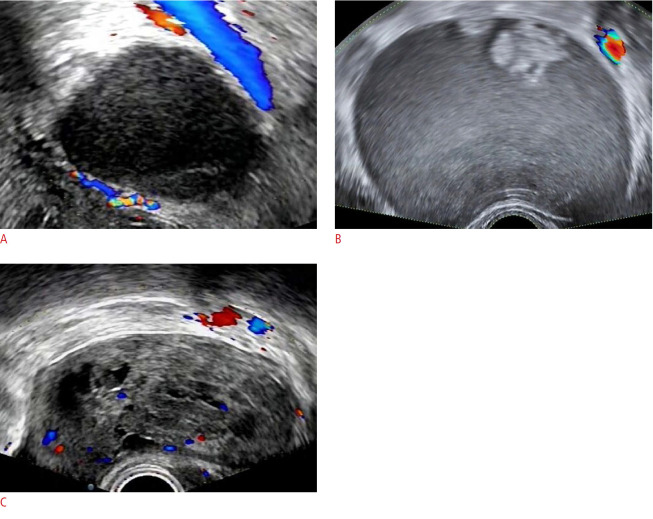
This study compared the diagnostic performance of the Ovarian-Adnexal Reporting and Data System (O-RADS), the Risk of Malignancy Index 4 (RMI4), the International Ovarian of Tumor Analysis Logistic Regression Model 2 (IOTA LR2), and the IOTA Simple Rules (IOTA SR) in predicting the malignancy of adnexal masses (AMs).
This retrospective study included 575 women with AMs between 2017 and 2020. All clinical messages, ultrasound images, and pathological findings were collected. Two senior doctors (group I) and two junior doctors (group II) used the four systems to classify AMs. The postoperative pathological diagnosis was used as the gold standard to evaluate the diagnostic efficiency. A receiver operating characteristic curve was used to test the diagnostic performance. The interrater agreement between the two groups was tested using kappa values.
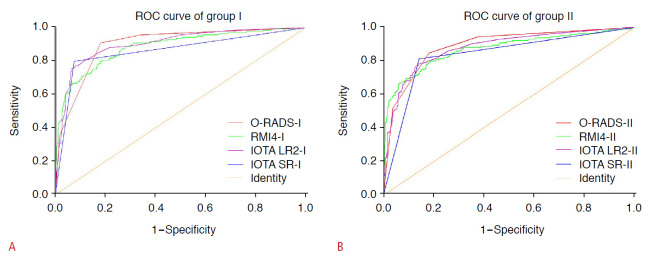
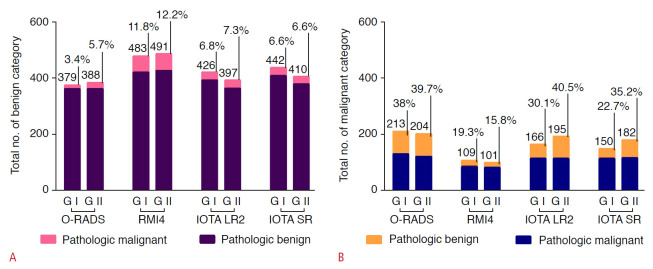
Of all 592 AMs, 447 (75.5%) were benign, 123 (20.8%) were malignant, and 22 (3.7%) were borderline. The intergroup consistency test yielded kappa values of 0.71, 0.92, 0.68, and 0.77 for the O-RADS, RMI4, IOTA LR2, and IOTA SR, respectively. To predict malignant lesions, the areas under the curve of the O-RADS, RMI4, IOTA LR2, and IOTA SR systems were 0.90, 0.89, 0.90, and 0.86 for group I and 0.89, 0.87, 0.88, and 0.84 for group II, respectively. The O-RADS had the highest sensitivity (91.0% in group I and 84.8% in group II).
The four diagnostic systems could compensate for junior doctors' inexperience in predicting malignant adnexal lesions. The O-RADS performed best and showed the highest sensitivity.
本研究比较了卵巢附件报告和数据系统(O-RADS)、恶性风险指数4(RMI4)、国际卵巢肿瘤分析逻辑回归模型2(IOTA LR2)和IOTA简单规则(IOTA SR)在预测附件包块(AM)恶性程度方面的诊断性能。
这项回顾性研究纳入了2017年至2020年间575例患有AM的女性。收集了所有临床信息、超声图像和病理结果。两名资深医生(第一组)和两名初级医生(第二组)使用这四种系统对AM进行分类。术后病理诊断作为评估诊断效率的金标准。采用受试者工作特征曲线来测试诊断性能。使用kappa值来测试两组之间的评分者间一致性。
在所有592个AM中,447个(75.5%)为良性,123个(20.8%)为恶性,22个(3.7%)为交界性。O-RADS、RMI4、IOTA LR2和IOTA SR的组间一致性测试kappa值分别为0.71、0.92、0.68和0.77。为预测恶性病变,O-RADS、RMI4、IOTA LR2和IOTA SR系统在第一组中的曲线下面积分别为0.90、0.89、0.90和0.86,在第二组中分别为0.89、0.87、0.88和0.84。O-RADS具有最高的敏感性(第一组为91.0%,第二组为84.8%)。
这四种诊断系统可以弥补初级医生在预测附件恶性病变方面的经验不足。O-RADS表现最佳,敏感性最高。