Hu Jingqiong, Wang Xiaochuan
Stem Cell Center, Department of Cell Therapy, Union Hospital, Tongji Medical College, Huazhong University of Science and Technology, Wuhan, China.
Co-innovation Center of Neuroregeneration, Nantong University, Nantong, China.
Front Cell Neurosci. 2022 Feb 7;15:811852. doi: 10.3389/fncel.2021.811852. eCollection 2021.
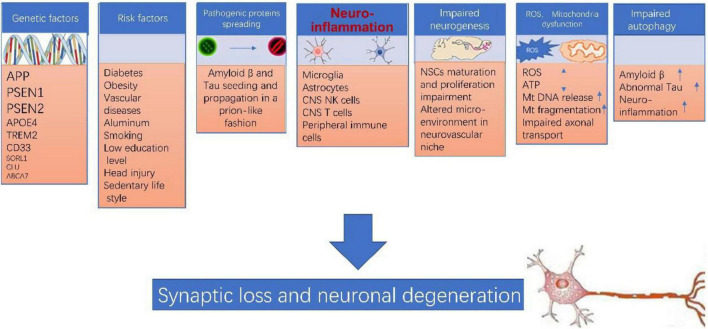
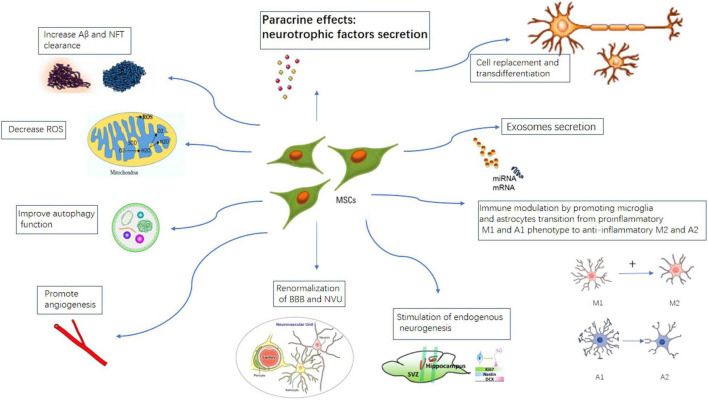
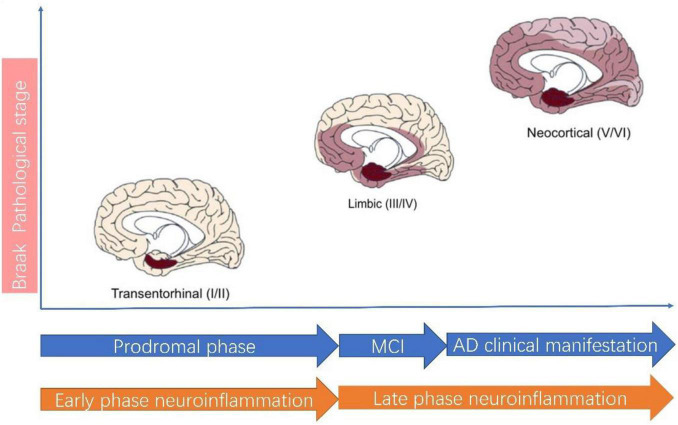
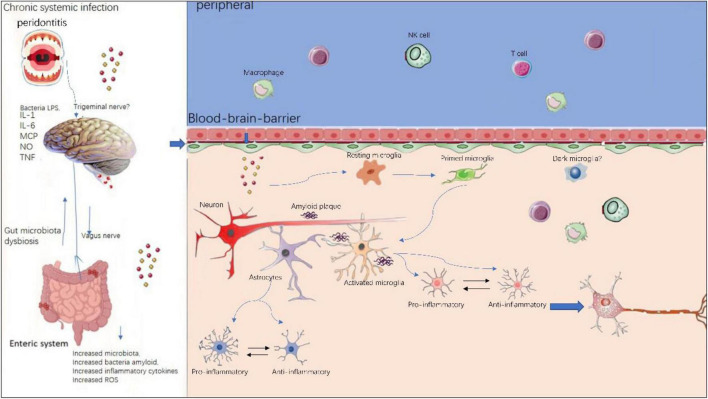
Alzheimer's disease (AD) is the most prevalent neurodegenerative disease worldwide. With the increasing trend of population aging, the estimated number of AD continues to climb, causing enormous medical, social and economic burden to the society. Currently, no drug is available to cure the disease or slow down its progression. There is an urgent need to improve our understanding on the pathogenesis of AD and develop novel therapy to combat it. Despite the two well-known pathological hallmarks (extracellular amyloid plaques and intracellular Neurofibrillary Tangles), the exact mechanisms for selective degeneration and loss of neurons and synapses in AD remain to be elucidated. Cumulative studies have shown neuroinflammation plays a central role in pathogenesis of AD. Neuroinflammation is actively involved both in the onset and the subsequent progression of AD. Microglia are the central player in AD neuroinflammation. In this review, we first introduced the different theories proposed for the pathogenesis of AD, focusing on neuroinflammation, especially on microglia, systemic inflammation, and peripheral and central immune system crosstalk. We explored the possible mechanisms of action of stem cell therapy, which is the only treatment modality so far that has pleiotropic effects and can target multiple mechanisms in AD. Mesenchymal stem cells are currently the most widely used stem cell type in AD clinical trials. We summarized the ongoing major mesenchymal stem cell clinical trials in AD and showed how translational stem cell therapy is bridging the gap between basic science and clinical intervention in this devastating disorder.
阿尔茨海默病(AD)是全球最常见的神经退行性疾病。随着人口老龄化趋势的加剧,AD的预估患病人数持续攀升,给社会带来了巨大的医疗、社会和经济负担。目前,尚无药物能够治愈该疾病或减缓其进展。迫切需要加深我们对AD发病机制的理解,并开发新的治疗方法来对抗它。尽管有两个广为人知的病理特征(细胞外淀粉样斑块和细胞内神经原纤维缠结),但AD中神经元和突触选择性退化和丧失的确切机制仍有待阐明。累积研究表明,神经炎症在AD发病机制中起核心作用。神经炎症积极参与AD的发病及后续进展。小胶质细胞是AD神经炎症的核心参与者。在本综述中,我们首先介绍了针对AD发病机制提出的不同理论,重点关注神经炎症,特别是小胶质细胞、全身炎症以及外周和中枢免疫系统的相互作用。我们探讨了干细胞治疗的可能作用机制,干细胞治疗是目前为止唯一具有多效性且能针对AD多种机制的治疗方式。间充质干细胞是目前AD临床试验中使用最广泛的干细胞类型。我们总结了正在进行的AD主要间充质干细胞临床试验,并展示了转化性干细胞治疗如何在这种毁灭性疾病中弥合基础科学与临床干预之间的差距。