Laboratory of Neurobiology, Faculty of Veterinary Medicine and Animal Science, Poznań University of Life Sciences, Poznań, Poland.
Molecular and Cell Biology Unit, Poznań University of Medical Sciences, Poznań, Poland.
Front Endocrinol (Lausanne). 2022 Feb 7;13:785674. doi: 10.3389/fendo.2022.785674. eCollection 2022.
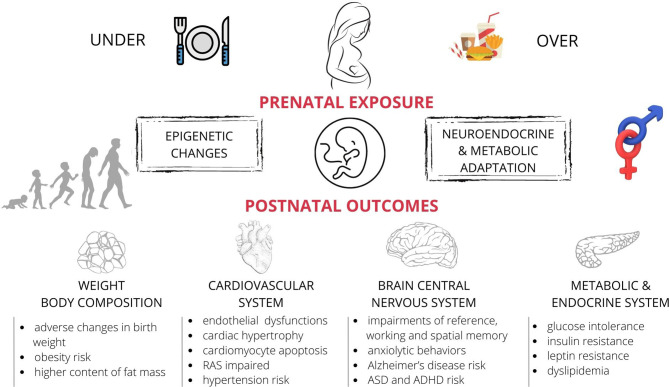
The prenatal period, during which a fully formed newborn capable of surviving outside its mother's body is built from a single cell, is critical for human development. It is also the time when the foetus is particularly vulnerable to environmental factors, which may modulate the course of its development. Both epidemiological and animal studies have shown that foetal programming of physiological systems may alter the growth and function of organs and lead to pathology in adulthood. Nutrition is a particularly important environmental factor for the pregnant mother as it affects the condition of offspring. Numerous studies have shown that an unbalanced maternal metabolic status (under- or overnutrition) may cause long-lasting physiological and behavioural alterations, resulting in metabolic disorders, such as obesity and type 2 diabetes (T2DM). Various diets are used in laboratory settings in order to induce maternal obesity and metabolic disorders, and to alter the offspring development. The most popular models are: high-fat, high-sugar, high-fat-high-sugar, and cafeteria diets. Maternal undernutrition models are also used, which results in metabolic problems in offspring. Similarly to animal data, human studies have shown the influence of mothers' diets on the development of children. There is a strong link between the maternal diet and the birth weight, metabolic state, changes in the cardiovascular and central nervous system of the offspring. The mechanisms linking impaired foetal development and adult diseases remain under discussion. Epigenetic mechanisms are believed to play a major role in prenatal programming. Additionally, sexually dimorphic effects on offspring are observed. Therefore, further research on both sexes is necessary.
胚胎期是一个从单个细胞构建出完全形成的、有能力在母体外生存的新生儿的关键时期,对人类发育至关重要。也是胎儿特别容易受到环境因素影响的时期,这些因素可能会调节其发育过程。流行病学和动物研究都表明,胎儿生理系统的编程可能会改变器官的生长和功能,并导致成年后的病理学。营养是孕妇特别重要的环境因素,因为它会影响后代的状况。许多研究表明,母体代谢状态的不平衡(营养不良或营养过剩)可能导致持久的生理和行为改变,从而导致代谢紊乱,如肥胖和 2 型糖尿病(T2DM)。在实验室环境中使用各种饮食来诱导母体肥胖和代谢紊乱,并改变后代的发育。最流行的模型是:高脂肪、高糖、高脂肪高糖和自助餐厅饮食。也使用母体营养不良模型,导致后代出现代谢问题。与动物数据类似,人类研究表明母亲饮食对儿童发育的影响。母亲饮食与出生体重、代谢状态、后代心血管和中枢神经系统的变化之间存在很强的联系。将胎儿发育障碍与成人疾病联系起来的机制仍在讨论中。表观遗传机制被认为在产前编程中起着重要作用。此外,还观察到对后代的性别二态影响。因此,需要对两性进行进一步的研究。