Mitra Tridip, Gulati Richa, Ramachandran Krithika, Rajiv Rohan, Enninga Elizabeth Ann L, Pierret Chris K, Kumari R Sajeetha, Janardhanan Rajiv
Division of Medical Research, Faculty of Medicine and Health Sciences, SRM Institute of Science and Technology, 603 203, Kattankulathur, Tamil Nadu, India.
Dietrich School of Arts and Sciences, University of Pittsburgh, 15260, Pittsburgh, PA, USA.
Diabetol Metab Syndr. 2024 Apr 26;16(1):95. doi: 10.1186/s13098-024-01317-9.
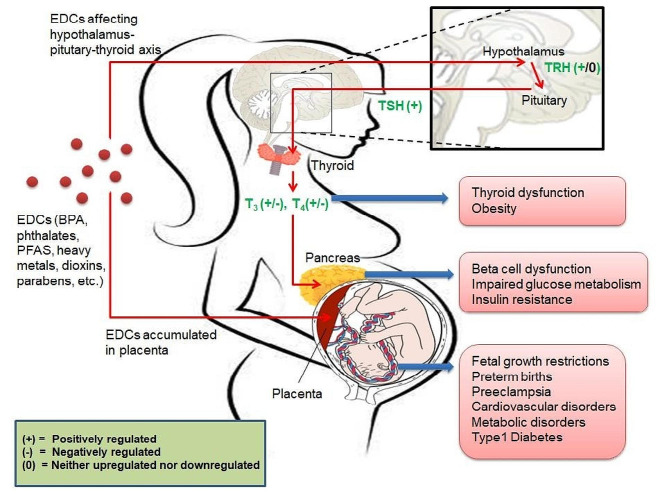
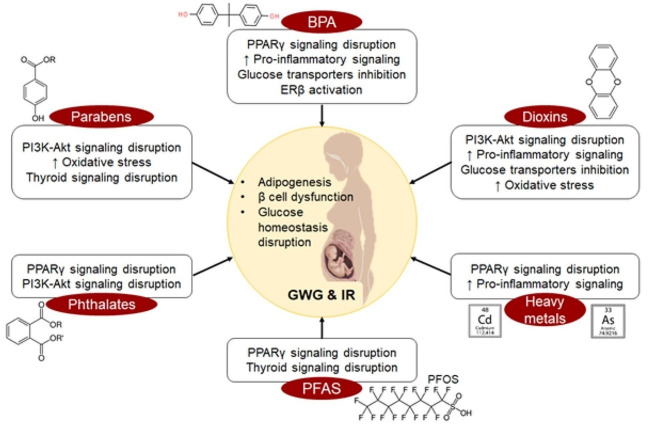
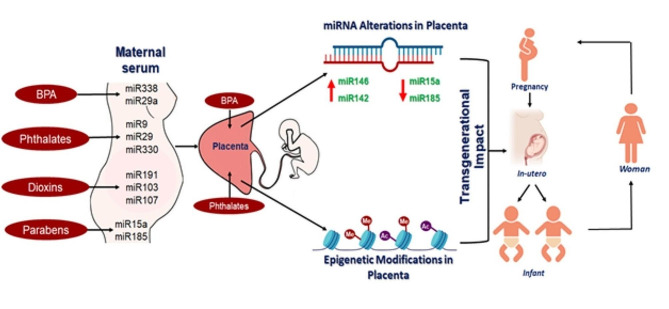
Gestational Diabetes Mellitus (GDM) has been on the rise for the last two decades along with the growing incidence of obesity. The ubiquitous use of Endocrine-Disrupting Chemicals (EDCs) worldwide has been associated with this increase in GDM incidence. Epigenetic modifications such as DNA methylation, histone acetylation, and methylation have been associated with prenatal exposure to EDCs. EDC exposure can also drive a sustained disruption of the hypothalamus-pituitary-thyroid axis and various other signaling pathways such as thyroid signaling, PPARγ signaling, PI3K-AKT signaling. This disruption leads to impaired glucose metabolism, insulin resistance as well as β-cell dysfunction, which culminate into GDM. Persistent EDC exposure in pregnant women also increases adipogenesis, which results in gestational weight gain. Importantly, pregnant mothers transfer these EDCs to the fetus via the placenta, thus leading to other pregnancy-associated complications such as intrauterine growth restriction (IUGR), and large for gestational age neonates. Furthermore, this early EDC exposure of the fetus increases the susceptibility of the infant to metabolic diseases in early life. The transgenerational impact of EDCs is also associated with higher vascular tone, cognitive aberrations, and enhanced susceptibility to lifestyle disorders including reproductive health anomalies. The review focuses on the impact of environmental toxins in inducing epigenetic alterations and increasing the susceptibility to metabolic diseases during pregnancy needs to be extensively studied such that interventions can be developed to break this vicious cycle. Furthermore, the use of EDC-associated ExomiRs from the serum of patients can help in the early diagnosis of GDM, thereby leading to triaging of patients based on increasing risk factor of the clinicopathological condition.
在过去二十年中,随着肥胖发生率的不断上升,妊娠期糖尿病(GDM)的发病率也持续攀升。全球范围内普遍使用的内分泌干扰化学物质(EDCs)与GDM发病率的增加有关。DNA甲基化、组蛋白乙酰化和甲基化等表观遗传修饰与产前接触EDCs有关。接触EDCs还会导致下丘脑 - 垂体 - 甲状腺轴以及甲状腺信号传导、PPARγ信号传导、PI3K - AKT信号传导等各种其他信号通路的持续破坏。这种破坏会导致葡萄糖代谢受损、胰岛素抵抗以及β细胞功能障碍,最终发展为GDM。孕妇持续接触EDCs还会增加脂肪生成,导致孕期体重增加。重要的是,怀孕母亲会通过胎盘将这些EDCs传递给胎儿,从而导致其他与妊娠相关的并发症,如宫内生长受限(IUGR)和大于胎龄的新生儿。此外,胎儿早期接触EDCs会增加婴儿在生命早期患代谢性疾病的易感性。EDCs的跨代影响还与更高的血管张力、认知异常以及对包括生殖健康异常在内的生活方式紊乱的易感性增加有关。这篇综述聚焦于环境毒素在孕期诱导表观遗传改变以及增加代谢性疾病易感性方面的影响,这一领域需要进行广泛研究,以便能够开发出干预措施来打破这种恶性循环。此外,使用患者血清中与EDCs相关的外泌体微小RNA(ExomiRs)有助于GDM的早期诊断,从而根据临床病理状况风险因素的增加对患者进行分类。