School of Biomedical Engineering (Suzhou), Division of Life Sciences and Medicine, University of Science and Technology of China, 96 Jinzhai Road, Hefei 230026, China.
CAS Key Laboratory of Bio Medical Diagnostics, Suzhou Institute of Biomedical Engineering and Technology Chinese Academy of Sciences, 88 Keling Road, Suzhou 215163, China.
Theranostics. 2022 Jan 24;12(4):1756-1768. doi: 10.7150/thno.68756. eCollection 2022.
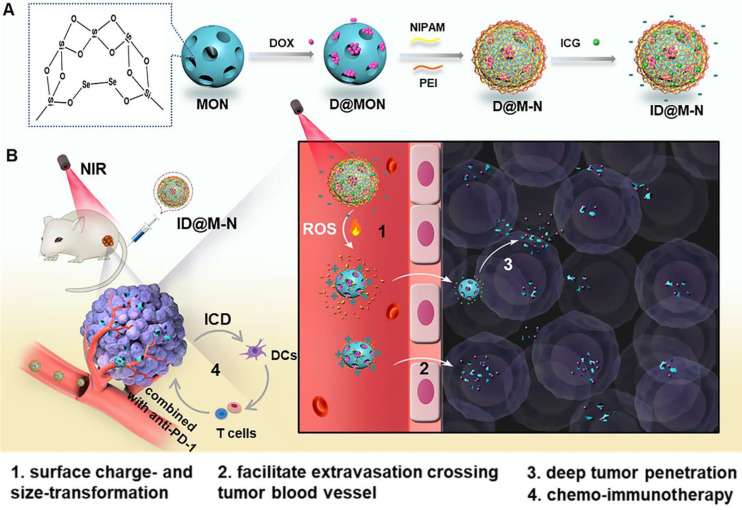
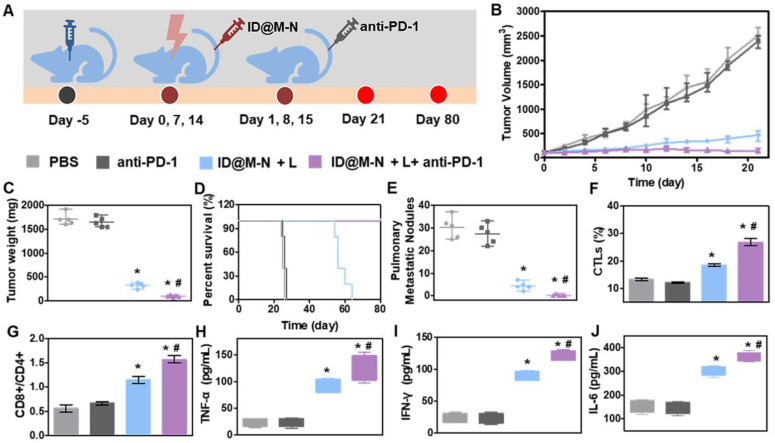
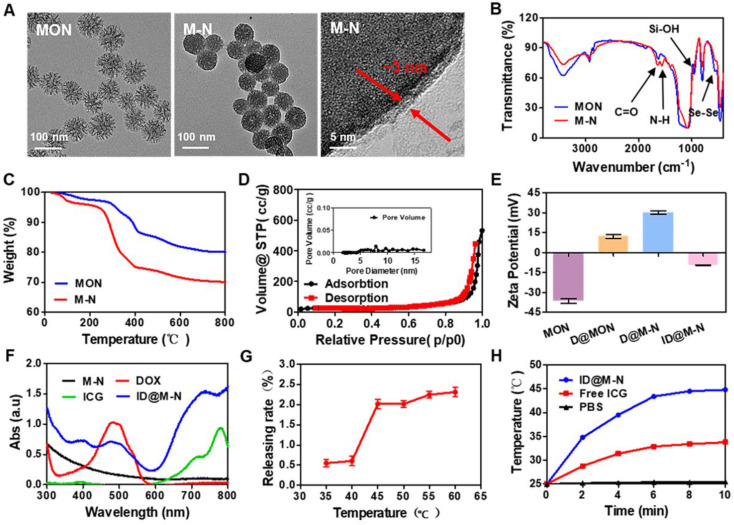
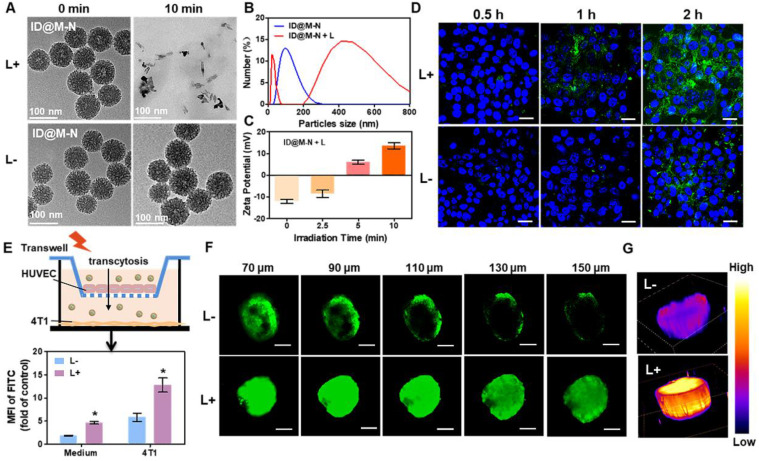
Designing a transformable nanosystem with improved tumor accumulation and penetration by tuning multiple physicochemical properties remains a challenge. Here, a near-infrared (NIR) light-driven nanosystem with size and charge dual-transformation for deep tumor penetration is developed. The core-shell nanotransformer is realized by integrating diselenide-bridged mesoporous organosilica nanoparticles as a reactive oxygen species (ROS)-responsive core with an indocyanine green (ICG)-hybrid N-isopropyl acrylamide layer as a thermosensitive shell. After loading doxorubicin (DOX), negatively charged nanomedicine prevents DOX leakage, rendering prolonged blood circulation time and high tumor accumulation. Upon NIR light irradiation, mild photothermal effects facilitate the dissociation of the thermosensitive shell to achieve negative-to-positive charge reversal. Meanwhile, ICG-generated ROS cleave the diselenide bond of the organosilica core, resulting in rapid matrix degradation that produces DOX-containing smaller fragments. Such a light-driven dual-transformable nanomedicine simultaneously promotes deep tumor penetration and implements sufficient chemotherapy, along with evoking robust immunogenic cell death effects and . With the combination of a programmed cell death protein-1 (PD-1) checkpoint blockade, the nanotransformer remarkably blocks primary tumor growth and pulmonary metastasis of breast cancer with low systemic toxicity. This study develops a promising strategy to realize high tumor accumulation and deep penetration of light-transformable nanomedicine for efficient and safe chemo-immunotherapy.
设计一种可通过调节多种物理化学性质来提高肿瘤积累和穿透能力的可变形纳米系统仍然是一个挑战。在这里,开发了一种具有大小和电荷双重转变的近红外(NIR)光驱动纳米系统,用于深层肿瘤穿透。核壳型纳米转导器是通过将二硒键桥联介孔有机硅纳米颗粒作为活性氧(ROS)响应核与吲哚菁绿(ICG)-混合 N-异丙基丙烯酰胺层作为热敏壳集成来实现的。负载多柔比星(DOX)后,带负电荷的纳米药物可防止 DOX 泄漏,从而延长血液循环时间并增加肿瘤积累。在近红外光照射下,温和的光热效应促进热敏壳的解离,实现负到正电荷的反转。同时,ICG 产生的 ROS 会切断有机硅核中的二硒键,导致基质迅速降解,产生含有 DOX 的较小片段。这种光驱动的双重可变形纳米药物可同时促进肿瘤的深层穿透和充分的化学治疗,并引发强烈的免疫原性细胞死亡效应。与程序性死亡蛋白 1(PD-1)检查点阻断相结合,该纳米转导剂可显著阻断乳腺癌的原发性肿瘤生长和肺转移,同时具有低全身毒性。本研究开发了一种有前途的策略,可实现高效和安全的化学免疫治疗用光可变形纳米药物的高肿瘤积累和深层穿透。