Nouri-Majd Saeedeh, Salari-Moghaddam Asma, Aminianfar Azadeh, Larijani Bagher, Esmaillzadeh Ahmad
Department of Community Nutrition, School of Nutritional Sciences and Dietetics, Tehran University of Medical Sciences, Tehran, Iran.
Research Center for Biochemistry and Nutrition in Metabolic Diseases, Kashan University of Medical Sciences, Kashan, Iran.
Front Nutr. 2022 Feb 7;9:801722. doi: 10.3389/fnut.2022.801722. eCollection 2022.
Debate on the potential carcinogenic effects of meat intake is open and the relationship between meat consumption and risk of prostate cancer remains uncertain. This meta-analysis was conducted to summarize earlier prospective studies on the association of meat consumption with risk of prostate cancer.
Relevant studies were identified by exploring PubMed/Medline, Scopus, Web of Science, EMBASE, and Google Scholar databases up to December 2020. Fixed-effects and random-effects meta-analyses were used for pooling the relative risks (RRs). Heterogeneity across studies was evaluated using the Q-statistic and -square ( ). A funnel plot and Egger's test was used to detect publication bias. Linear and non-linear dose-response analyses were performed to estimate the dose-response relations between meat intake and risk of prostate cancer.
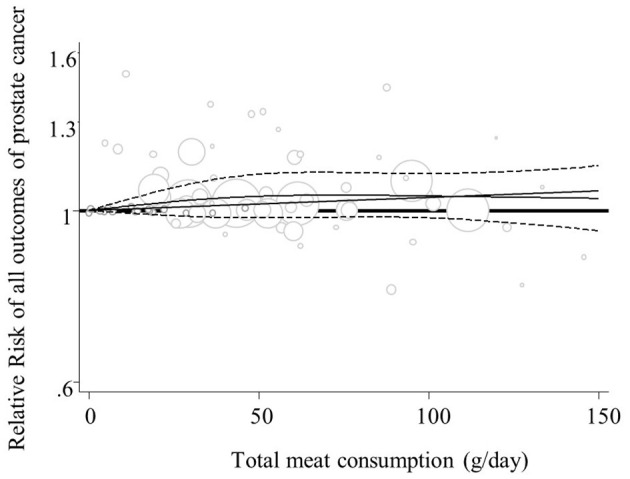
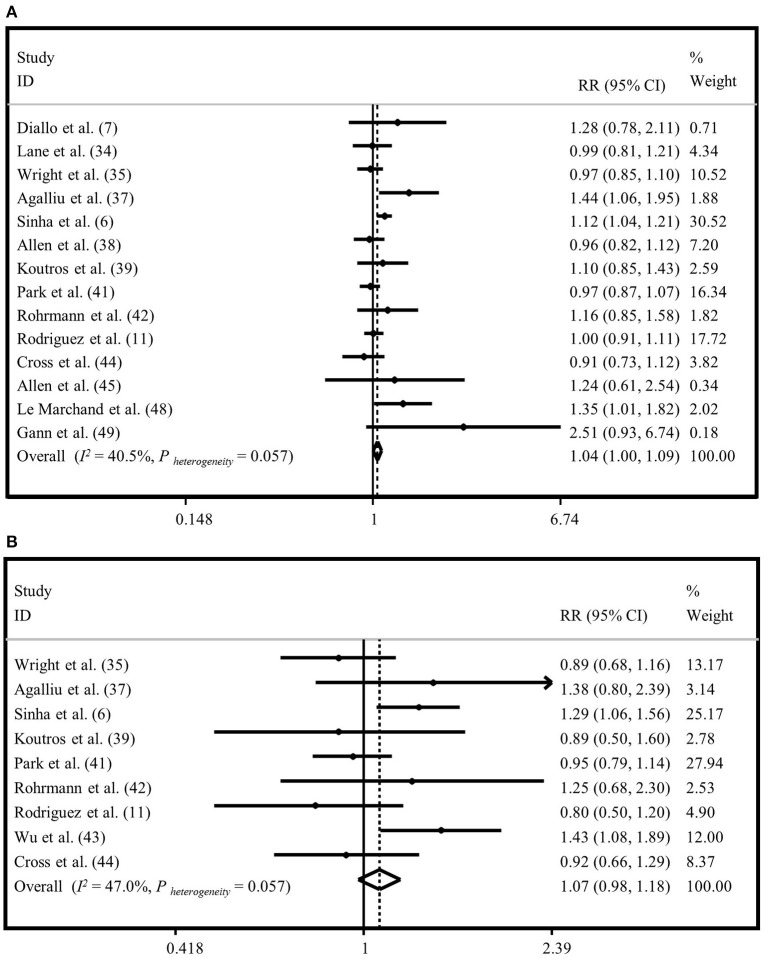
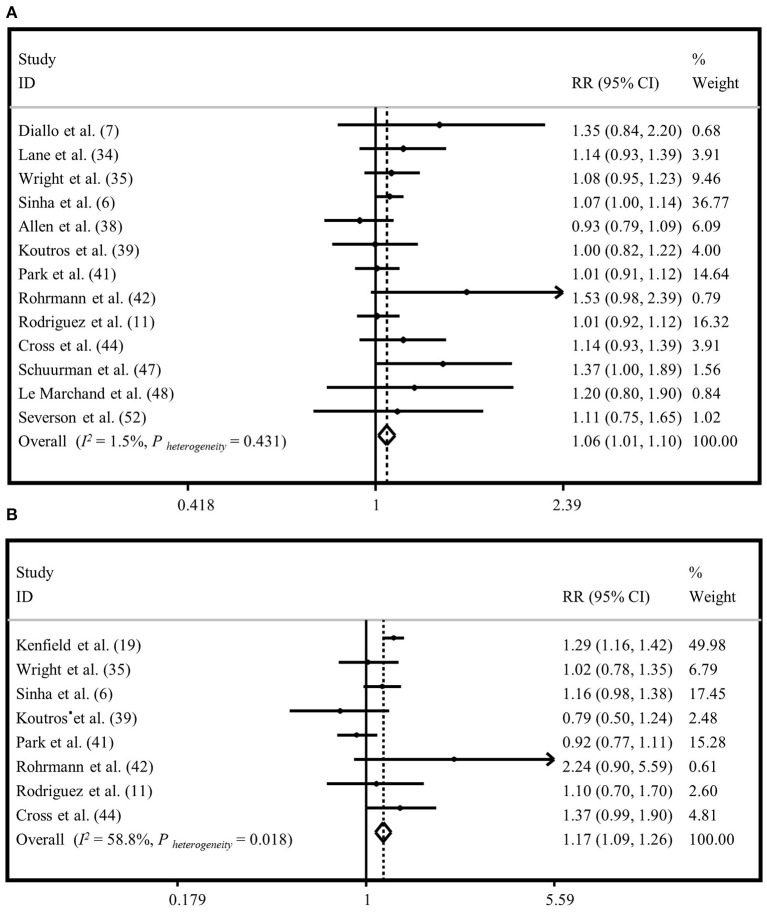
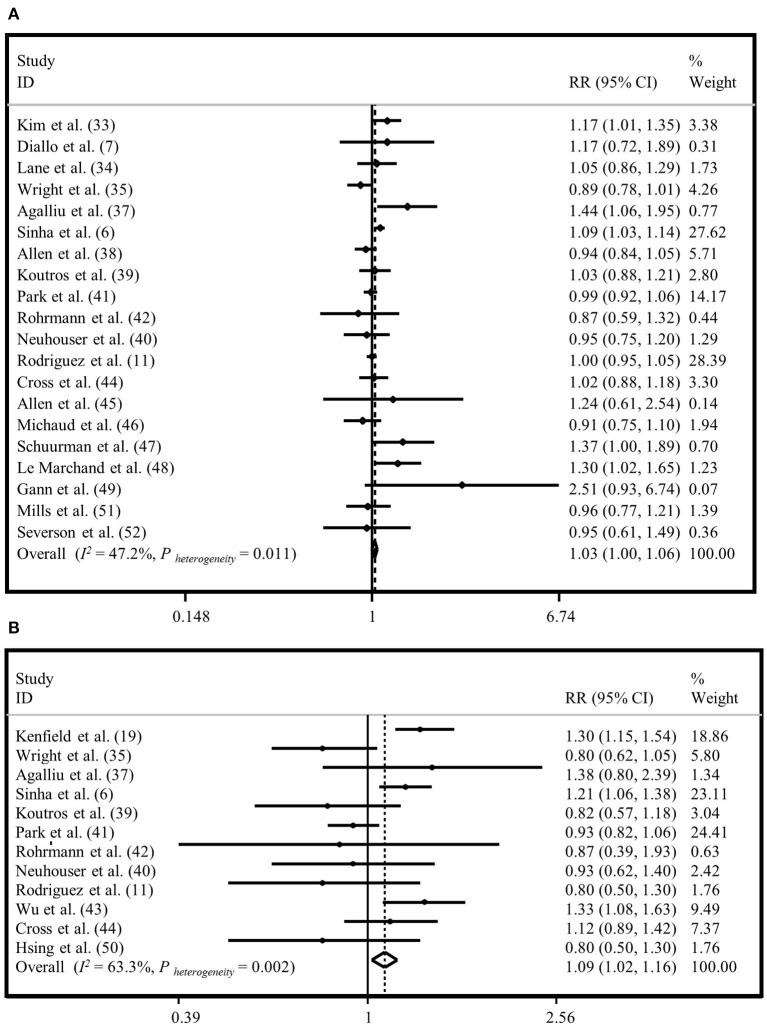
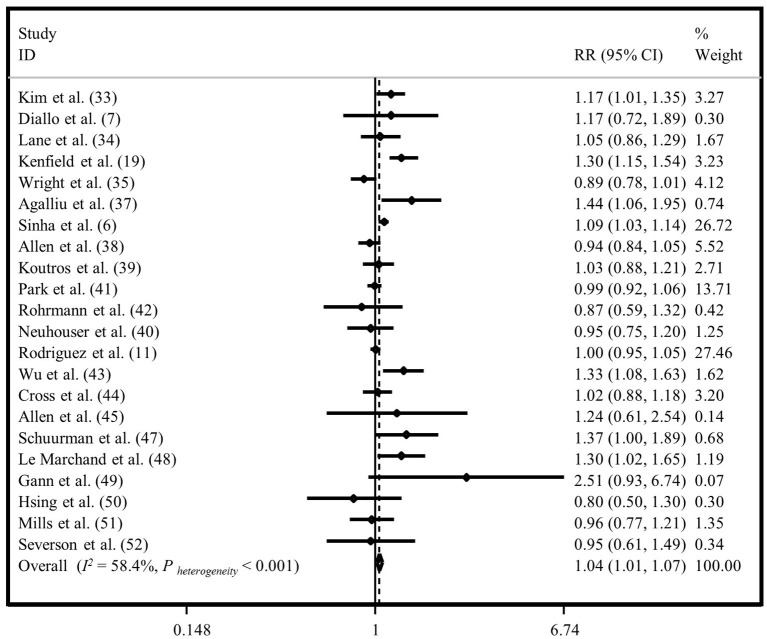
Twenty-five prospective studies were included in this meta-analysis. Totally, 1,900,910 participants with 35,326 incident cases of prostate cancer were investigated. Pooling the eligible effect sizes, we observed that high consumption of processed meat might be associated with an increased risk of "total prostate cancer" (RR: 1.06; 95% CI: 1.01, 1.10; = 1.5%, = 0.43) and "advanced prostate cancer" (1.17; 1.09, 1.26; = 58.8%, = 0.01). However, the association between processed meat and "advanced prostate cancer" was not significant in the random-effects model: 1.12 (95% CI: 0.98, 1.29). A linear dose-response analysis indicated that an increment of 50 grams per day of processed meat intake might be related to a 4% greater risk of "total prostate cancer" (1.04; 1.00, 1.08; = 0.0%, = 0.51). "Total meat intake" was marginally associated with all outcomes of prostate cancer risk (1.04; 1.01, 1.07; = 58.4%, < 0.001).
This systematic review and meta-analysis of prospective studies indicated that increased consumption of "total meat" and "processed meat" might be associated with a higher risk of prostate cancer.
https://www.crd.york.ac.uk/prospero/display_record.php?RecordID=230824, identifier: CRD42021230824.
关于肉类摄入潜在致癌作用的争论尚无定论,肉类消费与前列腺癌风险之间的关系仍不确定。本荟萃分析旨在总结早期关于肉类消费与前列腺癌风险关联的前瞻性研究。
通过检索截至2020年12月的PubMed/Medline、Scopus、Web of Science、EMBASE和谷歌学术数据库来识别相关研究。采用固定效应和随机效应荟萃分析合并相对风险(RRs)。使用Q统计量和I²统计量评估研究间的异质性。采用漏斗图和Egger检验检测发表偏倚。进行线性和非线性剂量反应分析,以估计肉类摄入量与前列腺癌风险之间的剂量反应关系。
本荟萃分析纳入了25项前瞻性研究。总共调查了1,900,910名参与者,其中有35,326例前列腺癌新发病例。合并符合条件的效应量后,我们观察到,大量食用加工肉类可能与“总体前列腺癌”风险增加相关(RR:1.06;95%CI:1.01,1.10;I² = 1.5%,P = 0.43)以及“晚期前列腺癌”风险增加相关(1.17;1.09,1.26;I² = 58.8%,P = 0.01)。然而,在随机效应模型中,加工肉类与“晚期前列腺癌”之间的关联不显著:1.12(95%CI:0.98,1.29)。线性剂量反应分析表明,每天加工肉类摄入量增加50克可能与“总体前列腺癌”风险增加4%相关(1.04;1.00,1.08;I² = 0.0%,P = 0.51)。“总肉类摄入量”与前列腺癌风险的所有结局均存在微弱关联(1.04;1.01,1.07;I² = 58.4%,P < 0.001)。
这项对前瞻性研究的系统评价和荟萃分析表明,“总肉类”和“加工肉类”消费量增加可能与前列腺癌风险升高相关。
https://www.crd.york.ac.uk/prospero/display_record.php?RecordID=230824,标识符:CRD42021230824。