Vergadi Eleni, Zacharioudaki Maria, Raissaki Maria, Galanakis Emmanouil
Department of Paediatrics, School of Medicine, University of Crete, 71003 Heraklion, Crete, Greece.
Department of Radiology, School of Medicine, University of Crete, 71003 Heraklion, Crete, Greece.
Infect Dis Rep. 2022 Feb 11;14(1):106-111. doi: 10.3390/idr14010014.
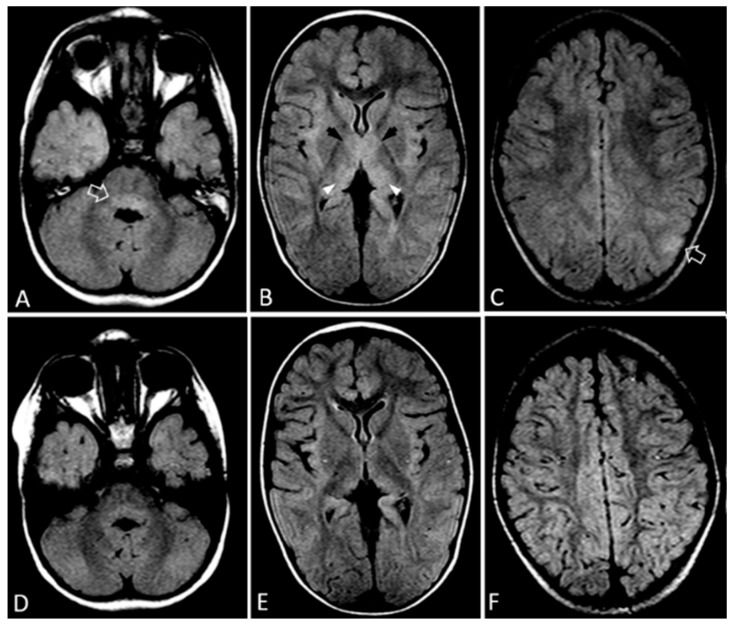
Encephalitis in children may lead to adverse outcomes and long-term neurodevelopmental sequelae. The prompt identification of the causative agent is important to guide proper management in cases with encephalitis; however, the etiology often remains undetermined. The use of polymerase chain reaction (PCR) analysis in the cerebrospinal fluid (CSF) has increased the diagnostic yield in encephalitis cases; however, it may be occasionally misleading. In this article, we describe the case of a male immunocompetent child with encephalitis in which human herpesvirus-7 (HHV-7) was detected in CSF by PCR. As the detection of HHV-7 DNA in the CSF alone is insufficient to prove an etiologic association of severe encephalitis in immunocompetent children, alternative diagnoses were pursued. Enterovirus (E-11) was detected by PCR analysis of the nasopharyngeal and rectal swabs of the male patient. The final diagnosis was facilitated by the findings in his sibling, which presented concurrently with enteroviral encephalitis. Failure to detect enterovirus in the CSF by PCR does not exclude enteroviral encephalitis; screening of other samples, from other body sites, may be necessary to identify the virus, and physicians should take into consideration all evidence, including history, clinical presentation, and sick contacts' clinical status.
儿童脑炎可能导致不良后果和长期神经发育后遗症。及时识别病原体对于指导脑炎病例的恰当治疗很重要;然而,病因往往仍不明确。在脑脊液(CSF)中使用聚合酶链反应(PCR)分析提高了脑炎病例的诊断率;然而,它偶尔可能会产生误导。在本文中,我们描述了一例免疫功能正常的患脑炎男童病例,通过PCR在其脑脊液中检测到了人类疱疹病毒7型(HHV - 7)。由于仅在脑脊液中检测到HHV - 7 DNA不足以证明免疫功能正常儿童严重脑炎的病因关联,因此进行了其他诊断。通过对该男童鼻咽拭子和直肠拭子的PCR分析检测到了肠道病毒(E - 11)。其同胞同时出现肠道病毒性脑炎的情况有助于最终诊断。通过PCR未能在脑脊液中检测到肠道病毒并不排除肠道病毒性脑炎;可能需要对来自身体其他部位的其他样本进行筛查以识别该病毒,并且医生应考虑所有证据,包括病史、临床表现以及密切接触者的临床状况。