Liang Wenken, Mo Chune, Wei Jianfen, Chen Wei, Gong Weiwei, Shi Jianling, Hou Xianliang, Li Chunhong, Deng Yecheng, Ou Minglin
College of Life Science, Guangxi Normal University, No. 1, Yanshan Middle Road, Guilin, 541000, China.
Central Laboratory, Guangxi Health Commission Key Laboratory of Glucose and Lipid Metabolism Disorders, The Second Affiliated Hospital of Guilin Medical University, No. 212, Renmin Road, Guilin, 541000, China.
Discov Oncol. 2021 Dec 7;12(1):60. doi: 10.1007/s12672-021-00456-z.
Family with sequence similarity 65 member A (FAM65A), also known as RIPOR1, is differentially expressed between human tumor and non-tumor tissues in kinds of cancers. In addition, it was reported that the product of FAM65A may be a biomarker for cholangiocarcinoma patients. However, there is still no evidence on the relationship between the FAM65A and different types of tumors. Our study is mainly for exploring the prognostic values of FAM65A in pan-cancer and for further discovering a potential therapeutics target.
We analyzed FAM65A expression, prognostic values, genetic alteration, protein phosphorylation, immune infiltration and enrichment analysis across different types of human malignant tumors based on The Cancer Genome Atlas (TCGA) and Gene Expression Omnibus (GEO) datasets. Additionally, Real-Time PCR (RT-qPCR) was performed to further confirm the roles of FAM65A in the pathogenesis of colorectal cancer.
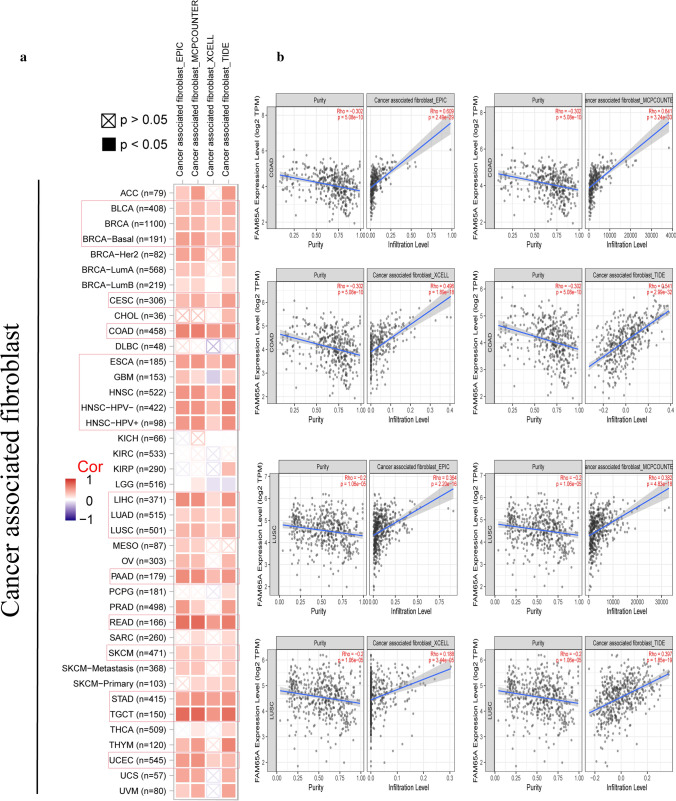
We found that FAM65A expression was associated with the prognosis of multiple human tumors, especially colorectal cancer. Moreover, we also observed that FAM65A was highly expressed in colorectal cancer through RT-qPCR. We observed that decreasing phosphorylation level of the S351 locus in colon adenocarcinoma, uterine corpus endometrial carcinoma and lung adenocarcinoma. And the expression of FAM65A was positively related to cancer-associated fibroblasts (CAFs) infiltration in many tumors, such as colon adenocarcinoma. Therefore, FAM65A may be a potential prognostic biomarker of human tumors.
序列相似性家族65成员A(FAM65A),也称为RIPOR1,在多种癌症的人类肿瘤组织和非肿瘤组织之间存在差异表达。此外,有报道称FAM65A的产物可能是胆管癌患者的生物标志物。然而,关于FAM65A与不同类型肿瘤之间的关系仍缺乏证据。我们的研究主要是为了探索FAM65A在泛癌中的预后价值,并进一步发现潜在的治疗靶点。
我们基于癌症基因组图谱(TCGA)和基因表达综合数据库(GEO)数据集,分析了FAM65A在不同类型人类恶性肿瘤中的表达、预后价值、基因改变、蛋白磷酸化、免疫浸润及富集分析。此外,进行实时定量聚合酶链反应(RT-qPCR)以进一步证实FAM65A在结直肠癌发病机制中的作用。
我们发现FAM65A的表达与多种人类肿瘤尤其是结直肠癌的预后相关。此外,通过RT-qPCR我们还观察到FAM65A在结直肠癌中高表达。我们观察到在结肠腺癌、子宫内膜癌和肺腺癌中,S351位点的磷酸化水平降低。并且在许多肿瘤如结肠腺癌中,FAM65A的表达与癌症相关成纤维细胞(CAFs)浸润呈正相关。因此,FAM65A可能是人类肿瘤潜在的预后生物标志物。