Sid Ahmed Mazen A, Khan Faisal Ahmad, Hadi Hamad Abdel, Skariah Sini, Sultan Ali A, Salam Abdul, Al Khal Abdul Latif, Söderquist Bo, Ibrahim Emad Bashir, Omrani Ali S, Jass Jana
Department of Laboratory Medicine and Pathology, Microbiology Division, Hamad Medical Corporation, Doha 3050, Qatar.
The Life Science Centre-Biology, School of Science and Technology, Orebro University, 701 82 Örebro, Sweden.
Antibiotics (Basel). 2022 Jan 19;11(2):130. doi: 10.3390/antibiotics11020130.
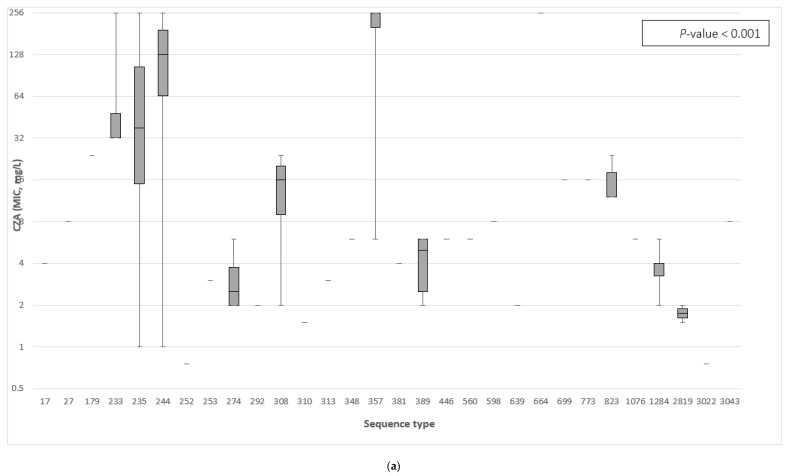
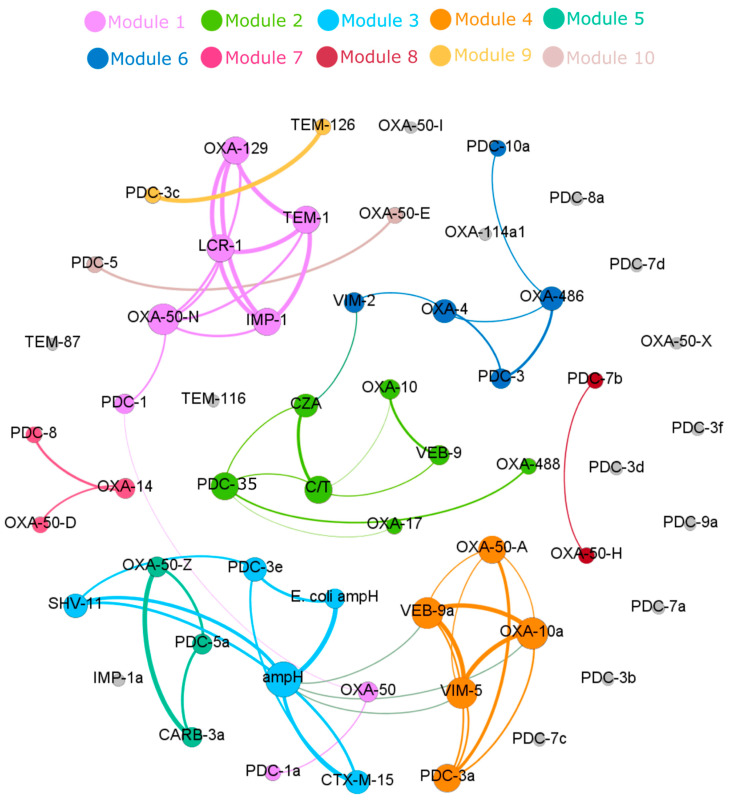
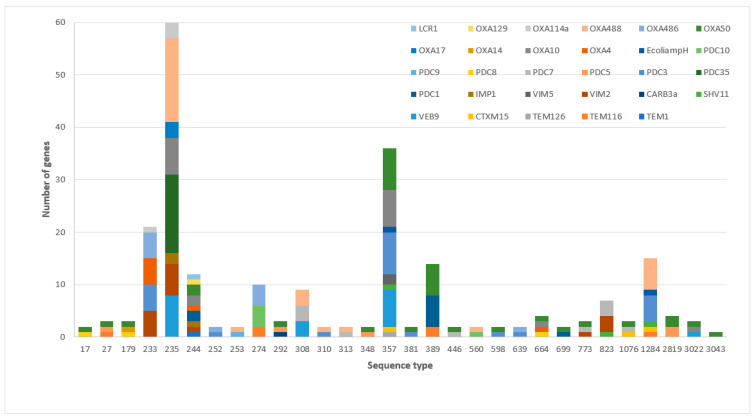
Ceftazidime-avibactam and ceftolozane-tazobactam are approved for the treatment of complicated Gram-negative bacterial infections including multidrug-resistant (MDR) . Resistance to both agents has been reported, but the underlying mechanisms have not been fully explored. This study aimed to correlate β-lactamases with phenotypic resistance to ceftazidime-avibactam and/or ceftolozane-tazobactam in MDR- from Qatar. A total of 525 MDR- isolates were collected from clinical specimens between 2014 and 2017. Identification and antimicrobial susceptibility were performed by the BD Phoenix system and gradient MIC test strips. Of the 75 sequenced MDR isolates, 35 (47%) were considered as having difficult-to-treat resistance, and 42 were resistant to ceftazidime-avibactam (37, 49.3%), and/or ceftolozane-tazobactam (40, 53.3%). They belonged to 12 sequence types, with ST235 being predominant (38%). Most isolates (97.6%) carried one or more β-lactamase genes, with (19%) and (45.2%) being predominant. A strong association was detected between class B β-lactamase genes and both ceftazidime-avibactam and ceftolozane-tazobactam resistance, while class A genes were associated with ceftolozane-tazobactam resistance. Co-resistance to ceftazidime-avibactam and ceftolozane-tazobactam correlated with the presence of , , , and . MDR- isolates resistant to both combination drugs were associated with class B β-lactamases () and class D β-lactamases (), while ceftolozane-tazobactam resistance was associated with class A (), class C (), and class D β-lactamases ().
头孢他啶-阿维巴坦和头孢洛扎-他唑巴坦已被批准用于治疗包括多重耐药(MDR)菌在内的复杂性革兰氏阴性菌感染。已有对这两种药物耐药的报道,但潜在机制尚未得到充分探究。本研究旨在关联β-内酰胺酶与卡塔尔MDR菌对头孢他啶-阿维巴坦和/或头孢洛扎-他唑巴坦的表型耐药性。2014年至2017年间,共从临床标本中收集了525株MDR菌分离株。通过BD Phoenix系统和梯度MIC测试条进行鉴定和药敏试验。在75株测序的MDR分离株中,35株(47%)被认为具有难治性耐药,42株对头孢他啶-阿维巴坦耐药(37株,49.3%),和/或对头孢洛扎-他唑巴坦耐药(40株,53.3%)。它们属于12种序列类型,其中ST235占主导(38%)。大多数分离株(97.6%)携带一个或多个β-内酰胺酶基因,其中blaCTX-M(19%)和blaTEM(45.2%)占主导。检测到B类β-内酰胺酶基因与头孢他啶-阿维巴坦和头孢洛扎-他唑巴坦耐药均有强关联,而A类基因与头孢洛扎-他唑巴坦耐药相关。对头孢他啶-阿维巴坦和头孢洛扎-他唑巴坦的共同耐药与blaCTX-M、blaTEM、blaSHV、blaOXA-48和blaKPC的存在相关。对两种联合药物均耐药的MDR菌分离株与B类β-内酰胺酶(blaVIM)和D类β-内酰胺酶(blaOXA-23)相关,而头孢洛扎-他唑巴坦耐药与A类(blaCTX-M)、C类(blaAmpC)和D类β-内酰胺酶(blaOXA-23)相关。