Papst Lea, Luzzati Roberto, Carević Biljana, Tascini Carlo, Gorišek Miksić Nina, Vlahović Palčevski Vera, Djordjevic Zorana M, Simonetti Omar, Sozio Emanuela, Lukić Milica, Stevanović Goran, Petek Davor, Beović Bojana
Department of Infectious Diseases, University Medical Centre Ljubljana, Zaloška cesta 2, 1000 Ljubljana, Slovenia.
Faculty of Medicine, University of Ljubljana, Vrazov trg 2, 1000 Ljubljana, Slovenia.
Antibiotics (Basel). 2022 Jan 28;11(2):176. doi: 10.3390/antibiotics11020176.
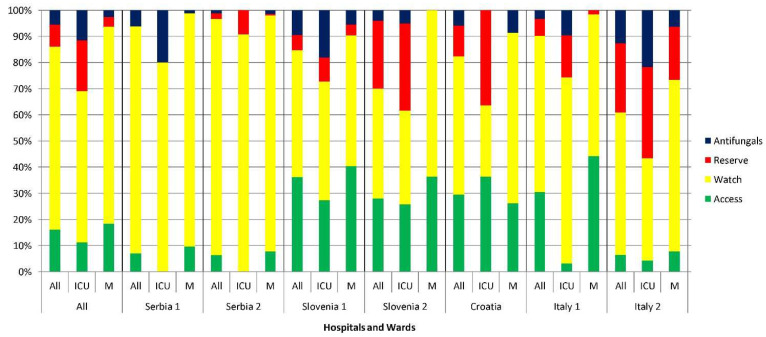
Studies suggest that the incidence of coinfections in patients with the coronavirus disease 2019 (COVID-19) is low, but a large number of patients receive antimicrobials during hospitalisation. This may fuel a rise in antimicrobial resistance (AMR). We conducted a multicentre point-prevalence survey in seven tertiary university hospitals (in medical wards and intensive care units) in Croatia, Italy, Serbia and Slovenia. Of 988 COVID-19 patients, 521 were receiving antibiotics and/or antifungals (52.7%; range across hospitals: 32.9-85.6%) on the day of the study. Differences between hospitals were statistically significant (χ (6, = 988) = 192.57, < 0.001). The majority of patients received antibiotics and/or antifungals within 48 h of admission (323/521, 62%; range across hospitals: 17.4-100%), their most common use was empirical (79.4% of prescriptions), and pneumonia was the main indication for starting the treatment (three-quarters of prescriptions). The majority of antibiotics prescribed (69.9%) belonged to the "Watch" group of the World Health Organization AWaRe classification. The pattern of antimicrobial use differed across hospitals. The data show that early empiric use of broad-spectrum antibiotics is common in COVID-19 patients, and that the pattern of antimicrobial use varies across hospitals. Judicious use of antimicrobials is warranted to prevent an increase in AMR.
研究表明,2019冠状病毒病(COVID-19)患者合并感染的发生率较低,但大量患者在住院期间接受抗菌药物治疗。这可能会助长抗菌药物耐药性(AMR)的上升。我们在克罗地亚、意大利、塞尔维亚和斯洛文尼亚的七家三级大学医院(内科病房和重症监护病房)进行了一项多中心现患率调查。在988例COVID-19患者中,521例在研究当天正在接受抗生素和/或抗真菌药物治疗(52.7%;各医院范围:32.9%-85.6%)。医院之间的差异具有统计学意义(χ(6,=988)=192.57,P<0.001)。大多数患者在入院后48小时内接受了抗生素和/或抗真菌药物治疗(323/521,62%;各医院范围:17.4%-100%),其最常见的用途是经验性用药(79.4%的处方),肺炎是开始治疗的主要指征(四分之三的处方)。所开具的大多数抗生素(69.9%)属于世界卫生组织AWaRe分类中的“观察”组。不同医院的抗菌药物使用模式有所不同。数据显示,COVID-19患者中早期经验性使用广谱抗生素很常见,且抗菌药物使用模式因医院而异。有必要明智地使用抗菌药物以防止AMR增加。