Department of Physical Therapy, College of Medicine, Tzu Chi University, Hualien 97004, Taiwan.
Center for Aging and Health, Hualien Tzu Chi Hospital, Buddhist Tzu Chi Medical Foundation, Hualien 97002, Taiwan.
Int J Environ Res Public Health. 2022 Feb 15;19(4):2182. doi: 10.3390/ijerph19042182.
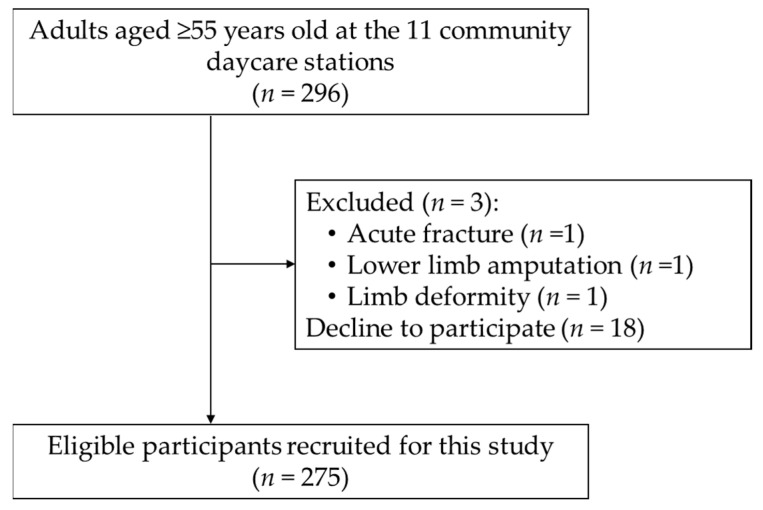
Physical inactivity and possible sarcopenia pose a challenge for long-term care, especially in rural areas. We aimed to examine the prevalence of and associated factors for physical inactivity and possible sarcopenia in rural community daycare stations. A total of 275 adults aged 55-98 years (75% women) were recruited from all 11 rural community daycare stations in Northern Hualien, Taiwan. Physical inactivity was defined as less than 150 min/week of moderate-intensity aerobic physical activity. Possible sarcopenia was defined according to the Asian-specific criteria from 2019. Multiple linear and logistic regression analyses were used to determine associated factors for physical inactivity and possible sarcopenia. The prevalence of physical inactivity and possible sarcopenia was 29.1% and 68.7%, respectively. About 86.8% of possible sarcopenia were ascribed to poor five-times-sit-to-stand performance. After adjusting for covariates, poor lower-limb muscle function, e.g., slow gait speed, was associated with possible sarcopenia and physical inactivity. However, physical inactivity was not independently associated with possible sarcopenia (adjusted odds ratio 1.95, 95% confidence interval 0.88-4.30, = 0.100). Our results indicated that individuals with poor lower-limb muscle function were more likely to have possible sarcopenia and physical inactivity. Improving lower-limb muscle function would be a priority task in rural community daycare stations.
身体活动不足和可能的肌肉减少症对长期护理构成挑战,尤其是在农村地区。我们旨在研究农村社区日托站身体活动不足和可能的肌肉减少症的流行情况及其相关因素。从台湾花莲北部的 11 个农村社区日托站招募了总共 275 名 55-98 岁的成年人(75%为女性)。身体活动不足定义为每周少于 150 分钟的中等强度有氧运动。可能的肌肉减少症根据 2019 年亚洲特定标准定义。采用多元线性和逻辑回归分析来确定身体活动不足和可能的肌肉减少症的相关因素。身体活动不足和可能的肌肉减少症的患病率分别为 29.1%和 68.7%。约 86.8%的可能的肌肉减少症归因于较差的五次坐站表现。在调整协变量后,较差的下肢肌肉功能,例如较慢的步行速度,与可能的肌肉减少症和身体活动不足有关。然而,身体活动不足与可能的肌肉减少症无独立相关性(调整后的优势比 1.95,95%置信区间 0.88-4.30, = 0.100)。我们的结果表明,下肢肌肉功能较差的个体更容易出现可能的肌肉减少症和身体活动不足。改善下肢肌肉功能将是农村社区日托站的首要任务。