Zheng Chen-Guang, Liu Zheng, Zhao Yan-Min, Wang Yang, Bu Wen-Jun, Wang Xin-Hua, Lin Xiao-Long
College of Life Sciences, Nankai University, Tianjin 300071, China.
Geological Museum of China, Beijing 100083, China.
Insects. 2022 Jan 21;13(2):115. doi: 10.3390/insects13020115.
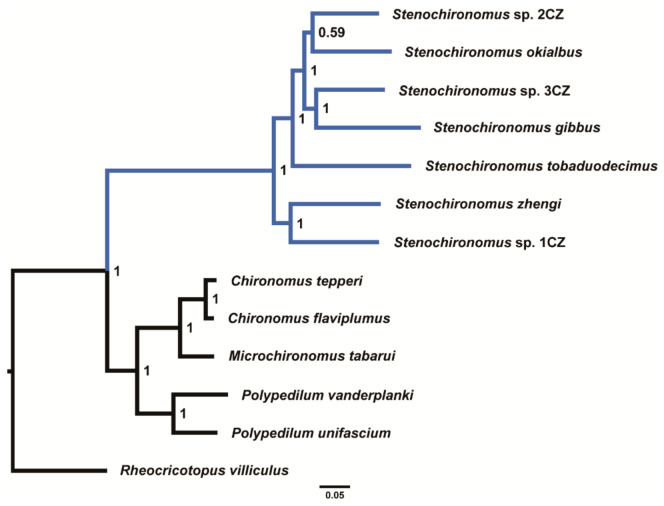
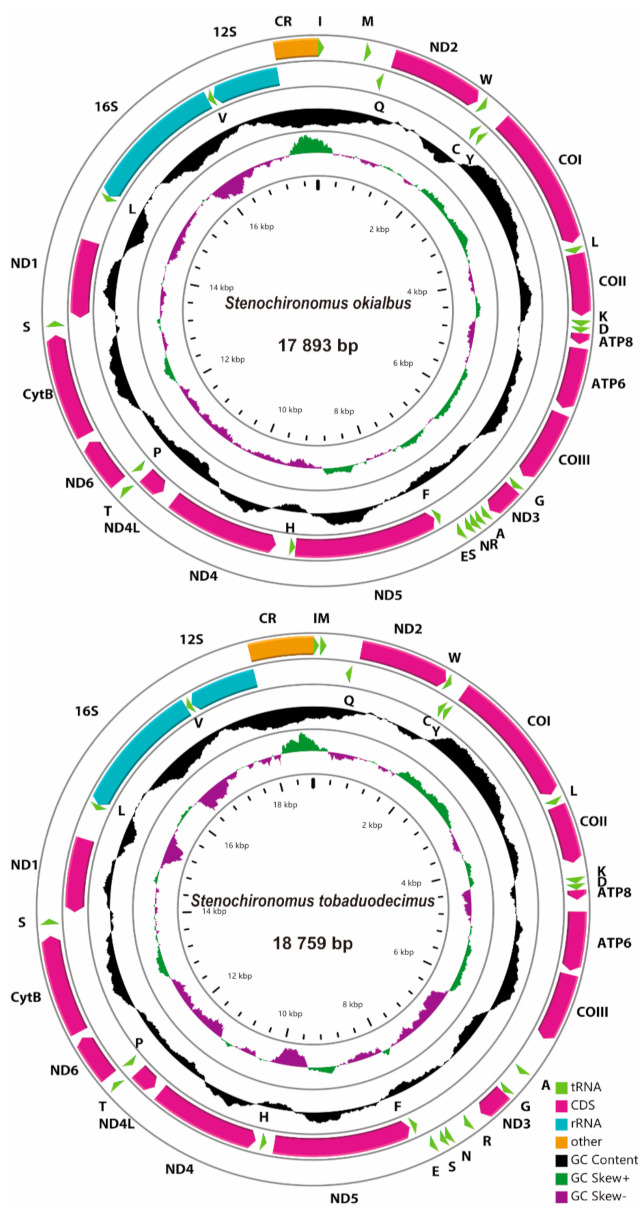
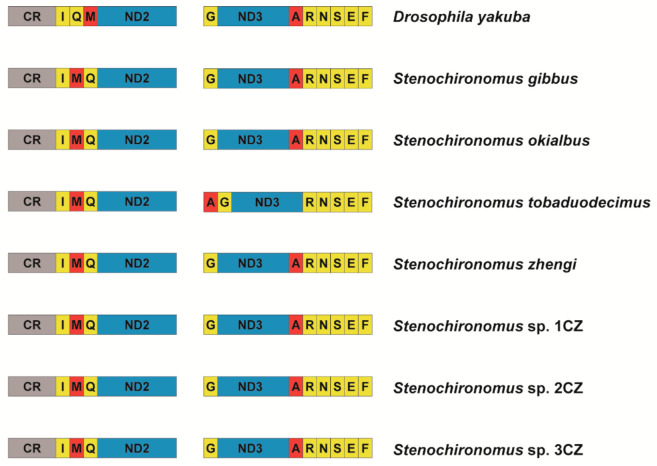
(1) Background: Gene rearrangement of mitochondrial genome, especially those with phylogenetic signals, has long fascinated evolutionary biologists. The synapomorphic gene rearrangements have been identified across multiple orders and at many different taxonomic levels, supporting the monophyletic or systematic relationships of related lineages. However, mitochondrial gene rearrangement has never been observed in the non-biting midges (Diptera: Chironomidae); (2) methods: in this study, the complete mitogenomes of seven Stenochironomus species were sequenced and analyzed for the first time; (3) results: each mitogenome of Stenochironomus contains 37 typical genes and a control region. The whole mitogenomes of Stenochironomus species exhibit a higher A+T bias than other published chironomid species. The gene order rearranges from trnI-trnQ-trnM to trnI-trnM-trnQ in all the seven mitogenomes of Stenochironomus, which might be act as a synapomorphy of the genus, supporting the monophyletic of Stenochironomus species. In addition, another derived gene cluster: trnA-trnG-ND3-trnR exists in Stenochironomus tobaduodecimus. The derived gene orders described above are the first case of mitochondrial gene rearrangement in Chironomidae. Coupled with published data, phylogenetic relationships were reconstructed within Chironominae, and strongly supported the monophyly of Stenochironomus; (4) conclusions: our study provides new insights into the mitochondrial gene order of Chironomidae, and provides a valuable resource for understanding the synapomorphic gene rearrangements.
(1)背景:线粒体基因组的基因重排,尤其是那些带有系统发育信号的重排,长期以来一直吸引着进化生物学家。已在多个目以及许多不同分类水平上鉴定出了共衍征基因重排,这支持了相关谱系的单系性或系统发育关系。然而,在摇蚊(双翅目:摇蚊科)中从未观察到线粒体基因重排;(2)方法:在本研究中,首次对7种细摇蚊属物种的完整线粒体基因组进行了测序和分析;(3)结果:细摇蚊属的每个线粒体基因组都包含37个典型基因和一个控制区。细摇蚊属物种的整个线粒体基因组比其他已发表的摇蚊科物种表现出更高的A+T偏向性。在细摇蚊属的所有7个线粒体基因组中,基因顺序从trnI-trnQ-trnM重排为trnI-trnM-trnQ,这可能是该属的一个共衍征,支持细摇蚊属物种的单系性。此外,在十二斑细摇蚊中存在另一个衍生基因簇:trnA-trnG-ND3-trnR。上述衍生基因顺序是摇蚊科中线粒体基因重排的首例。结合已发表的数据,重建了摇蚊亚科内的系统发育关系,并有力地支持了细摇蚊属的单系性;(4)结论:我们的研究为摇蚊科的线粒体基因顺序提供了新的见解,并为理解共衍征基因重排提供了宝贵的资源。