Díaz-Agea José Luis, Orcajada-Muñoz Irene, Leal-Costa César, Adánez-Martínez Maria Gracia, De Souza Oliveira Adriana Catarina, Rojo-Rojo Andrés
Faculty of Nursing, Universidad Católica de Murcia, 30107 Guadalupe, Spain.
Faculty of Nursing, Universidad de Murcia, 30120 El Palmar, Spain.
Healthcare (Basel). 2022 Feb 14;10(2):373. doi: 10.3390/healthcare10020373.
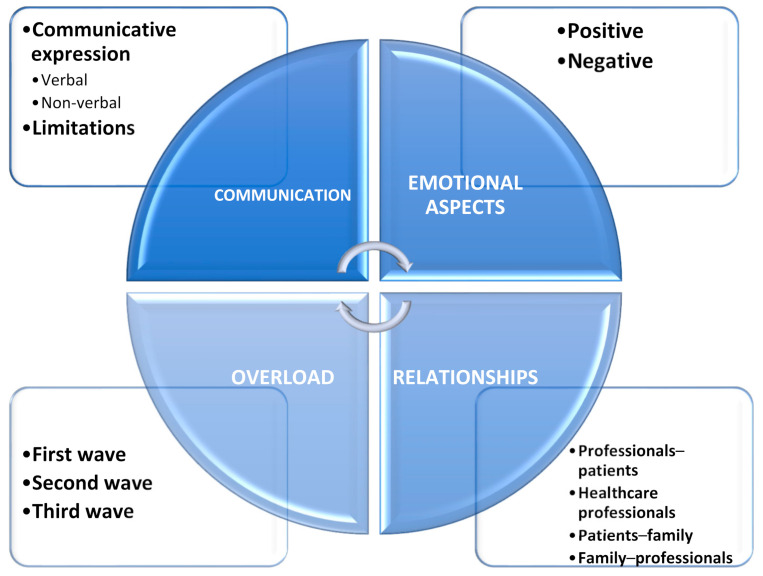
The objective of the present study was to determine the subjective impact of the pandemic due to COVID-19 on communication, as perceived by nurses working at emergency services and Intensive Care Units at various hospitals in the Region of Murcia (Spain). A qualitative study was conducted based on the content analysis of 12 semi-structured individual interviews. The participant recruitment process was performed through a snowball sampling technique. Four main dimensions, eleven categories, and two sub-categories were obtained: (1) communication (communicative expressions, both verbal and non-verbal-, and limitations); (2) emotional aspects (positive, negative); (3) overload (first wave, second wave, and third wave); and (4) relationships (health professionals-patients, healthcare professionals, patients-family, and family-health professionals). The main findings of the study show that communication was slightly affected during the pandemic, especially the non-verbal kind, with verbal communication maintained and, in some occasions, strengthened. The lack of training in communication skills and its influence on the management of difficult periods was another important finding. Communication in general deteriorated during the pandemic, especially during the initial waves. Non-verbal communication was more affected due to the use of Personal Protective Equipment and the initial fear of infection, with this finding strongly observed in departments such as emergencies or critical care. The nurses who were interviewed underlined negative emotional aspects associated with a deficit in communication. The positive aspects described were associated with the creation of mutual support spaces and the group cohesion of the work teams during the pandemic. As an implication for current and future clinical practice, we recommend a coordinated institutional response to mitigate the potential emotional effects on workers by designing appropriate communication and emotional expression protocols.
本研究的目的是确定新型冠状病毒肺炎疫情对沟通的主观影响,该影响由在西班牙穆尔西亚地区各医院急诊科和重症监护室工作的护士感知。基于对12次半结构化个人访谈的内容分析进行了一项定性研究。参与者招募过程通过滚雪球抽样技术进行。获得了四个主要维度、十一个类别和两个子类别:(1)沟通(言语和非言语沟通表达以及局限性);(2)情感方面(积极、消极);(3)负荷(第一波、第二波和第三波);(4)关系(医护人员 - 患者、医护人员 - 患者家属、患者家属 - 医护人员)。该研究的主要发现表明,疫情期间沟通受到了轻微影响,尤其是非言语沟通,而言语沟通得以维持,并且在某些情况下得到了加强。沟通技能培训的缺乏及其对困难时期管理的影响是另一项重要发现。总体而言,疫情期间沟通恶化,尤其是在最初几波疫情期间。由于使用个人防护装备以及最初对感染的恐惧,非言语沟通受到的影响更大,这一发现急诊或重症监护等科室尤为明显。接受访谈的护士强调了与沟通不足相关的负面情绪方面。所描述的积极方面与疫情期间相互支持空间的创建以及工作团队的团队凝聚力有关。作为对当前和未来临床实践的启示,我们建议通过设计适当的沟通和情感表达方案,做出协调一致的机构应对措施,以减轻对工作人员可能产生的情感影响。