Zhang Xiaochen, Ishikawa Dai, Nomura Kei, Fukuda Naoyuki, Haraikawa Mayuko, Haga Keiichi, Shibuya Tomoyoshi, Mita Toshihiro, Nagahara Akihito
Department of Gastroenterology, Juntendo University School of Medicine, 2-1-1 Hongo, Bunkyo-ku, Tokyo 113-8421, Japan.
Department of Intestinal Microbiota Therapy, Juntendo University School of Medicine, 2-1-1 Hongo, Bunkyo-ku, Tokyo 113-8421, Japan.
J Clin Med. 2022 Feb 17;11(4):1055. doi: 10.3390/jcm11041055.
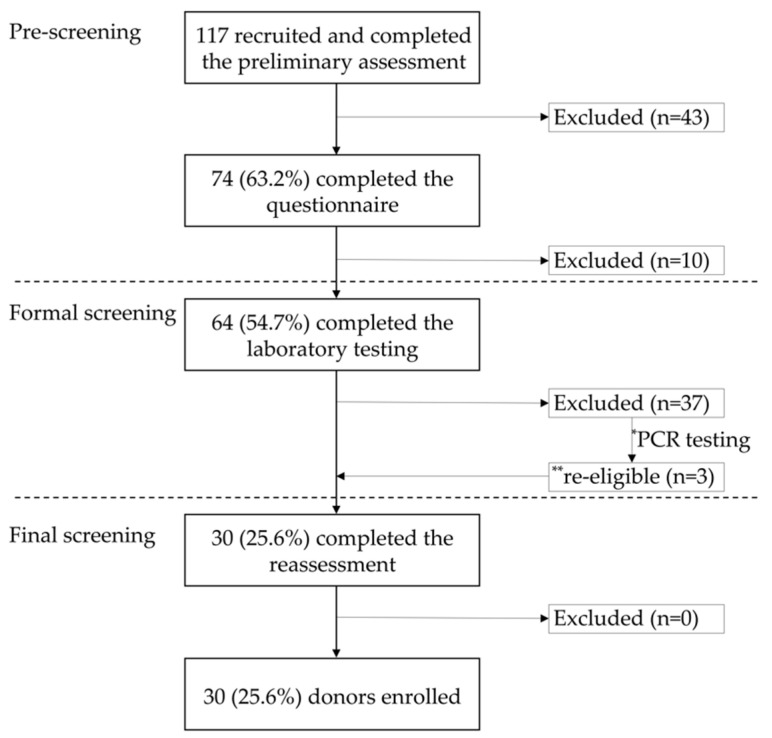
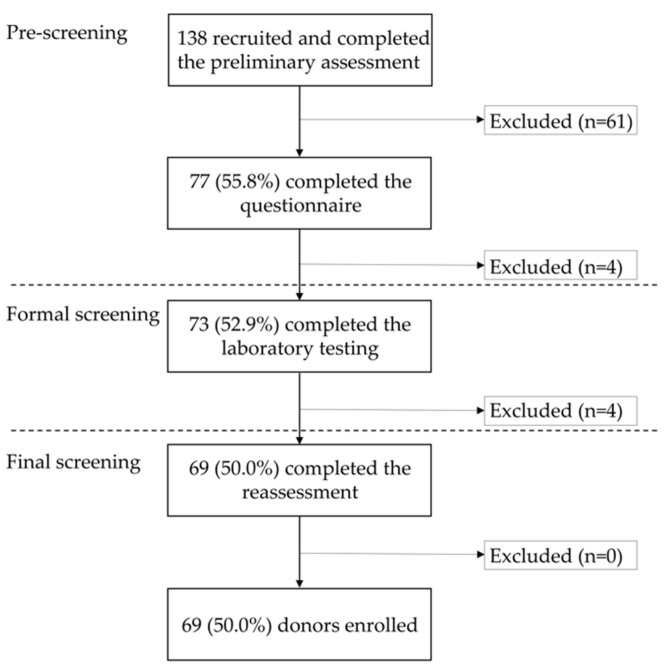
Fecal microbiota transplantation (FMT) has been recognized as a promising treatment for dysbiosis-related diseases. Since 2014, FMT has been utilized to treat ulcerative colitis (UC) in our clinical studies and has shown efficacy and safety. As donor screening (DS) is the primary step to ensure the safety of FMT, we report our experience with DS and present the screening results to improve the prospective DS criteria and provide references for future studies. The donor candidates were screened according to the DS criteria. The first DS criteria were proposed in June 2014 and revised substantially in May 2018. We further sorted the screening results and costs of laboratory tests. From June 2014 to April 2018, the DS eligibility rate was 50%. The total laboratory testing cost for each candidate was JPY 17,580/USD 160.21. From May 2018 to September 2021, the DS eligibility rate was 25.6%. The total laboratory testing cost for each candidate was JPY 40,740/USD 371.36. The reduction in donor eligibility rates due to more stringent criteria should be considered for cost and safety. Studies must consider the latest updates and make timely modifications in the DS criteria to ensure patient safety.
粪便微生物群移植(FMT)已被公认为是一种治疗与菌群失调相关疾病的有前景的疗法。自2014年以来,FMT已被用于我们的临床研究中治疗溃疡性结肠炎(UC),并已显示出疗效和安全性。由于供体筛选(DS)是确保FMT安全性的首要步骤,我们报告我们在DS方面的经验并展示筛选结果,以改进前瞻性DS标准并为未来研究提供参考。候选供体根据DS标准进行筛选。最初的DS标准于2014年6月提出,并于2018年5月进行了大幅修订。我们进一步整理了筛选结果和实验室检测成本。2014年6月至2018年4月,DS合格率为50%。每位候选者的实验室检测总费用为17,580日元/160.21美元。2018年5月至2021年9月,DS合格率为25.6%。每位候选者的实验室检测总费用为40,740日元/371.36美元。由于标准更加严格导致供体合格率降低,应从成本和安全性方面加以考虑。研究必须考虑最新更新情况并及时修改DS标准,以确保患者安全。