Altamura Concetta, Gavazzo Paola, Pusch Michael, Desaphy Jean-François
Section of Pharmacology, Department of Biomedical Sciences and Human Oncology, School of Medicine, University of Bari Aldo Moro, 70124 Bari, Italy.
Institute of Biophysics, National Research Council, 16149 Genoa, Italy.
J Pers Med. 2022 Feb 3;12(2):210. doi: 10.3390/jpm12020210.
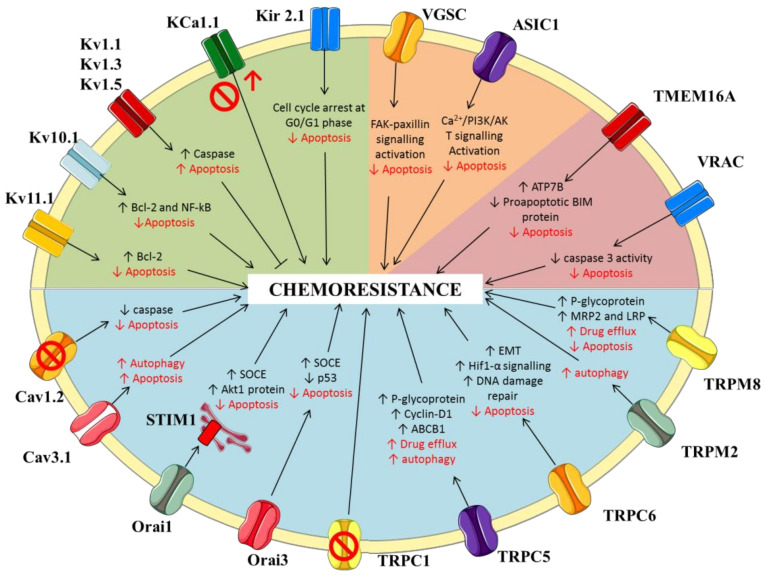
Over 90% of deaths in cancer patients are attributed to tumor drug resistance. Resistance to therapeutic agents can be due to an innate property of cancer cells or can be acquired during chemotherapy. In recent years, it has become increasingly clear that regulation of membrane ion channels is an important mechanism in the development of chemoresistance. Here, we review the contribution of ion channels in drug resistance of various types of cancers, evaluating their potential in clinical management. Several molecular mechanisms have been proposed, including evasion of apoptosis, cell cycle arrest, decreased drug accumulation in cancer cells, and activation of alternative escape pathways such as autophagy. Each of these mechanisms leads to a reduction of the therapeutic efficacy of administered drugs, causing more difficulty in cancer treatment. Thus, targeting ion channels might represent a good option for adjuvant therapies in order to counteract chemoresistance development.
超过90%的癌症患者死亡归因于肿瘤耐药性。对治疗药物的耐药性可能是癌细胞的固有特性,也可能是在化疗过程中获得的。近年来,越来越清楚的是,膜离子通道的调节是化疗耐药性发展的重要机制。在此,我们综述离子通道在各类癌症耐药性中的作用,评估它们在临床管理中的潜力。已经提出了几种分子机制,包括逃避细胞凋亡、细胞周期停滞、癌细胞中药物积累减少以及激活自噬等替代逃逸途径。这些机制中的每一种都会导致所用药物的治疗效果降低,给癌症治疗带来更大困难。因此,靶向离子通道可能是辅助治疗的一个好选择,以对抗化疗耐药性的发展。