Kirtikliene Tatjana, Mierauskaitė Aistė, Razmienė Ilona, Kuisiene Nomeda
Department of Microbiology and Biotechnology, Institute of Biosciences, Life Sciences Center, Vilnius University, LT-10257 Vilnius, Lithuania.
Clinical Testing Department, National Public Health Surveillance Laboratory, LT-10210 Vilnius, Lithuania.
Microorganisms. 2022 Feb 15;10(2):449. doi: 10.3390/microorganisms10020449.
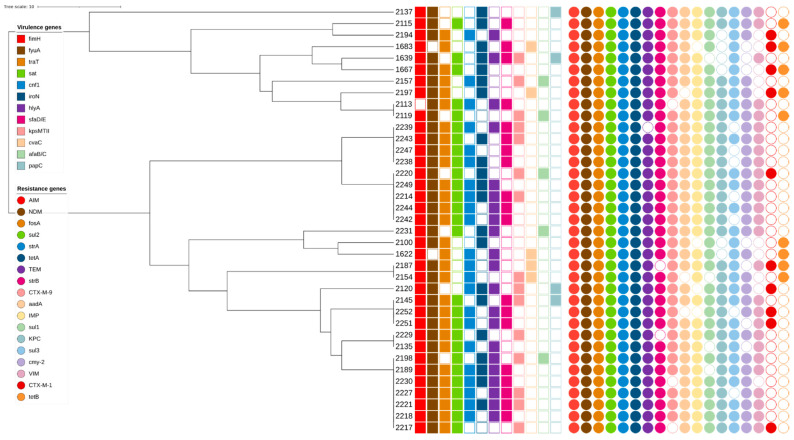
Extraintestinal pathogenic (ExPEC) isolates are a main cause of bloodstream infections. The aim of this study was to characterize 256 β-lactam-resistant, bacteremia-causing isolates collected from 12 healthcare institutions in Lithuania in 2014 and 2018. All isolates were identified as via MALDI-TOF MS and VITEK 2. In addition, the isolates were analyzed for the presence of 29 resistance genes and 13 virulence genes, divided into phylogenetic groups (A, B1, B2, C, D, E, and F), and characterized using rep-PCR genotyping methods (BOX-PCR and (GTG)-PCR). Analyzing the results of this study showed to be the most common resistance gene combination (67.2% of all isolates). Additionally, the most common virulence genes established were (98.4% of all isolates), (91.8%), and (81.3%) and the most common gene combination was (58.6% of all isolates). Next, the isolates were separated into four phylogenetic groups: A, B1, B2, and F, where group A isolates were detected at a significantly higher frequency (79.3% of all isolates). Finally, a total of 235 genotyping profiles were established using rep-PCR methods, and all profiles were separated into fourteen genotypic clusters, with each cluster containing profiles with a variety of virulence and resistance genes not restricted to any specific cluster. The results of this study elucidate E. coli antimicrobial resistance patterns by highlighting the variability and diversity of resistance and virulence genes and providing phylogenetic classification, genetic profiling, and clustering data. These results may improve clinical control of multidrug-resistant infections in healthcare institutions and contribute to the prevention of potential outbreaks.
肠外致病性(ExPEC)分离株是血流感染的主要原因。本研究的目的是对2014年和2018年从立陶宛12家医疗机构收集的256株耐β-内酰胺、引起菌血症的分离株进行特征分析。所有分离株均通过基质辅助激光解吸电离飞行时间质谱(MALDI-TOF MS)和VITEK 2进行鉴定。此外,对分离株进行了29种耐药基因和13种毒力基因的检测,分为系统发育组(A、B1、B2、C、D、E和F),并使用重复聚合酶链反应基因分型方法(BOX-PCR和(GTG)-PCR)进行特征分析。分析本研究结果表明,[具体基因组合]是最常见的耐药基因组合(占所有分离株的67.2%)。此外,确定的最常见毒力基因是[具体基因1](占所有分离株的98.4%)、[具体基因2](91.8%)和[具体基因3](81.3%),最常见的基因组合是[具体组合](占所有分离株的58.6%)。接下来,将分离株分为四个系统发育组:A、B1、B2和F,其中A组分离株的检测频率显著更高(占所有分离株的79.3%)。最后,使用重复聚合酶链反应方法建立了总共235个基因分型图谱,所有图谱被分为14个基因型簇,每个簇包含具有多种毒力和耐药基因的图谱,不限于任何特定簇。本研究结果通过突出耐药性和毒力基因的变异性和多样性,并提供系统发育分类、基因图谱和聚类数据,阐明了大肠杆菌的抗菌耐药模式。这些结果可能会改善医疗机构中多重耐药感染的临床控制,并有助于预防潜在的疫情爆发。