Cerebrovascular Concussion Lab, Faculty of Kinesiology, University of Calgary, Alberta, Canada.
Sport Injury Prevention Research Centre, Faculty of Kinesiology, University of Calgary, Calgary, Alberta, Canada.
J Cereb Blood Flow Metab. 2022 Aug;42(8):1478-1492. doi: 10.1177/0271678X221084400. Epub 2022 Feb 25.
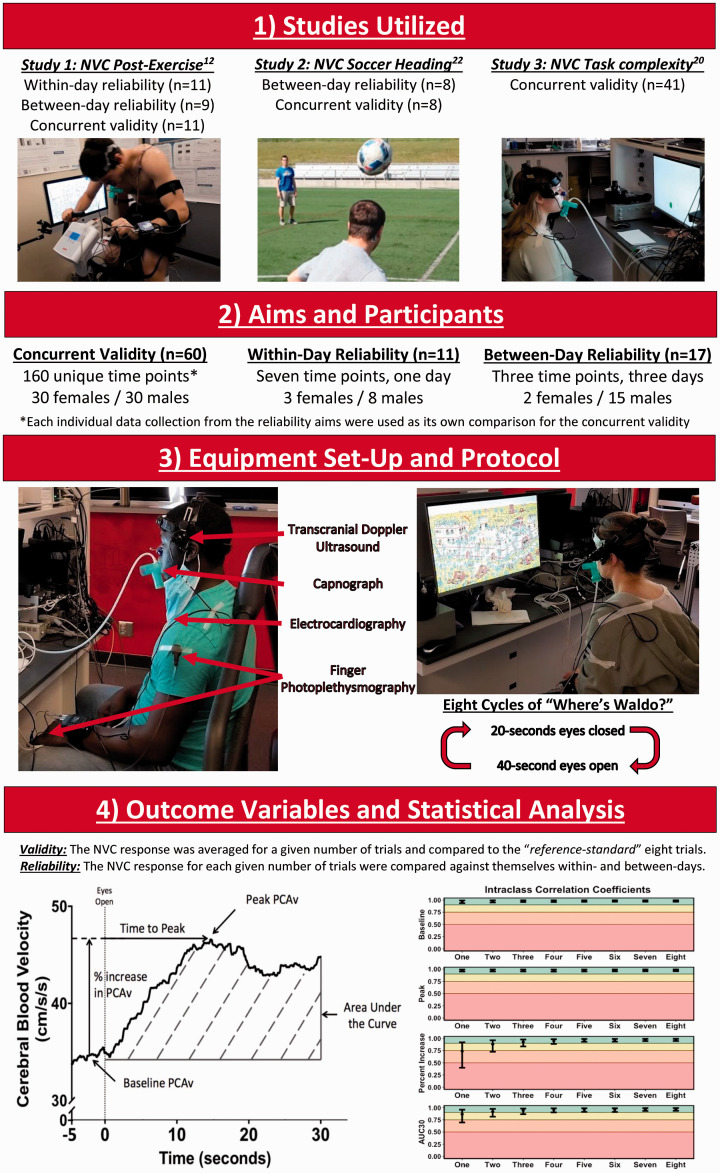
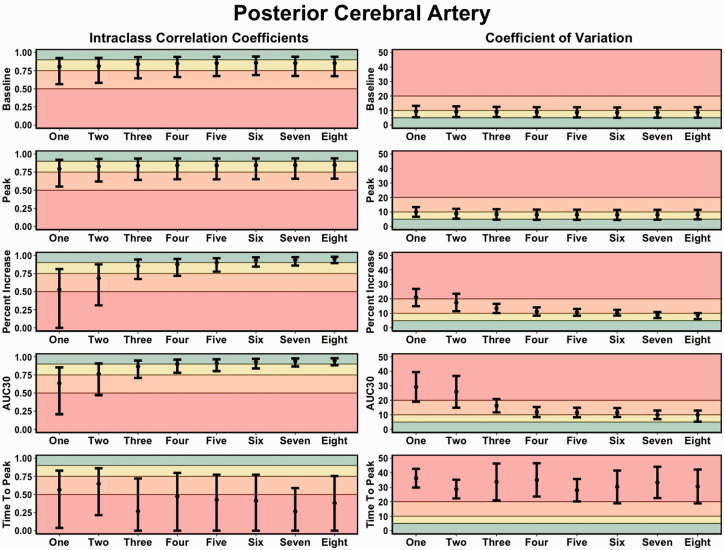
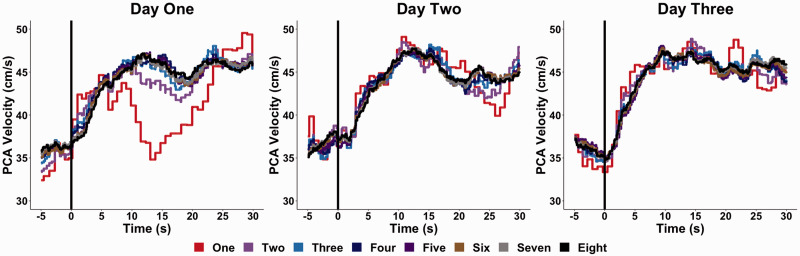
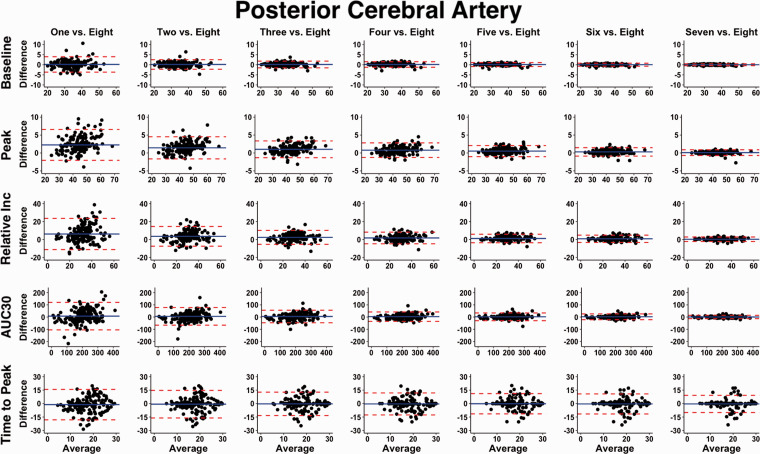
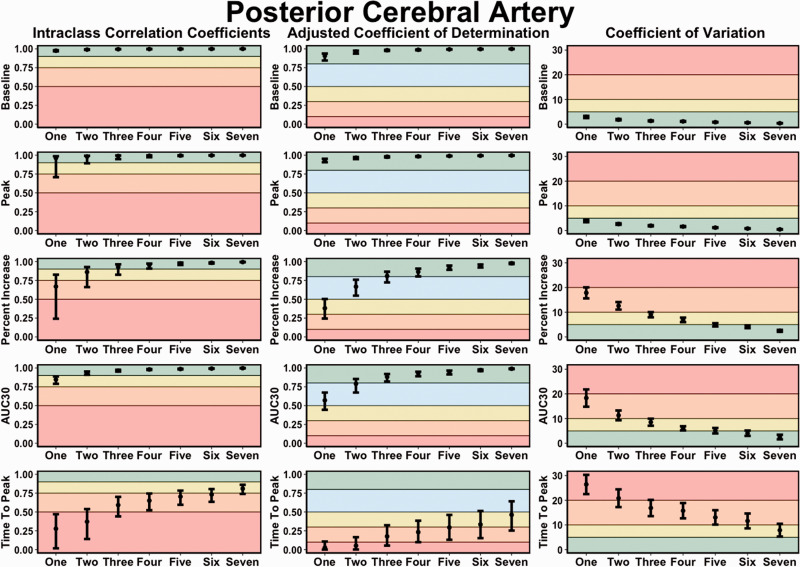
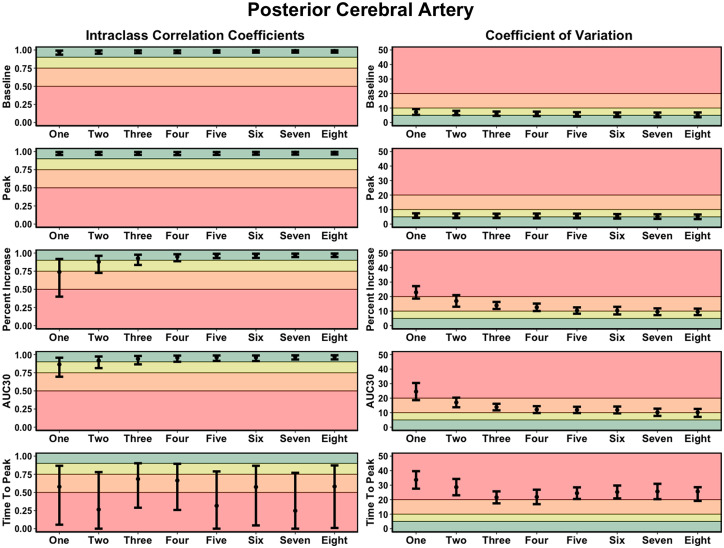
Standard practices for quantifying neurovascular coupling (NVC) with transcranial Doppler ultrasound (TCD) require participants to complete one-to-ten repetitive trials. However, limited empirical evidence exists regarding how the number of trials completed influences the validity and reliability of temporally derived NVC metrics. Secondary analyses was performed on 60 young healthy participants (30 females/30 males) who completed eight cyclical eyes-closed (20-seconds), eyes-open (40-seconds) NVC trials, using the visual paradigm. TCD data was obtained in posterior and middle cerebral arteries (PCA and MCA, respectively). The within-day (n = 11) and between-day ( = 17) reliability were assessed at seven- and three-time points, respectively. Repeat testing from the reliability aims were also used for the concurrent validity analysis ( = 160). PCA metrics (i.e., baseline, peak, percent increase, and area-under-the-curve) demonstrated five trials produced excellent intraclass correlation coefficient (ICC) 95% confidence intervals for validity and within-day reliability (>0.900), whereas between-day reliability was good-to-excellent (>0.750). Likewise, 95% confidence intervals for coefficient of variation (CoV) measures ranged from acceptable (<20%) to excellent (<5%) with five-or-more trials. Employing fewer than five trials produced poor/unacceptable ICC and CoV metrics. Future NVC, TCD-based research should therefore have participants complete a minimum of five trials when quantifying the NVC response with TCD via a "" paradigm.
使用经颅多普勒超声(TCD)量化神经血管耦合(NVC)的标准实践要求参与者完成一到十次重复试验。然而,关于完成的试验次数如何影响时间衍生的 NVC 指标的有效性和可靠性,实证证据有限。对 60 名年轻健康参与者(30 名女性/30 名男性)进行了二次分析,他们完成了 8 个循环闭眼(20 秒)、睁眼(40 秒)NVC 试验,使用视觉范式。在大脑后动脉(PCA)和大脑中动脉(MCA)中获得 TCD 数据。在 7 个和 3 个时间点分别评估了日内(n = 11)和日间(n = 17)的可靠性。从可靠性目标重复测试还用于同时进行有效性分析(n = 160)。PCA 指标(即基线、峰值、百分比增加和曲线下面积)表明,对于有效性和日内可靠性,五次试验产生了极好的组内相关系数(ICC)95%置信区间(>0.900),而日间可靠性为良好至极好(>0.750)。同样,五次或更多次试验时,变异系数(CoV)测量值的 95%置信区间范围从可接受(<20%)到极好(<5%)。少于五次试验会产生较差/不可接受的 ICC 和 CoV 指标。因此,未来的 NVC、基于 TCD 的研究在使用 TCD 通过“范式”量化 NVC 反应时,应要求参与者完成至少五次试验。