Department of Psychiatry, Erasmus Medical Center, Rotterdam, Zuid-Holland, The Netherlands
Department of Psychiatry, Erasmus Medical Center, Rotterdam, Zuid-Holland, The Netherlands.
BMJ Open. 2022 Feb 24;12(2):e059124. doi: 10.1136/bmjopen-2021-059124.
The aim of the current study is to gain insight into the factors that benefit vitality and resilience of healthcare workers during the COVID-19 pandemic, to develop and direct specific support strategies.
DESIGN, SETTING AND PARTICIPANTS: This study applies a qualitative design, consisting of six focus groups and five interviews among 38 frontline healthcare workers in a large Dutch academic hospital. Included were professionals of the intensive care unit, COVID-19 departments, infection prevention units and facility management services. The study was conducted in October and November 2020, during the second wave of the COVID-19 pandemic.
Thematic analysis was applied to focus group and interview data to gain insight into the factors that contribute to maintaining vitality and resilience, and to assess specific support needs.
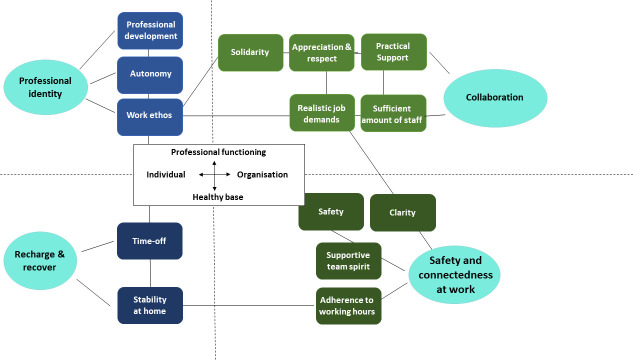
Data analysis of the focus groups and individual interviews resulted in a thematic map of the factors that contribute to maintaining resilience and vitality. The map stretches over two axes: one ranging from a healthy basis to adequate professional functioning and the other from individual to organisation, resulting in four quadrants: recharge and recover (healthy basis, individual), safety and connectedness at work (healthy basis, organisational), collaboration (professional functioning, organisational) and professional identity (professional functioning, individual).
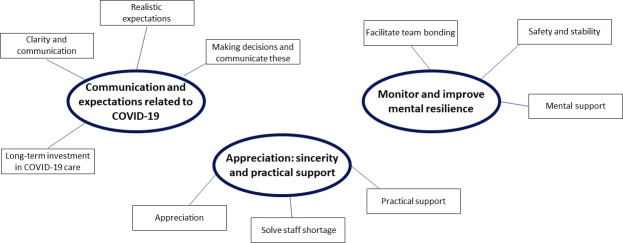
Areas for organisational support strategies to increase vitality and resilience among healthcare professionals are: consistent communication, realistic job performance expectations, monitor and improve mental resilience, showing appreciation and act upon practical support requests.
本研究旨在深入了解 COVID-19 大流行期间有益于医护人员活力和适应力的因素,以制定和指导具体的支持策略。
设计、地点和参与者:本研究采用定性设计,包括在荷兰一家大型学术医院的 38 名一线医护人员中进行的 6 个焦点小组和 5 次访谈。参与者包括重症监护室、COVID-19 部门、感染预防部门和设施管理服务的专业人员。研究于 2020 年 10 月至 11 月期间 COVID-19 大流行的第二波进行。
采用主题分析方法对焦点小组和访谈数据进行分析,以深入了解维持活力和适应力的因素,并评估具体的支持需求。
对焦点小组和个人访谈数据的分析得出了一个有助于维持适应力和活力的因素的主题图。该图跨越两个轴:一个从健康基础到充分的专业功能,另一个从个人到组织,分为四个象限:充电和恢复(健康基础,个人)、工作中的安全和联系(健康基础,组织)、协作(专业功能,组织)和专业身份(专业功能,个人)。
为提高医护人员活力和适应力而制定组织支持策略的领域包括:一致的沟通、现实的工作绩效期望、监测和提高心理适应力、表示赞赏并采取实际支持请求。