Odago Wyclif Ochieng, Waswa Emmanuel Nyongesa, Nanjala Consolata, Mutinda Elizabeth Syowai, Wanga Vincent Okelo, Mkala Elijah Mbandi, Oulo Millicent Akinyi, Wang Yan, Zhang Cai-Fei, Hu Guang-Wan, Wang Qing-Feng
CAS Key Laboratory of Plant Germplasm Enhancement and Specialty Agriculture, Wuhan Botanical Garden, Chinese Academy of Sciences, Wuhan, China.
Sino-Africa Joint Research Center, Chinese Academy of Sciences, Wuhan, China.
Front Plant Sci. 2022 Feb 8;12:814833. doi: 10.3389/fpls.2021.814833. eCollection 2021.
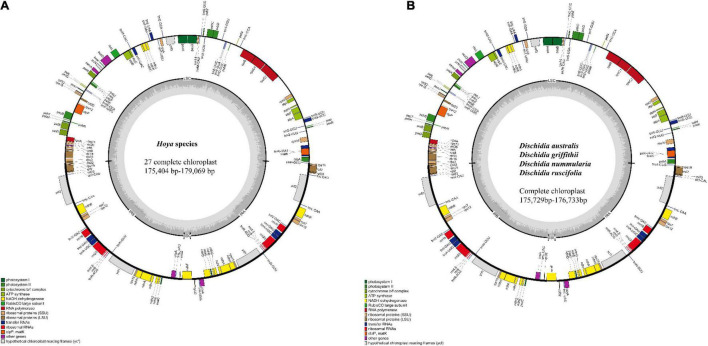
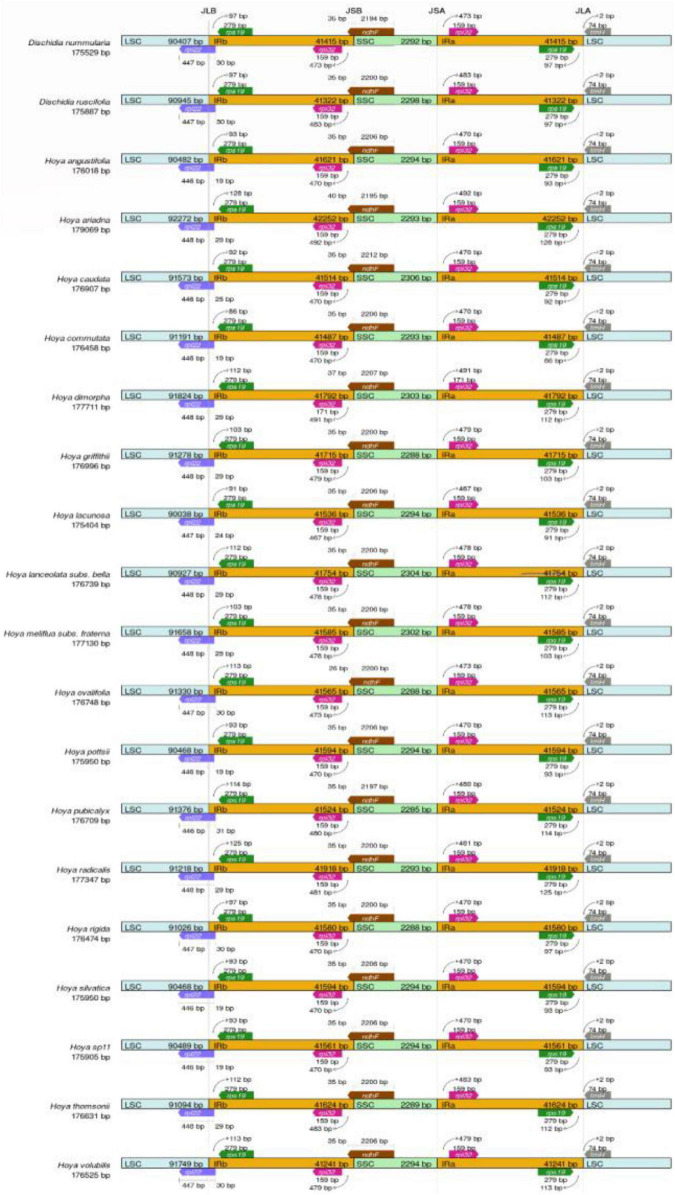
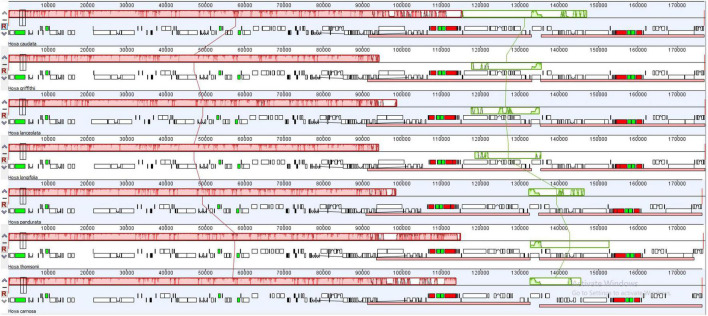
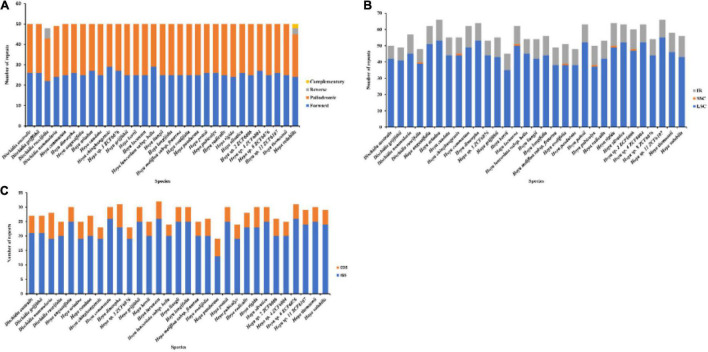
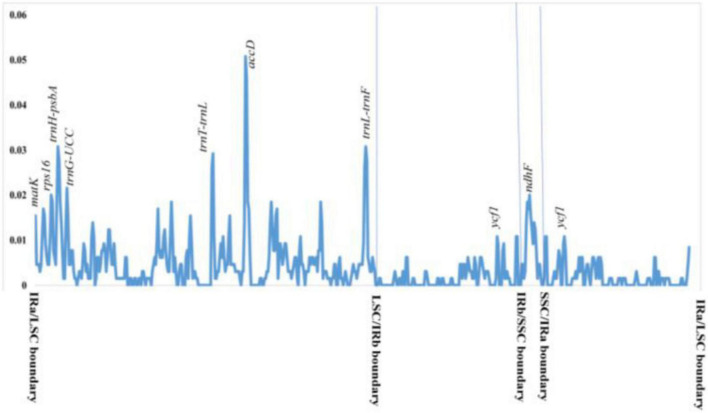
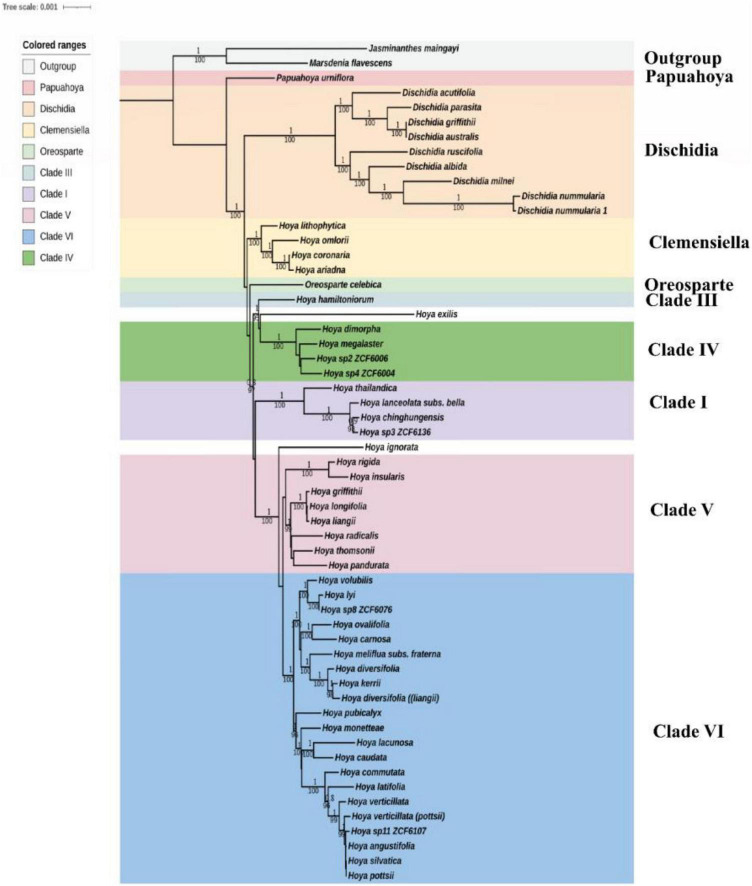
is a genus in Apocynaceae-Asclepiadoideae, known for its showy wax flowers, making it a popular ornamental plant. However, phylogenetic relationships among most species are not yet fully resolved. In this study, we sequenced 31 plastomes of group species using genome skimming data and carried out multiple analyses to understand genome variation to resolve the phylogenetic positions of some newly sequenced Chinese endemic species. We also screened possible hotspots, , and , , , and genes that could be used as molecular markers for DNA barcoding and species identification. Using maximum likelihood (ML) and Bayesian Inference (BI), a species phylogeny was constructed. The newly assembled plastomes genomes showed the quasi-tripartite structure characteristic for and with a reduced small single copy (SSC) and extremely enlarged inverted repeats (IR). The lengths ranged from 175,404 bp in to 179,069 bp in . The large single copy (LSC) regions ranged from 80,795 bp () to 92,072 bp (sp2ZCF6006). The massively expanded IR regions were relatively conserved in length, with the small single-copy region reduced to a single gene, . We identified 235 long dispersed repeats (LDRs) and ten highly divergent hotspots in the 31 plastomes, which can be used as DNA barcodes for species identification. The phylogeny supports as a distinct genus. is resolved as a relative to Clade VI species. This study discloses the advantages of using Plastome genome data to study phylogenetic relationships.
是夹竹桃科马利筋亚科的一个属,以其艳丽的蜡花而闻名,使其成为一种受欢迎的观赏植物。然而,大多数物种之间的系统发育关系尚未完全解决。在本研究中,我们使用基因组浅层测序数据对该组物种的31个质体基因组进行了测序,并进行了多项分析以了解基因组变异,从而确定一些新测序的中国特有物种的系统发育位置。我们还筛选了可能的热点区域,以及,,,和基因,这些基因可作为DNA条形码和物种鉴定的分子标记。使用最大似然法(ML)和贝叶斯推断(BI)构建了物种系统发育树。新组装的质体基因组显示出和的准三方结构特征,小单拷贝(SSC)区域缩小,反向重复序列(IR)极度扩大。长度范围从的175,404 bp到的179,069 bp。大单拷贝(LSC)区域范围从80,795 bp()到92,072 bp(sp2ZCF6006)。大量扩展的IR区域在长度上相对保守,小单拷贝区域缩小到一个单一基因,。我们在31个质体基因组中鉴定出235个长散在重复序列(LDR)和10个高度分化的热点区域,可作为物种鉴定的DNA条形码。系统发育树支持作为一个独特的属。被确定为与进化枝VI物种相关。本研究揭示了使用质体基因组数据研究系统发育关系的优势。