Feng Song-Tao, Yang Yang, Yang Jin-Fei, Gao Yue-Ming, Cao Jing-Yuan, Li Zuo-Lin, Tang Tao-Tao, Lv Lin-Li, Wang Bin, Wen Yi, Sun Lin, Xing Guo-Lan, Liu Bi-Cheng
Institute of Nephrology, Zhongda Hospital, Southeast University School of Medicine, Nanjing, Jiangsu Province, China.
Department of Nephrology, the First Affiliated Hospital of Zhengzhou University, Zhengzhou, Henan Province, China.
Clin Kidney J. 2021 Sep 28;15(3):534-544. doi: 10.1093/ckj/sfab186. eCollection 2022 Mar.
Urinary sediment messenger RNAs (mRNAs) have been shown as novel biomarkers of kidney disease. We aimed to identify targeted urinary mRNAs in diabetic nephropathy (DN) based on bioinformatics analysis and clinical validation.
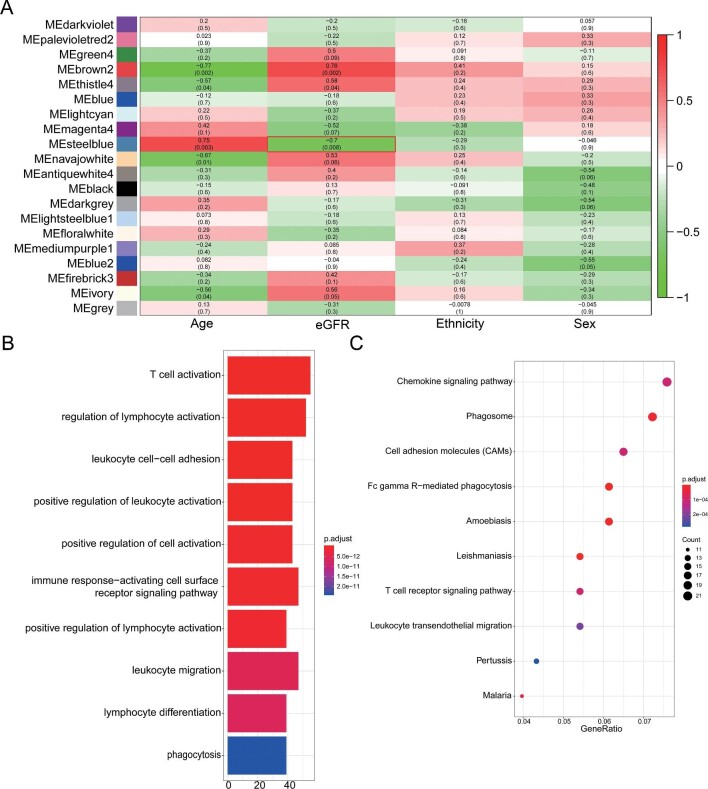
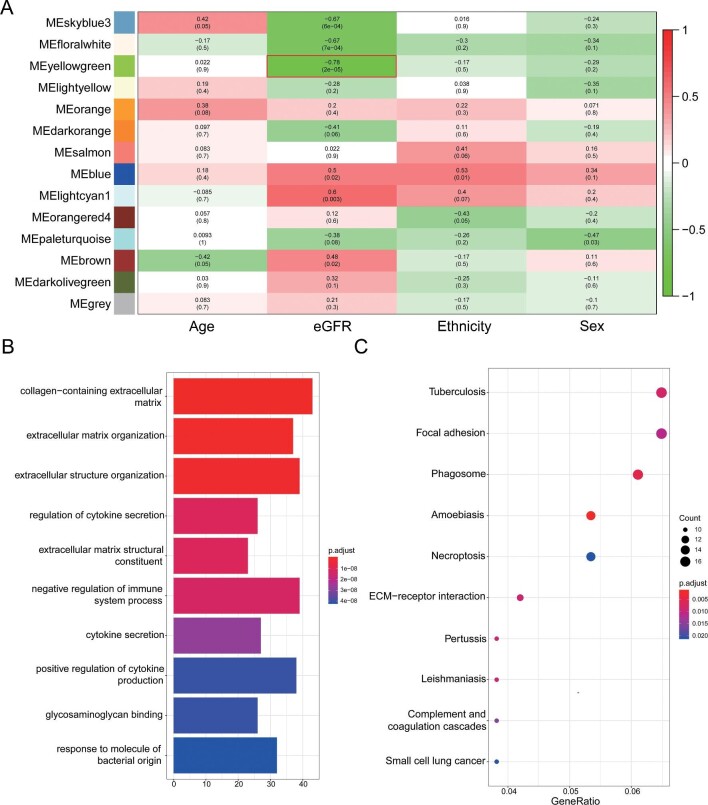
Microarray studies of DN were searched in the GEO database and Nephroseq platform. Gene modules negatively correlated with estimated glomerular filtration rate (eGFR) were identified by informatics methods. Hub genes were screened within the selected modules. In validation cohorts, a quantitative polymerase chain reaction assay was used to compare the expression levels of candidate mRNAs. Patients with renal biopsy-confirmed DN were then followed up for a median time of 21 months. End-stage renal disease (ESRD) was defined as the primary endpoint. Multivariate Cox proportional hazards regression was developed to evaluate the prognostic values of candidate mRNAs.
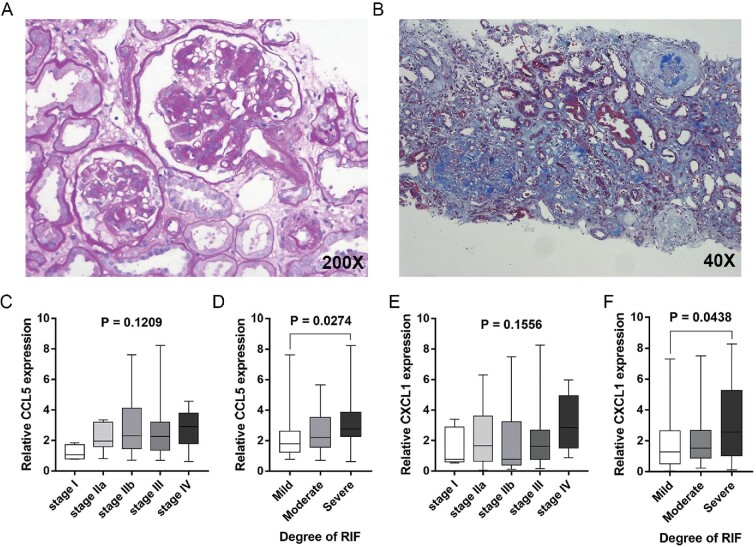
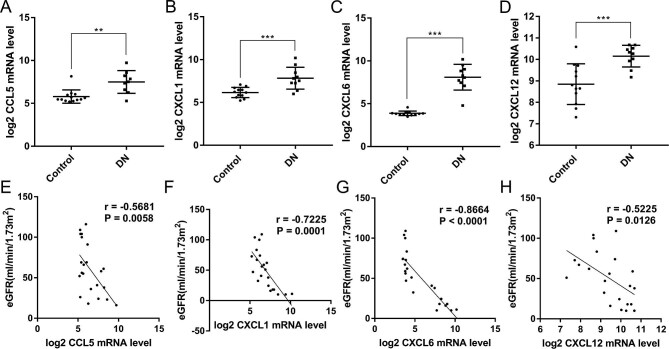
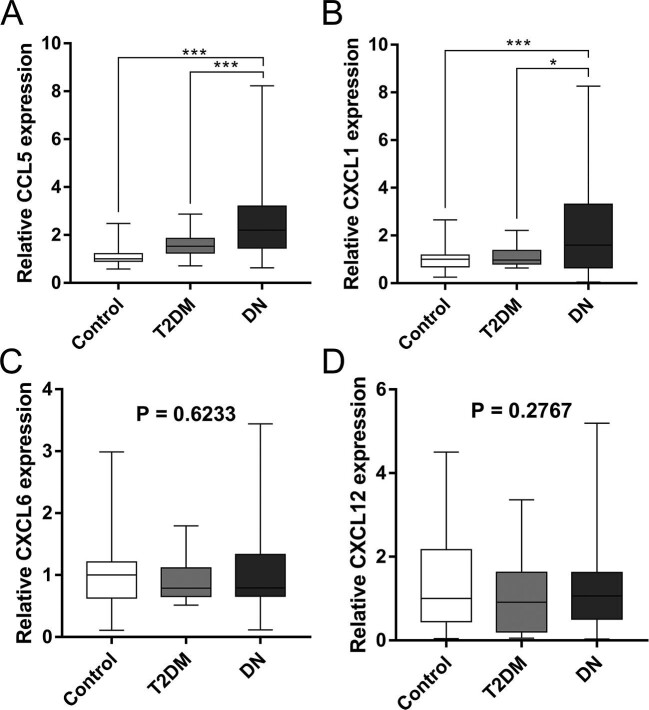
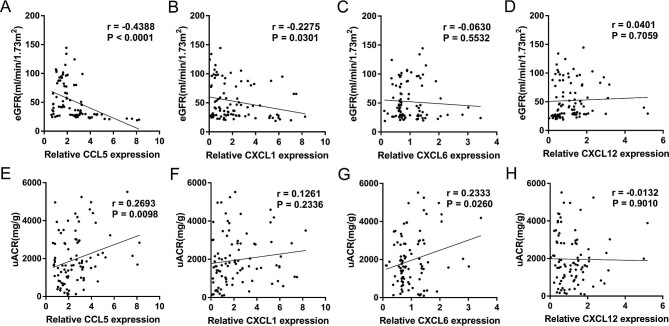
Bioinformatics analysis revealed four chemokines (CCL5, CXCL1, CXLC6 and CXCL12) as candidate mRNAs negatively correlated with eGFR, of which CCL5 and CXCL1 mRNA levels were upregulated in the urinary sediment of patients with DN. In addition, urinary sediment mRNA of CXCL1 was negatively correlated with eGFR ( = -0.2275, P = 0.0301) and CCL5 level was negatively correlated with eGFR ( = -0.4388, P < 0.0001) and positively correlated with urinary albumin:creatinine ratio (r = 0.2693, P = 0.0098); also, CCL5 and CXCL1 were upregulated in patients with severe renal interstitial fibrosis. Urinary sediment CCL5 mRNA was an independent predictor of ESRD [hazard ratio 1.350 (95% confidence interval 1.045-1.745)].
Urinary sediment CCL5 and CXCL1 mRNAs were upregulated in DN patients and associated with a decline in renal function and degree of renal interstitial fibrosis. Urinary sediment CCL5 mRNA could be used as a potential prognostic biomarker of DN.
尿沉渣信使核糖核酸(mRNA)已被证明是肾脏疾病的新型生物标志物。我们旨在通过生物信息学分析和临床验证来鉴定糖尿病肾病(DN)中的靶向尿mRNA。
在GEO数据库和Nephroseq平台中搜索DN的微阵列研究。通过信息学方法鉴定与估计肾小球滤过率(eGFR)呈负相关的基因模块。在选定的模块中筛选枢纽基因。在验证队列中,使用定量聚合酶链反应测定法比较候选mRNA的表达水平。然后对肾活检确诊的DN患者进行中位时间为21个月的随访。将终末期肾病(ESRD)定义为主要终点。开展多变量Cox比例风险回归以评估候选mRNA的预后价值。
生物信息学分析显示四种趋化因子(CCL5、CXCL1、CXLC6和CXCL12)作为与eGFR呈负相关的候选mRNA,其中CCL5和CXCL1 mRNA水平在DN患者的尿沉渣中上调。此外,CXCL1的尿沉渣mRNA与eGFR呈负相关(r = -0.2275,P = 0.0301),CCL5水平与eGFR呈负相关(r = -0.4388,P < 0.0001),与尿白蛋白:肌酐比值呈正相关(r = 0.2693,P = 0.0098);而且,CCL5和CXCL1在严重肾间质纤维化患者中上调。尿沉渣CCL5 mRNA是ESRD的独立预测因子[风险比1.350(95%置信区间1.045 - 1.745)]。
DN患者尿沉渣中CCL5和CXCL1 mRNA上调,且与肾功能下降和肾间质纤维化程度相关。尿沉渣CCL5 mRNA可作为DN潜在的预后生物标志物。