Sancheznieto Fátima, Sorkness Christine A, Attia Jacqueline, Buettner Kathryn, Edelman David, Hobbs Stuart, McIntosh Scott, McManus Linda M, Sandberg Kathryn, Schnaper H William, Scholl Linda, Umans Jason G, Weavers Karen, Windebank Anthony, McCormack Wayne T
University of Wisconsin Institute for Clinical and Translational Research, Madison, WI, USA.
Center for Leading Innovation and Collaboration, Department of Public Health Sciences, University of Rochester Medical Center, Rochester, NY, USA.
J Clin Transl Sci. 2021 Dec 27;6(1):e13. doi: 10.1017/cts.2021.884. eCollection 2022.
A national survey characterized training and career development for translational researchers through Clinical and Translational Science Award (CTSA) T32/TL1 programs. This report summarizes program goals, trainee characteristics, and mentorship practices.
A web link to a voluntary survey was emailed to 51 active TL1 program directors and administrators. Descriptive analyses were performed on aggregate data. Qualitative data analysis used open coding of text followed by an axial coding strategy based on the grounded theory approach.
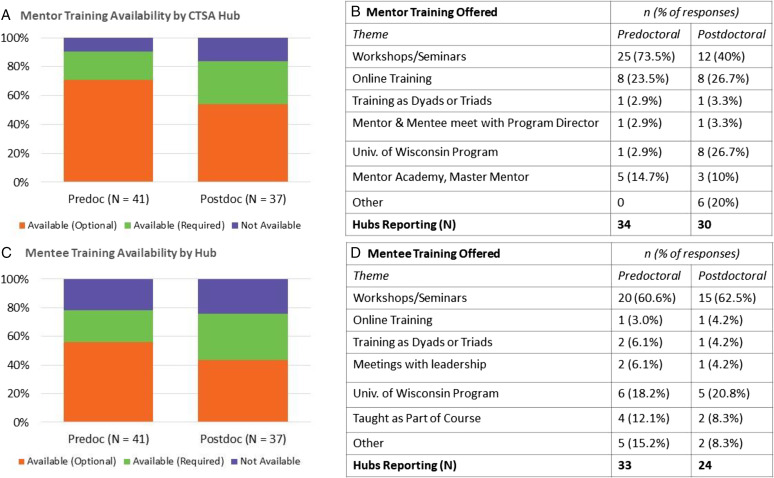
Fifty out of 51 (98%) invited CTSA hubs responded. Training program goals were aligned with the CTSA mission. The trainee population consisted of predoctoral students (50%), postdoctoral fellows (30%), and health professional students in short-term (11%) or year-out (9%) research training. Forty percent of TL1 programs support both predoctoral and postdoctoral trainees. Trainees are diverse by academic affiliation, mostly from medicine, engineering, public health, non-health sciences, pharmacy, and nursing. Mentor training is offered by most programs, but mandatory at less than one-third of them. Most mentoring teams consist of two or more mentors.
CTSA TL1 programs are distinct from other NIH-funded training programs in their focus on clinical and translational research, cross-disciplinary approaches, emphasis on team science, and integration of multiple trainee types. Trainees in nearly all TL1 programs were engaged in all phases of translational research (preclinical, clinical, implementation, public health), suggesting that the CTSA TL1 program is meeting the mandate of NCATS to provide training to develop the clinical and translational research workforce.
一项全国性调查通过临床与转化科学奖(CTSA)的T32/TL1项目对转化研究人员的培训和职业发展进行了特征描述。本报告总结了项目目标、学员特征和指导实践。
向51位活跃的TL1项目主任和管理人员发送了一份自愿调查问卷的网络链接。对汇总数据进行描述性分析。定性数据分析采用文本开放编码,然后基于扎根理论方法采用轴向编码策略。
51个受邀的CTSA中心中有50个(98%)做出了回应。培训项目目标与CTSA的使命一致。学员群体包括博士前学生(50%)、博士后研究员(30%)以及参加短期(11%)或为期一年(9%)研究培训的卫生专业学生。40%的TL1项目同时支持博士前和博士后学员。学员的学术背景多样,大多来自医学、工程、公共卫生、非健康科学、药学和护理学。大多数项目提供导师培训,但不到三分之一的项目是强制性的。大多数指导团队由两名或更多导师组成。
CTSA TL1项目在关注临床和转化研究、跨学科方法、强调团队科学以及整合多种学员类型方面,与其他由美国国立卫生研究院资助的培训项目不同。几乎所有TL1项目的学员都参与了转化研究的各个阶段(临床前、临床、实施、公共卫生),这表明CTSA TL1项目正在履行美国国立转化医学科学研究所(NCATS)提供培训以培养临床和转化研究人员队伍的使命。