Hatch Mellissa R, Carandang Kristine, Moullin Joanna C, Ehrhart Mark G, Aarons Gregory A
Center for Alcohol and Addiction Studies, Brown University School of Public Health, Providence, RI, USA.
Child and Adolescent Services Research Center, San Diego, CA, USA.
Implement Res Pract. 2021 Jan-Dec;2. doi: 10.1177/26334895211018400. Epub 2021 May 31.
The successful implementation of evidence-based practices (EBPs) in real-world settings requires an adaptive approach and ongoing process evaluation and tailoring. Although conducting a needs assessment during the preparation phase of implementation is beneficial, it is challenging to predict all barriers to EBP implementation that may arise over the course of implementation and sustainment. This article describes a process evaluation that identified emergent and persistent barriers that impacted the implementation of an EBP across multiple behavioral health organizations and clinics.
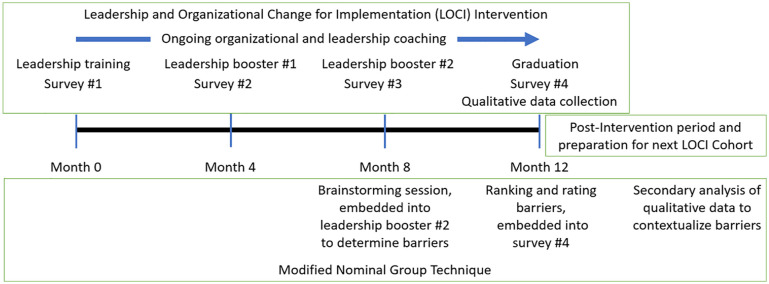
This study was conducted during the first cohort of a cluster randomized controlled trial testing the effectiveness of the Leadership and Organizational Change for Implementation (LOCI) strategy to implement motivational interviewing (MI) in substance use disorder treatment agencies and clinics. We used a modified nominal group technique (NGT) in which clinic leaders identified barriers faced during the implementation process. Barriers were categorized, then ranked and rated according to leaders' perceptions of each barrier's influence on implementation. The barriers were then contextualized through individual qualitative interviews.
Fifteen barriers were identified, grouped into staff-level barriers, management-level barriers, and implementation program barriers. Time and resistance to MI were rated as the most influential staff-level barriers. Among management-level barriers, time was also rated highest, followed by turnover and external contractual constraints. The most influential implementation barrier was client apprehension of recording for fidelity assessment and feedback. Individual interviews supported these findings and provided suggested adaptations for future implementation efforts.
EBP implementation is an ongoing process whereby implementation strategies must be proactively and strategically tailored to address emergent barriers. This research described a process evaluation that was used to identify 15 emergent and/or persistent barriers related to staff, management, and the implementation program. Using implementation strategies that can be tailored and/or adapted to such emergent barriers is critical to implementation effectiveness.
在现实环境中成功实施循证实践(EBP)需要一种适应性方法以及持续的过程评估和调整。尽管在实施准备阶段进行需求评估是有益的,但要预测在实施和维持过程中可能出现的所有循证实践实施障碍具有挑战性。本文描述了一项过程评估,该评估确定了影响多个行为健康组织和诊所中循证实践实施的新出现和持续存在的障碍。
本研究是在一项整群随机对照试验的第一个队列中进行的,该试验测试了实施领导力与组织变革(LOCI)策略以在物质使用障碍治疗机构和诊所中实施动机性访谈(MI)的有效性。我们使用了一种改良的名义小组技术(NGT),其中诊所负责人确定了实施过程中面临的障碍。对障碍进行分类,然后根据负责人对每个障碍对实施影响的看法进行排名和评级。然后通过个体定性访谈将这些障碍置于具体情境中。
确定了15个障碍,分为员工层面障碍、管理层面障碍和实施项目障碍。时间和对动机性访谈的抵触被评为最有影响力的员工层面障碍。在管理层面障碍中,时间也被评为最高,其次是人员更替和外部合同限制。最有影响力的实施障碍是客户对记录保真度评估和反馈的担忧。个体访谈支持了这些发现,并为未来的实施工作提供了建议的调整措施。
循证实践实施是一个持续的过程,在此过程中,必须积极主动且有策略地调整实施策略以应对新出现的障碍。本研究描述了一项过程评估,该评估用于识别与员工、管理和实施项目相关的15个新出现和/或持续存在的障碍。使用能够针对此类新出现障碍进行调整和/或适应的实施策略对于实施效果至关重要。