Minnesota Department of Health, St Paul.
Association of Public Health Laboratories, Silver Spring, Maryland.
JAMA Netw Open. 2022 Feb 1;5(2):e220536. doi: 10.1001/jamanetworkopen.2022.0536.
Characterizing rates of SARS-CoV-2 infection among vaccinated and unvaccinated persons with the same exposure is critical to understanding the association of vaccination with the risk of infection with the Delta variant. Additionally, evidence of Delta variant transmission by children to vaccinated adults has important public health implications.
To characterize transmission and infection of SARS-CoV-2 among vaccinated and unvaccinated attendees of an indoor wedding reception.
DESIGN, SETTING, AND PARTICIPANTS: This cohort study included attendees at an indoor wedding reception in Minnesota in July 2021. Data were collected from REDCap surveys and routine surveillance interviews. The full list of attendees and a partial list of emails were obtained. Fifty-seven attendees completed the emailed survey. Eighteen additional attendees were identified from the state health department COVID-19 surveillance database.
Attendance at an indoor event.
Risk of SARS-CoV-2 infection among vaccinated and unvaccinated attendees, identification of an index case, whole genome sequencing (WGS) to identify the COVID-19 variant, understanding of transmission patterns, and assessment of secondary transmission. The primary case definition was an individual with a positive SARS-CoV-2 test who attended the wedding in the 14 days prior to their illness.
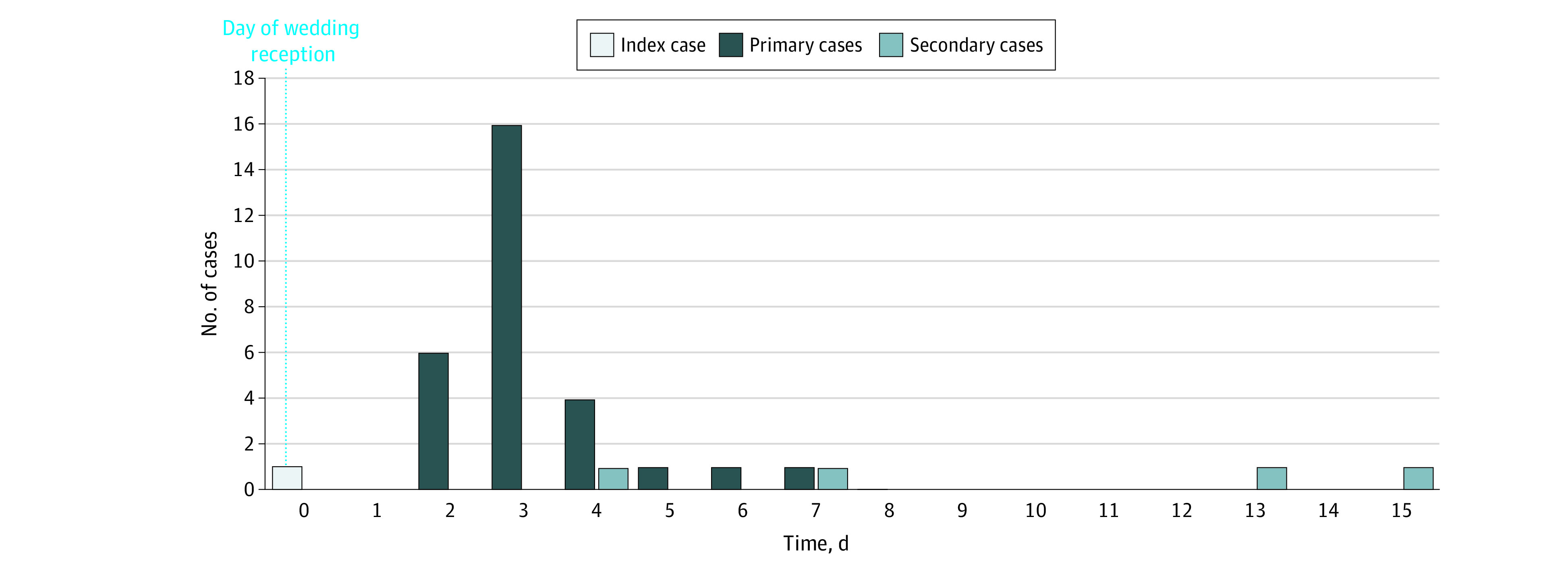
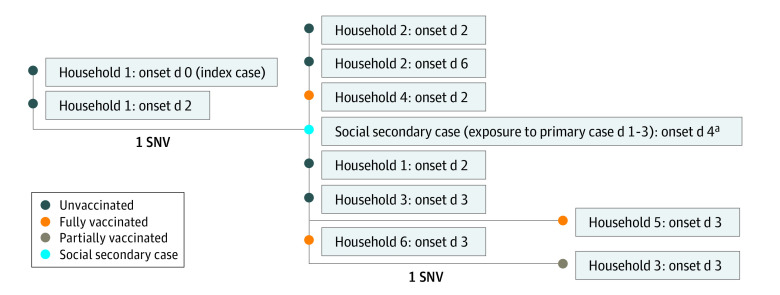
Data were gathered for 75 attendees (mean [SE] age, 37.5 [13.7] years; 57 [76%] female individuals), of whom 56 (75%) were fully vaccinated, 4 (5%) were partially vaccinated, and 15 (20%) were unvaccinated. Of 62 attendees who were tested, 29 (47%) tested positive, including 16 of 46 fully vaccinated attendees (35%), 2 of 4 partially vaccinated attendees (50%), and 11 of 12 unvaccinated attendees (92%). Being unvaccinated was associated with a higher risk of infection compared with being vaccinated (risk ratio, 2.64; 95% CI, 1.71-4.06; P = .001). One unvaccinated adult required hospitalization. An unvaccinated child who was symptomatic on the event date was identified as the index case. Eleven specimens were available for WGS. All sequenced specimens were closely related and were identified as the Delta variant. WGS supported secondary transmission from a vaccinated individual with SARS-CoV-2.
This cohort study identified a COVID-19 Delta variant outbreak at an indoor event despite a high proportion of vaccinated attendees. It found that vaccination was associated with a reduced risk of infection.
描述具有相同暴露风险的疫苗接种者和未接种者的 SARS-CoV-2 感染率,对于了解疫苗接种与感染 Delta 变异株风险之间的关联至关重要。此外,儿童向接种疫苗的成年人传播 Delta 变异株的证据对公共卫生具有重要意义。
描述 2021 年 7 月明尼苏达州一次室内婚礼接待会上接种疫苗者和未接种疫苗者的 SARS-CoV-2 传播和感染情况。
设计、地点和参与者:这项队列研究包括在明尼苏达州一次室内婚礼上的参加者。数据来自 REDCap 调查和常规监测访谈。获得了完整的参加者名单和部分电子邮件名单。57 名参加者完成了电子邮件调查。从州卫生部门的 COVID-19 监测数据库中又确定了 18 名参加者。
参加室内活动。
接种疫苗者和未接种疫苗者的 SARS-CoV-2 感染风险,确定首例病例,全基因组测序(WGS)以确定 COVID-19 变异株,了解传播模式,并评估二次传播。主要病例定义为在患病前 14 天内参加婚礼且 SARS-CoV-2 检测呈阳性的个体。
共收集了 75 名参加者的数据(平均[SE]年龄,37.5[13.7]岁;57[76%]为女性),其中 56 名(75%)完全接种疫苗,4 名(5%)部分接种疫苗,15 名(20%)未接种疫苗。在 62 名接受检测的参加者中,29 名(47%)检测呈阳性,包括 46 名完全接种疫苗的参加者中的 16 名(35%)、4 名部分接种疫苗的参加者中的 2 名(50%)和 12 名未接种疫苗的参加者中的 11 名(92%)。与接种疫苗者相比,未接种疫苗者的感染风险更高(风险比,2.64;95%CI,1.71-4.06;P = .001)。一名未接种疫苗的成年人需要住院治疗。一名在活动当天出现症状的未接种疫苗的儿童被确定为首例病例。共有 11 个样本可进行 WGS。所有测序样本密切相关,均被鉴定为 Delta 变异株。WGS 支持接种疫苗的个体发生 SARS-CoV-2 的二次传播。
这项队列研究在一次室内活动中发现了 COVID-19 Delta 变异株爆发,尽管接种疫苗的参加者比例很高。研究发现,接种疫苗可降低感染风险。