Faculty of Mathematics, Technion - IIT, Haifa, Israel.
Department of Applied Mathematics, ORT Braude College of Engineering, Karmiel, Israel.
PLoS Comput Biol. 2022 Feb 25;18(2):e1009872. doi: 10.1371/journal.pcbi.1009872. eCollection 2022 Feb.
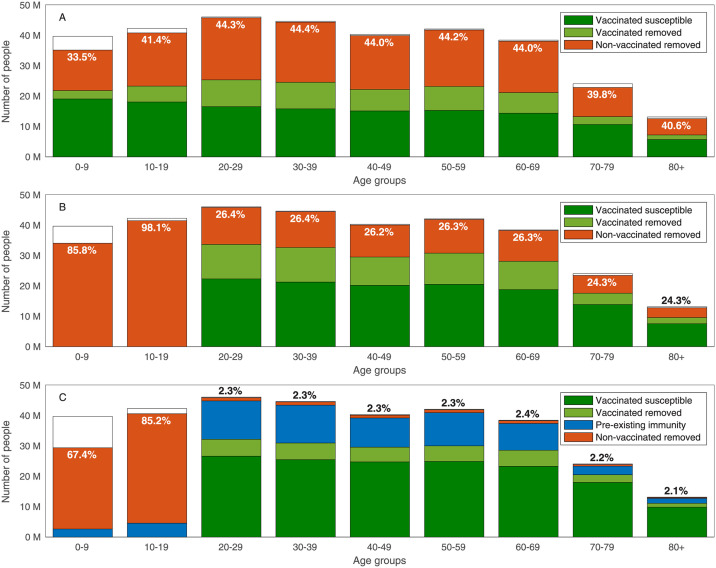
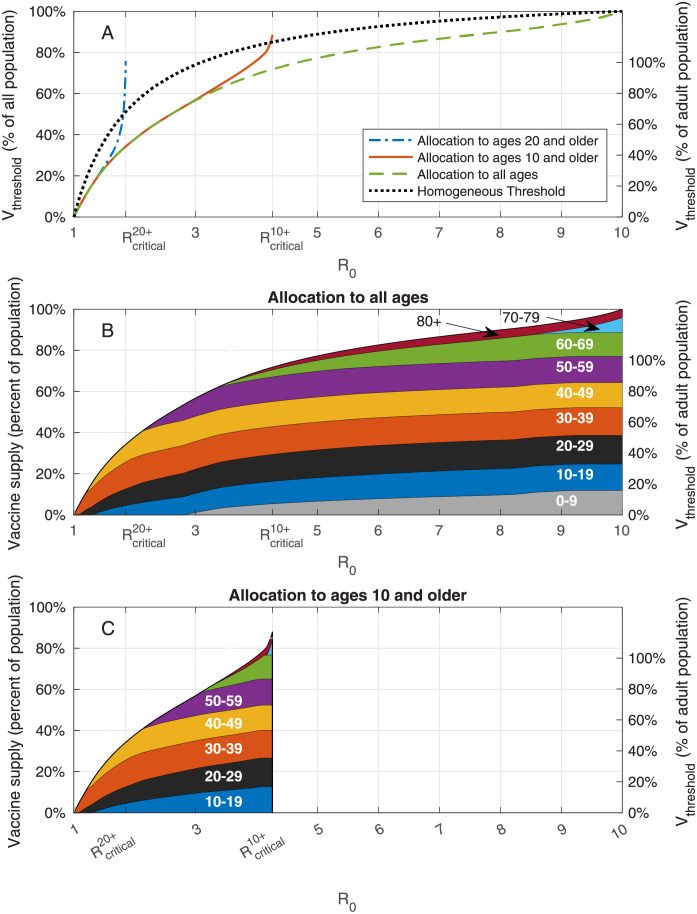
COVID-19 vaccines have been approved for children of age five and older in many countries. However, there is an ongoing debate as to whether children should be vaccinated and at what priority. In this work, we use mathematical modeling and optimization to study how vaccine allocations to different age groups effect epidemic outcomes. In particular, we consider the effect of extending vaccination campaigns to include the vaccination of children. When vaccine availability is limited, we consider Pareto-optimal allocations with respect to competing measures of the number of infections and mortality and systematically study the trade-offs among them. In the scenarios considered, when some weight is given to the number of infections, we find that it is optimal to allocate vaccines to adolescents in the age group 10-19, even when they are assumed to be less susceptible than adults. We further find that age group 0-9 is included in the optimal allocation for sufficiently high values of the basic reproduction number.
在许多国家,COVID-19 疫苗已获准用于 5 岁及以上的儿童。然而,对于儿童是否应该接种疫苗以及接种的优先级如何,目前仍存在争议。在这项工作中,我们使用数学建模和优化来研究向不同年龄组分配疫苗如何影响疫情结果。特别是,我们考虑了扩大疫苗接种活动以包括儿童接种疫苗的影响。当疫苗供应有限时,我们考虑了针对感染人数和死亡率等竞争措施的帕累托最优分配,并系统地研究了它们之间的权衡。在所考虑的情况下,当给予感染人数一定权重时,我们发现将疫苗分配给 10-19 岁的青少年是最优的,即使他们被认为比成年人更不易感染。我们进一步发现,对于基本繁殖数足够高的情况,0-9 岁年龄组也包含在最优分配中。