Centre for Infectious Disease Control, National Institute for Public Health and the Environment (RIVM), Bilthoven, the Netherlands.
Center for Marine Environmental Studies (CMES), Ehime University, Ehime, Japan.
PLoS Comput Biol. 2021 Dec 13;17(12):e1009697. doi: 10.1371/journal.pcbi.1009697. eCollection 2021 Dec.
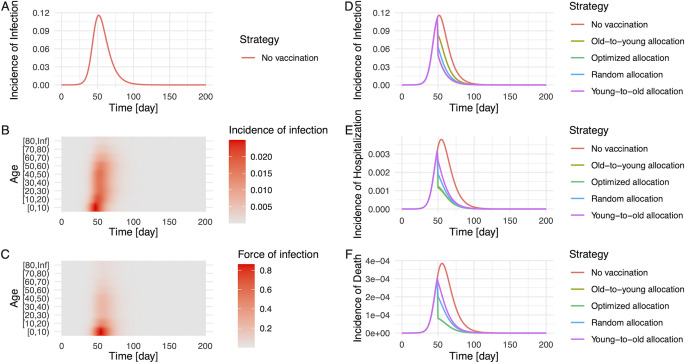
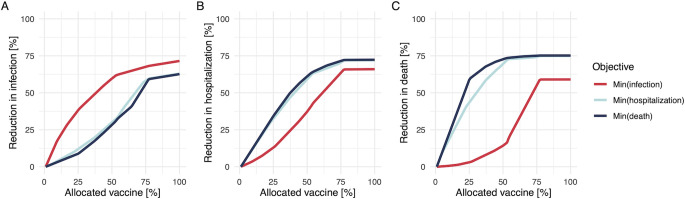
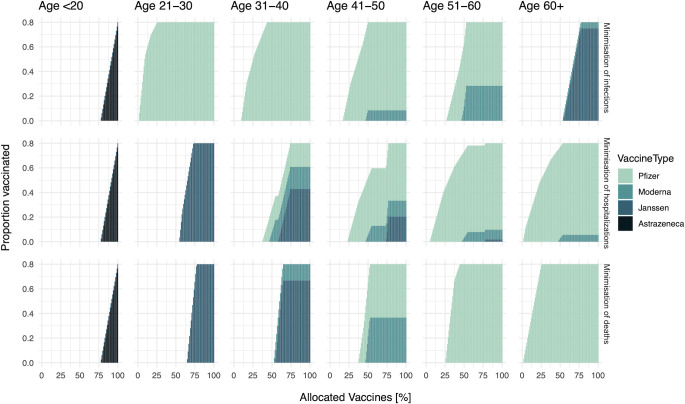
For the control of COVID-19, vaccination programmes provide a long-term solution. The amount of available vaccines is often limited, and thus it is crucial to determine the allocation strategy. While mathematical modelling approaches have been used to find an optimal distribution of vaccines, there is an excessively large number of possible allocation schemes to be simulated. Here, we propose an algorithm to find a near-optimal allocation scheme given an intervention objective such as minimization of new infections, hospitalizations, or deaths, where multiple vaccines are available. The proposed principle for allocating vaccines is to target subgroups with the largest reduction in the outcome of interest. We use an approximation method to reconstruct the age-specific transmission intensity (the next generation matrix), and express the expected impact of vaccinating each subgroup in terms of the observed incidence of infection and force of infection. The proposed approach is firstly evaluated with a simulated epidemic and then applied to the epidemiological data on COVID-19 in the Netherlands. Our results reveal how the optimal allocation depends on the objective of infection control. In the case of COVID-19, if we wish to minimize deaths, the optimal allocation strategy is not efficient for minimizing other outcomes, such as infections. In simulated epidemics, an allocation strategy optimized for an outcome outperforms other strategies such as the allocation from young to old, from old to young, and at random. Our simulations clarify that the current policy in the Netherlands (i.e., allocation from old to young) was concordant with the allocation scheme that minimizes deaths. The proposed method provides an optimal allocation scheme, given routine surveillance data that reflect ongoing transmissions. This approach to allocation is useful for providing plausible simulation scenarios for complex models, which give a more robust basis to determine intervention strategies.
为了控制 COVID-19,疫苗接种计划提供了一种长期解决方案。可用疫苗的数量通常是有限的,因此确定分配策略至关重要。虽然已经使用数学模型方法来寻找疫苗的最佳分配,但需要模拟的可能分配方案数量过多。在这里,我们提出了一种算法,用于在存在多种疫苗的情况下,根据干预目标(例如,将新感染、住院或死亡人数降至最低)找到接近最优的分配方案。我们分配疫苗的原则是针对具有最大预期效果的亚组进行靶向。我们使用近似方法重建特定年龄的传播强度(下一代矩阵),并根据观察到的感染发生率和感染强度来表示为每个亚组接种疫苗的预期效果。该方法首先在模拟疫情中进行评估,然后应用于荷兰 COVID-19 的流行病学数据。我们的结果揭示了最优分配方案如何取决于感染控制的目标。在 COVID-19 的情况下,如果我们希望将死亡人数降至最低,那么针对死亡人数进行优化的最佳分配策略对于降低其他结果(如感染人数)并不有效。在模拟疫情中,针对特定结果进行优化的分配策略优于其他策略,例如从年轻到年老、从年老到年轻和随机分配。我们的模拟结果表明,荷兰当前的政策(即从年老到年轻的分配)与最小化死亡人数的分配方案是一致的。该方法提供了一种最优分配方案,前提是有反映正在进行的传播的常规监测数据。这种分配方法对于为复杂模型提供合理的模拟场景很有用,这为确定干预策略提供了更可靠的基础。