Beijing International Center for Mathematical Research, Peking University, Beijing, China.
Harvard Medical School, Harvard University, Boston, MA, USA.
Nat Commun. 2021 Aug 3;12(1):4673. doi: 10.1038/s41467-021-24872-5.
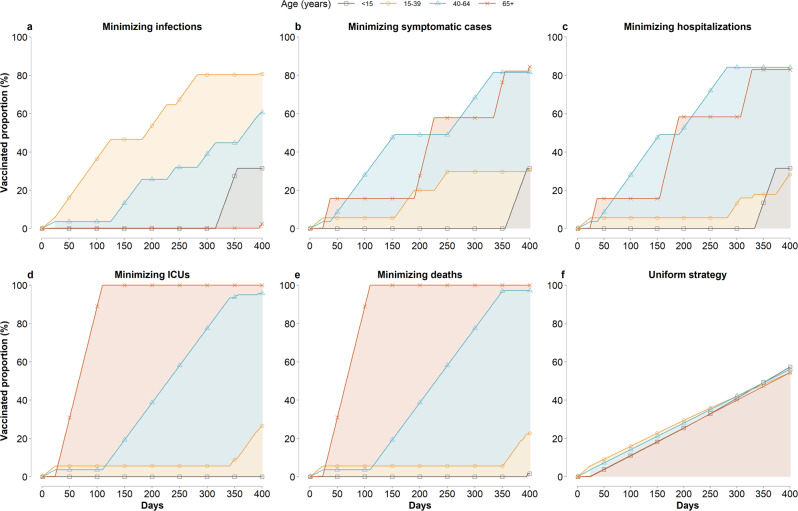
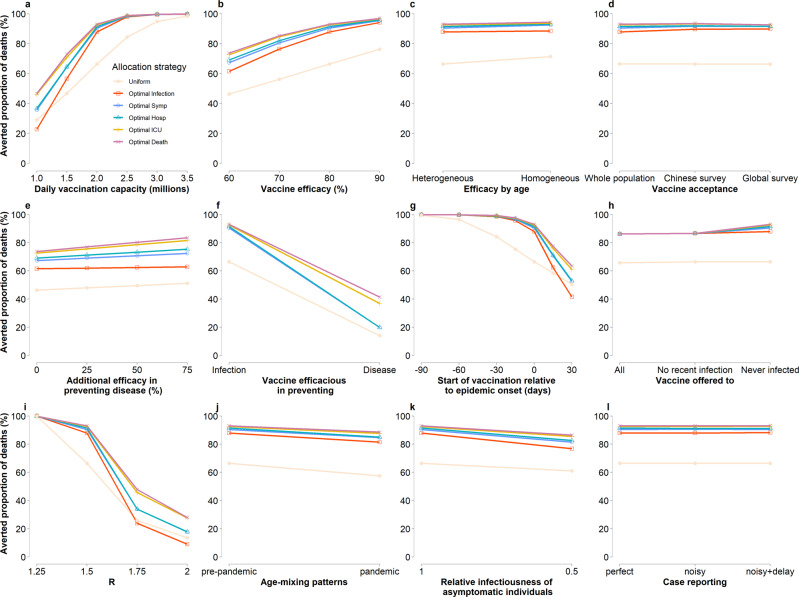
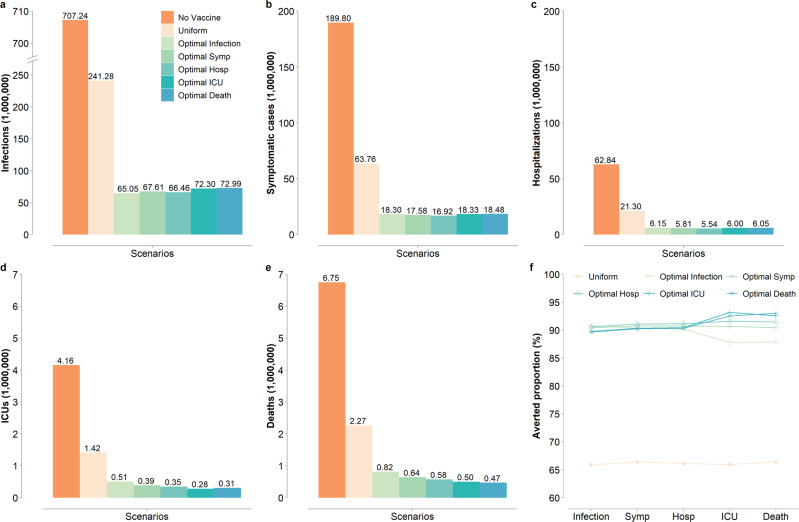
Dynamically adapting the allocation of COVID-19 vaccines to the evolving epidemiological situation could be key to reduce COVID-19 burden. Here we developed a data-driven mechanistic model of SARS-CoV-2 transmission to explore optimal vaccine prioritization strategies in China. We found that a time-varying vaccination program (i.e., allocating vaccines to different target groups as the epidemic evolves) can be highly beneficial as it is capable of simultaneously achieving different objectives (e.g., minimizing the number of deaths and of infections). Our findings suggest that boosting the vaccination capacity up to 2.5 million first doses per day (0.17% rollout speed) or higher could greatly reduce COVID-19 burden, should a new wave start to unfold in China with reproduction number ≤1.5. The highest priority categories are consistent under a broad range of assumptions. Finally, a high vaccination capacity in the early phase of the vaccination campaign is key to achieve large gains of strategic prioritizations.
动态调整 COVID-19 疫苗的分配以适应不断变化的流行病学情况,可能是减轻 COVID-19 负担的关键。在这里,我们开发了一种基于数据的 SARS-CoV-2 传播的机制模型,以探索中国最佳的疫苗优先接种策略。我们发现,随着疫情的演变,时间变化的疫苗接种计划(即根据疫情的变化将疫苗分配给不同的目标人群)可能非常有益,因为它能够同时实现不同的目标(例如,最大限度地减少死亡和感染人数)。我们的研究结果表明,如果中国开始出现繁殖数≤1.5 的新一波疫情,将疫苗接种能力提高到每天 250 万剂首针(0.17%的推出速度)或更高水平,将大大减轻 COVID-19 的负担。在广泛的假设下,最高优先级类别是一致的。最后,在疫苗接种运动的早期阶段,高疫苗接种能力是实现战略优先事项的关键。