Department of Computer Science and Engineering, Karpagam College of Engineering, Coimbatore 641032, India.
Department of Computer Science and Engineering, R.M.K Engineering College, Chennai 601206, India.
Sensors (Basel). 2022 Feb 18;22(4):1618. doi: 10.3390/s22041618.
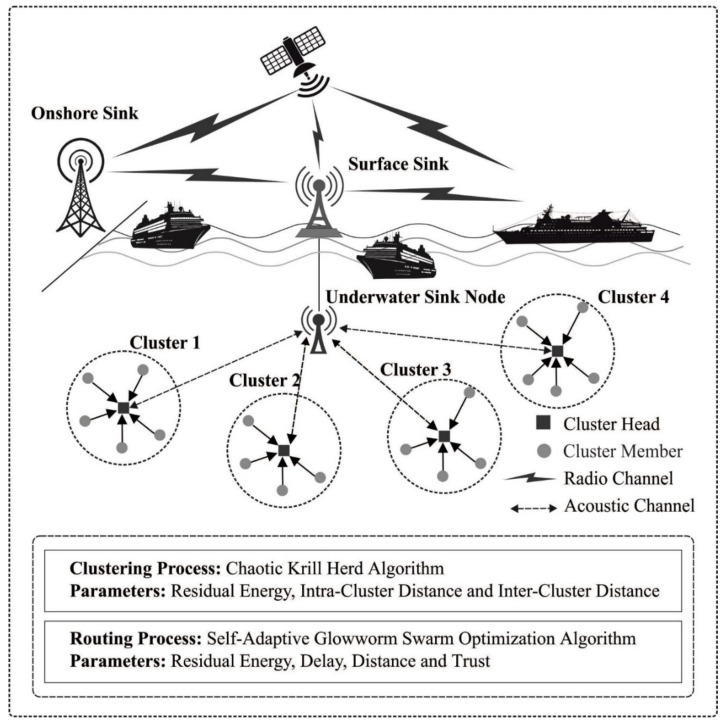
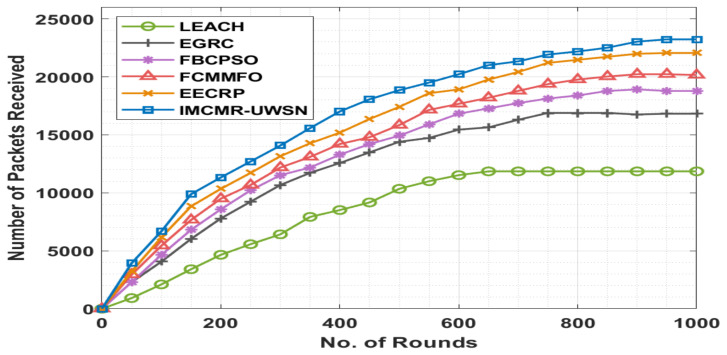
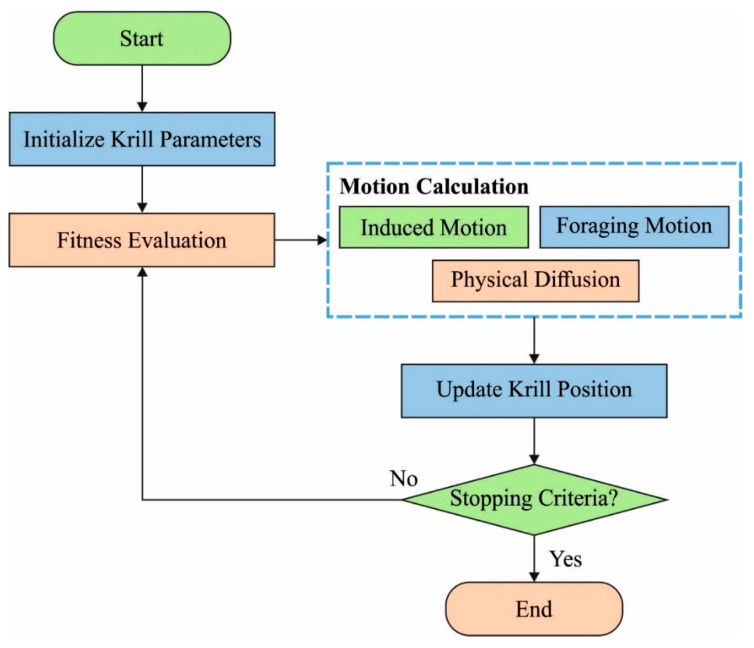
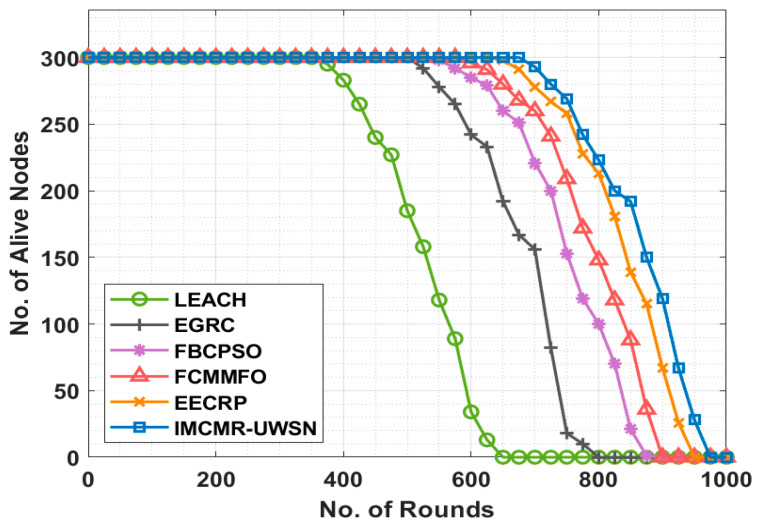
Underwater wireless sensor networks (UWSNs) comprise numerous underwater wireless sensor nodes dispersed in the marine environment, which find applicability in several areas like data collection, navigation, resource investigation, surveillance, and disaster prediction. Because of the usage of restricted battery capacity and the difficulty in replacing or charging the inbuilt batteries, energy efficiency becomes a challenging issue in the design of UWSN. Earlier studies reported that clustering and routing are considered effective ways of attaining energy efficacy in the UWSN. Clustering and routing processes can be treated as nondeterministic polynomial-time (NP) hard optimization problems, and they can be addressed by the use of metaheuristics. This study introduces an improved metaheuristics-based clustering with multihop routing protocol for underwater wireless sensor networks, named the IMCMR-UWSN technique. The major aim of the IMCMR-UWSN technique is to choose cluster heads (CHs) and optimal routes to a destination. The IMCMR-UWSN technique incorporates two major processes, namely the chaotic krill head algorithm (CKHA)-based clustering and self-adaptive glow worm swarm optimization algorithm (SA-GSO)-based multihop routing. The CKHA technique selects CHs and organizes clusters based on different parameters such as residual energy, intra-cluster distance, and inter-cluster distance. Similarly, the SA-GSO algorithm derives a fitness function involving four parameters, namely residual energy, delay, distance, and trust. Utilization of the IMCMR-UWSN technique helps to significantly boost the energy efficiency and lifetime of the UWSN. To ensure the improved performance of the IMCMR-UWSN technique, a series of simulations were carried out, and the comparative results reported the supremacy of the IMCMR-UWSN technique in terms of different measures.
水下无线传感器网络 (UWSN) 由许多分散在海洋环境中的水下无线传感器节点组成,在数据收集、导航、资源调查、监控和灾害预测等多个领域具有适用性。由于使用了有限的电池容量,并且内置电池难以更换或充电,因此能源效率成为 UWSN 设计中的一个挑战。早期的研究报告称,聚类和路由被认为是在 UWSN 中实现能效的有效方法。聚类和路由过程可以被视为非确定性多项式时间 (NP) 硬优化问题,可以通过使用元启发式算法来解决。本研究提出了一种基于改进元启发式的聚类与多跳路由协议的水下无线传感器网络,名为 IMCMR-UWSN 技术。IMCMR-UWSN 技术的主要目标是选择簇头 (CH) 和到目的地的最佳路径。IMCMR-UWSN 技术包含两个主要过程,即基于混沌磷虾头算法 (CKHA) 的聚类和基于自适应萤火虫群优化算法 (SA-GSO) 的多跳路由。CKHA 技术根据剩余能量、簇内距离和簇间距离等不同参数选择 CH 并组织簇。类似地,SA-GSO 算法导出了一个包含四个参数的适应度函数,即剩余能量、延迟、距离和信任。使用 IMCMR-UWSN 技术有助于显著提高 UWSN 的能量效率和寿命。为了确保 IMCMR-UWSN 技术的改进性能,进行了一系列仿真,报告的比较结果表明,IMCMR-UWSN 技术在不同方面具有优越性。