Matsunaga Hidenori, Takeuchi Hidefumi, Oba Yuichiro, Fujimi Satoshi, Honda Tomoyuki, Tomonaga Keizo
Department of Psychiatry, Osaka General Medical Center, Osaka 558-8558, Japan.
Institute for General Research, Nihon Igaku Ltd., Kaizuka-City, Osaka 597-0081, Japan.
Vaccines (Basel). 2022 Jan 24;10(2):177. doi: 10.3390/vaccines10020177.
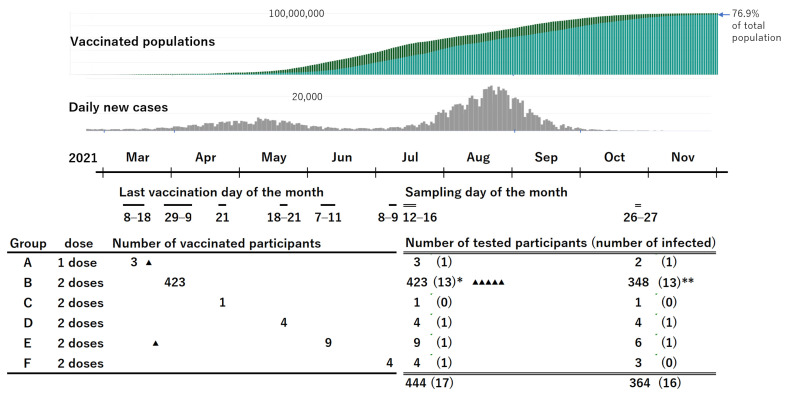
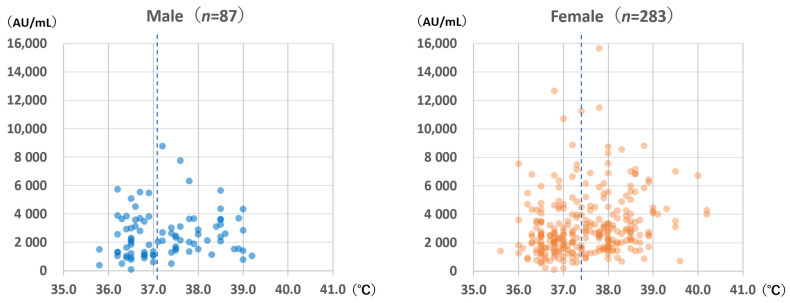
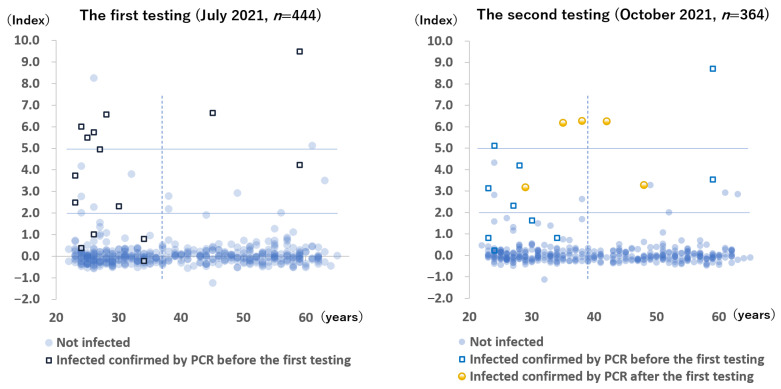
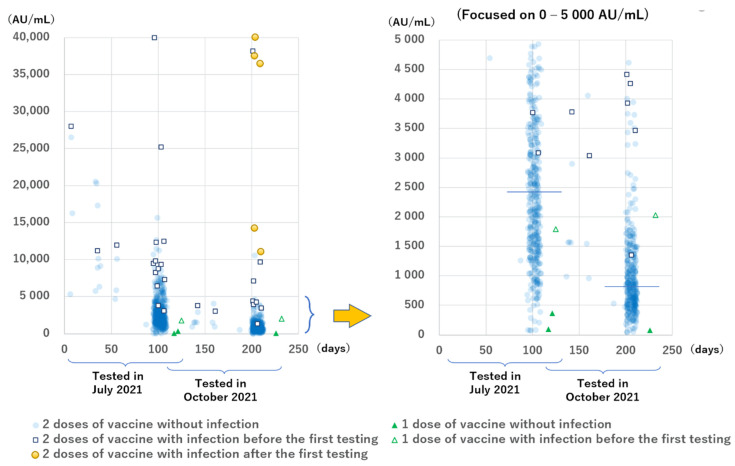
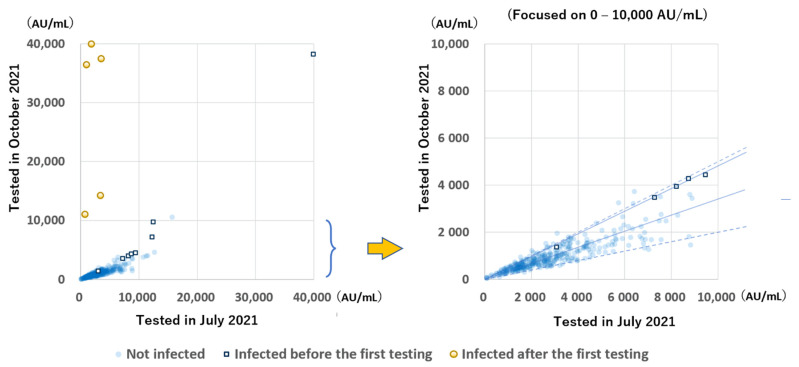
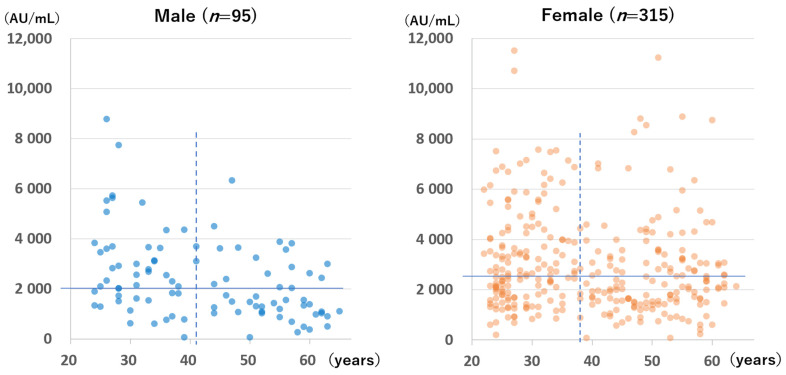
Anti-SARS-CoV-2 antibodies of 444 vaccinated hospital employees in Japan were measured 94-109 days and 199-212 days after receiving the second BNT162b2 vaccine dose to evaluate the intensity and duration of antibody response in our own cohort. Among uninfected participants, anti-S antibody levels were greatly decreased 199-212 days after the second vaccination compared to the levels measured 94-109 days after the second vaccination (median levels: 830 AU/mL and 2425 AU/mL, respectively; < 0.001). The rate of decrease between the two testing periods was lower in infected participants than in uninfected participants (median: 47.7% and 33.9%, respectively; < 0.001). Anti-S antibody levels were significantly higher in females (median: females, 2546 AU/mL; males, 2041 AU/mL; = 0.002 during the first test period). The peak body temperature after vaccination was higher in females than in males (median: females, 37.4 °C; males: 37.1 °C; = 0.044). Older males tended to have lower antibody levels. In conclusion, the duration of the anti-S antibody response to the BNT162b2 vaccine was short-lived, particularly in males. Anti-S antibody levels of 1000 AU/mL or lower according to SARS-CoV-2 IgG II Quant (Abbott) might indicate insufficient prevention against the delta variant, and the majority of participants appeared to have lost their protection 200 days after vaccination.
在日本,对444名接种疫苗的医院工作人员在接种第二剂BNT162b2疫苗后的94 - 109天和199 - 212天测量了抗SARS-CoV-2抗体,以评估我们自己队列中抗体反应的强度和持续时间。在未感染的参与者中,与第二次接种疫苗后94 - 109天测量的水平相比,第二次接种疫苗后199 - 212天抗S抗体水平大幅下降(中位数水平:分别为830 AU/mL和2425 AU/mL;<0.001)。在感染的参与者中,两个检测期之间的下降率低于未感染的参与者(中位数:分别为47.7%和33.9%;<0.001)。女性的抗S抗体水平显著更高(第一次检测期中位数:女性为2546 AU/mL,男性为2041 AU/mL;=0.002)。接种疫苗后的最高体温女性高于男性(中位数:女性为37.4℃,男性为37.1℃;=0.044)。年龄较大的男性往往抗体水平较低。总之,对BNT162b2疫苗的抗S抗体反应持续时间较短,尤其是在男性中。根据SARS-CoV-2 IgG II Quant(雅培)检测,抗S抗体水平为1000 AU/mL或更低可能表明对德尔塔变体的预防不足,并且大多数参与者在接种疫苗200天后似乎已失去保护。